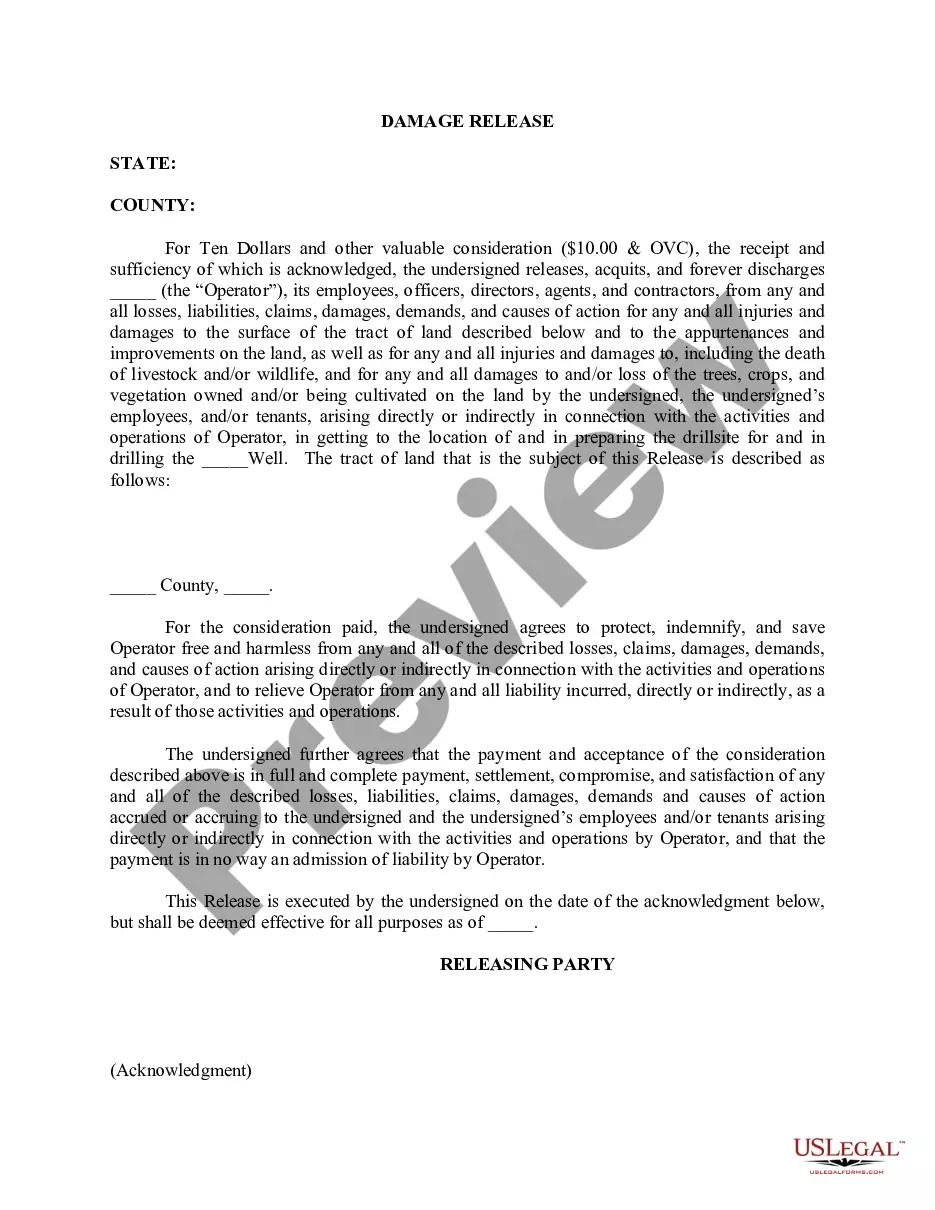
Release Form For Property Damage
Description

Get your form ready online
Our built-in tools help you complete, sign, share, and store your documents in one place.
Make edits, fill in missing information, and update formatting in US Legal Forms—just like you would in MS Word.
Download a copy, print it, send it by email, or mail it via USPS—whatever works best for your next step.
Sign and collect signatures with our SignNow integration. Send to multiple recipients, set reminders, and more. Go Premium to unlock E-Sign.
If this form requires notarization, complete it online through a secure video call—no need to meet a notary in person or wait for an appointment.
We protect your documents and personal data by following strict security and privacy standards.

Make edits, fill in missing information, and update formatting in US Legal Forms—just like you would in MS Word.

Download a copy, print it, send it by email, or mail it via USPS—whatever works best for your next step.

Sign and collect signatures with our SignNow integration. Send to multiple recipients, set reminders, and more. Go Premium to unlock E-Sign.

If this form requires notarization, complete it online through a secure video call—no need to meet a notary in person or wait for an appointment.

We protect your documents and personal data by following strict security and privacy standards.
Looking for another form?


How to fill out Texas Damage Release?
Managing legal documents can be perplexing, even for experienced professionals.
If you're trying to find a Release Form For Property Damage and lack the time to search for the correct and current version, the process may be arduous.
US Legal Forms addresses all your needs, from personal to corporate documentation, conveniently in one place.
Utilize state-of-the-art tools to complete and manage your Release Form For Property Damage.
Here are the steps to follow after obtaining the form you require: Confirm that this is the accurate form by previewing it and reviewing its details. Ensure that the template is approved in your state or county. Click Buy Now when you're ready. Select a subscription option. Choose the format you need and Download, fill it in, sign, print, and send your document. Rely on the US Legal Forms online library, backed by 25 years of experience and credibility. Streamline your daily document management into a smooth and user-friendly process today.
- Tap into a valuable collection of articles, guides, handbooks, and materials pertinent to your circumstances and needs.
- Conserve time and energy searching for the forms you require by using US Legal Forms' advanced search and Review feature to locate and download the Release Form For Property Damage.
- If you have a monthly membership, Log In to your US Legal Forms account, search for the desired form, and download it.
- Check the My documents section to view the documents you've previously downloaded and manage your files as desired.
- If this is your initial experience with US Legal Forms, create an account and enjoy full access to all features of the library.
- A comprehensive online form directory could significantly benefit anyone aiming to navigate these matters effectively.
- US Legal Forms stands as a frontrunner in digital legal documents, providing access to over 85,000 jurisdiction-specific legal forms at your convenience.
- With US Legal Forms, you gain access to specialized legal and business documents tailored to specific states or counties.
Form popularity
FAQ
One of the documents the insurance adjuster will attempt to get you to sign is the 'Release of All Claims' Form. This form is often included as part of a settlement agreement and it is a release of liability. Essentially, this form releases the other party from fault.
I hereby WAIVE, in advance, ALL CLAIMS for loss, theft or damage to any property owned or controlled by me, that I may in the future have against the Released Parties, relating in any way to an Event and either of the following: (a) my choosing to park any vehicle owned or controlled by me in any areas owned or ...
How Do You Write a Release Form? The first step in writing is identifying all parties involved, including the releaser and the release. Specify the activity or event in detail, such as a photo shoot, a video production, or a performance. Clearly specify what is being released, whether liability, claims, or damages.
?The undersigned hereby assumes all risk of injury or harm as a result of the activities specified above and agrees to release, indemnify, defend, and forever discharge the releasee from all liability, claims, demands, damages, costs, expenses, and causes of action due to death, injury, loss, or damage to the ...
The liability release form, also known as the waiver form, contains a legally binding agreement between two parties, stating that one of them (the releasor) promises not to sue the other side (the releasee) for past, current, or future damages, losses, or injuries.