Uccjea Affidavit Without Consent
Description
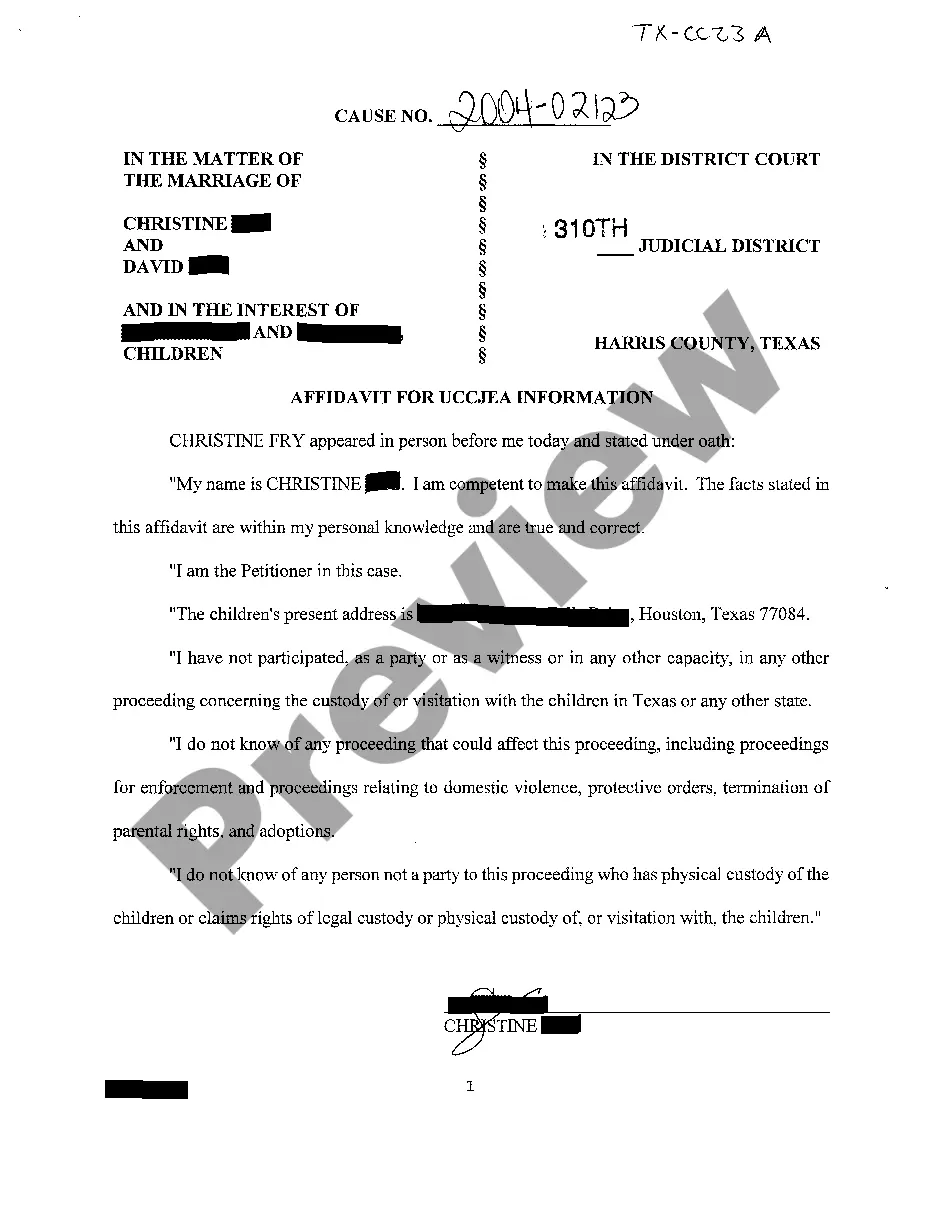







How to fill out Texas Affidavit For UCCJEA Information?
Regardless if it's for professional reasons or personal issues, everyone will eventually encounter legal circumstances during their lifetime.
Filling out legal documents requires meticulous focus, starting with choosing the correct template example.
- For example, if you select an incorrect version of the Uccjea Affidavit Without Consent, it will be rejected upon submission.
- Thus, it is crucial to obtain a trustworthy source of legal paperwork such as US Legal Forms.
- Should you need a Uccjea Affidavit Without Consent template, follow these straightforward steps.
- Locate the template you require by using the search bar or browsing the catalog.
- Review the form’s details to confirm it aligns with your case, jurisdiction, and location.
- Click on the document’s preview to inspect it.
- If it is not the correct form, return to the search feature to find the Uccjea Affidavit Without Consent template you seek.
- Obtain the template when it satisfies your criteria.
- If you possess a US Legal Forms account, click Log in to access previously stored documents in My documents.
- If you lack an account at this point, you can download the form by clicking Buy now.
- Select the appropriate pricing option.
- Fill out the account registration form.
- Choose your payment method: either use a credit card or PayPal account.
Form popularity
FAQ
One of the biggest mistakes in a custody battle is failing to prioritize the child's best interests. Parents may focus on winning at all costs rather than considering the child's emotional and psychological needs. Additionally, not addressing jurisdictional complexities using a UCCJEA affidavit without consent can lead to unfavorable outcomes. It's vital to remain calm, collected, and child-focused throughout the legal process.
To fill out a UCCJEA, first gather all necessary information about the child and the parties involved. Ensure you include details regarding the child’s residence history and any previous custody orders. Following the correct guidelines is crucial for accuracy. The ulegalforms platform provides helpful resources and templates to assist you in completing a UCCJEA affidavit without consent.
Kids Can Have Some Say in Time-Sharing, But Florida Law Does Not Identify a Specific Age. While minors cannot entirely refuse visitation with one parent, courts can consider the child's preference for time-sharing when deciding what type of custody arrangement is in the child's best interests.
While there is no guarantee of a specific custody arrangement, the state of Florida generally favors shared parental responsibility and encourages frequent and continuing contact with both parents, unless it's determined that such an arrangement would not be in the best interests of the child.
The court can restrict or deny a noncustodial parent visitation grounds on the flowing grounds: If the parent has a history of molesting the child. If the court believes that the parent can kidnap the child. If the parent is likely to abuse drugs while taking care of the child.
While there is no guarantee of a specific custody arrangement, the state of Florida generally favors shared parental responsibility and encourages frequent and continuing contact with both parents, unless it's determined that such an arrangement would not be in the best interests of the child.
Declaration Under Uniform Child Custody Jurisdiction and Enforcement Act (UCCJEA) (FL-105) Give the court important information about the children you have with your spouse or domestic partner. The court considers this information before making child custody and visitation orders.