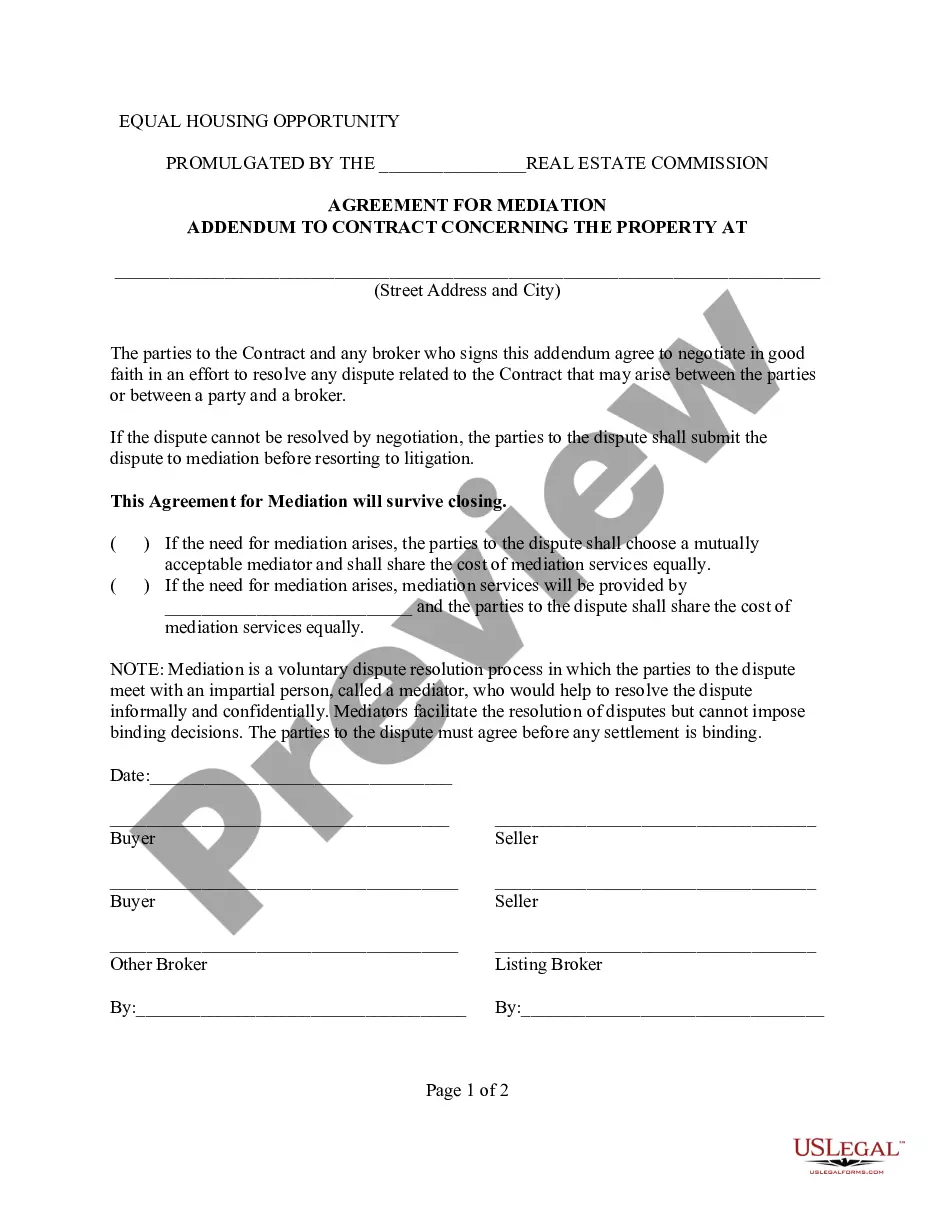
Agreement In Mediation
Description



Get your form ready online
Our built-in tools help you complete, sign, share, and store your documents in one place.
Make edits, fill in missing information, and update formatting in US Legal Forms—just like you would in MS Word.
Download a copy, print it, send it by email, or mail it via USPS—whatever works best for your next step.
Sign and collect signatures with our SignNow integration. Send to multiple recipients, set reminders, and more. Go Premium to unlock E-Sign.
If this form requires notarization, complete it online through a secure video call—no need to meet a notary in person or wait for an appointment.
We protect your documents and personal data by following strict security and privacy standards.

Make edits, fill in missing information, and update formatting in US Legal Forms—just like you would in MS Word.

Download a copy, print it, send it by email, or mail it via USPS—whatever works best for your next step.

Sign and collect signatures with our SignNow integration. Send to multiple recipients, set reminders, and more. Go Premium to unlock E-Sign.

If this form requires notarization, complete it online through a secure video call—no need to meet a notary in person or wait for an appointment.

We protect your documents and personal data by following strict security and privacy standards.
Looking for another form?







How to fill out Texas Agreement For Mediation?
Whether for commercial reasons or personal affairs, everyone must deal with legal matters at some point in their lives.
Completing legal documents demands careful consideration, starting with choosing the correct form template.
With an extensive US Legal Forms catalog available, you will never have to waste time searching for the suitable template online. Take advantage of the library’s simple navigation to find the perfect template for any occasion.
- Acquire the template you require by using the search bar or browsing the catalog.
- Review the description of the form to confirm it corresponds with your situation, jurisdiction, and locality.
- Click on the form’s preview to view it.
- If it is not the correct form, return to the search feature to find the Agreement In Mediation example you need.
- Obtain the template if it fits your specifications.
- If you already possess a US Legal Forms account, click Log in to access earlier saved documents in My documents.
- If you do not yet have an account, you can download the form by clicking Buy now.
- Choose the correct pricing option.
- Complete the account registration form.
- Select your payment method: utilize a credit card or PayPal account.
- Select the document format you prefer and download the Agreement In Mediation.
- Once it is saved, you can fill out the form using editing software or print it and complete it by hand.
Form popularity
FAQ
The five steps of mediation include: 1) preparing for mediation, 2) establishing ground rules, 3) presenting issues, 4) discussing possible solutions, and 5) signing a mediation agreement. These steps guide the process, ensuring that each party has an opportunity to express themselves while working towards a resolution. Following this structured approach often leads to a more effective agreement in mediation.
At What Age Can a Child Refuse Visitation in Texas? In Texas, there is no age under 18 that allows for a child to refuse visitation. Visitation is the right of the parent, and it cannot be taken away by the custodial parent or child. The only option would be for the custodial parent to request a modification of orders.
A person who is at least 10 years old and under the age of 17 can be charged as a juvenile. Once a person turns 17 in Texas, he is legally considered an adult, and any criminal charges would be handled in adult court.
The rules governing child support liens have changed. Previously, child support liens had a 10-year limit, but that limit no longer applies. Now, child support liens can remain in effect indefinitely. Moreover, expired child support liens on real property can be renewed.
In a SAPCR (short for "Suit Affecting the Parent-Child Relationship"), a judge can make custody, visitation, child support, medical support, and dental support orders.
No, you cannot just leave home at 16 in Texas. The age of majority in Texas is 18. Until then, your parent(s) are your legal guardians and have control over you. As a matter of fact, until you're 17 years of age in Texas, under Texas Family Code 31.001(a), a minor cannot even petition a Court to be emancipated.
As a parent, you have control over your children until they are 18 years of age. At the age of 18, they become an adult. However, prior to the age of 18, a child can be or may be emancipated, or declared an adult in the eyes of the state of Texas.
In Texas, a minor is a person under 18 years of age who has never been married and never been declared an adult by a court (emancipated).
Though there are some exceptions, the age of consent is 17 in Texas. That means that an older person can lawfully engage in consensual sex with someone who is 17 years or older.