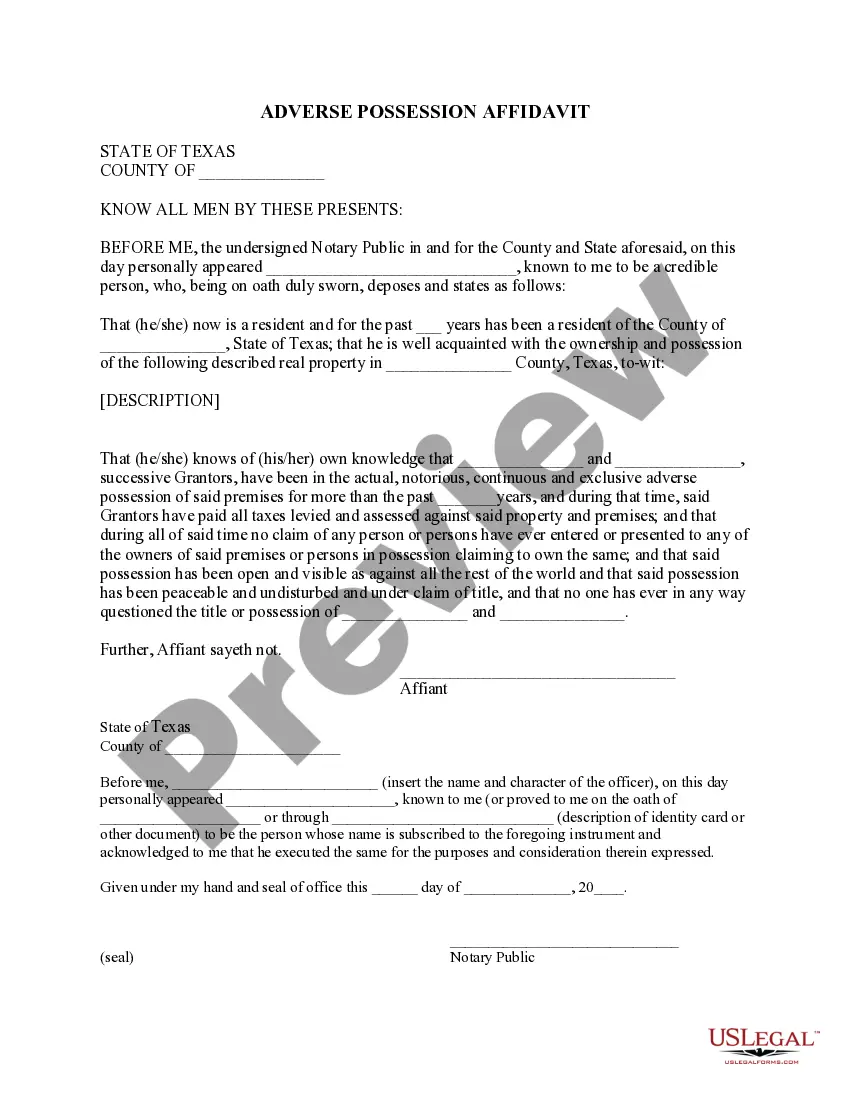
Texas Squatters Rights Form Application Without Lease Agreement
Description
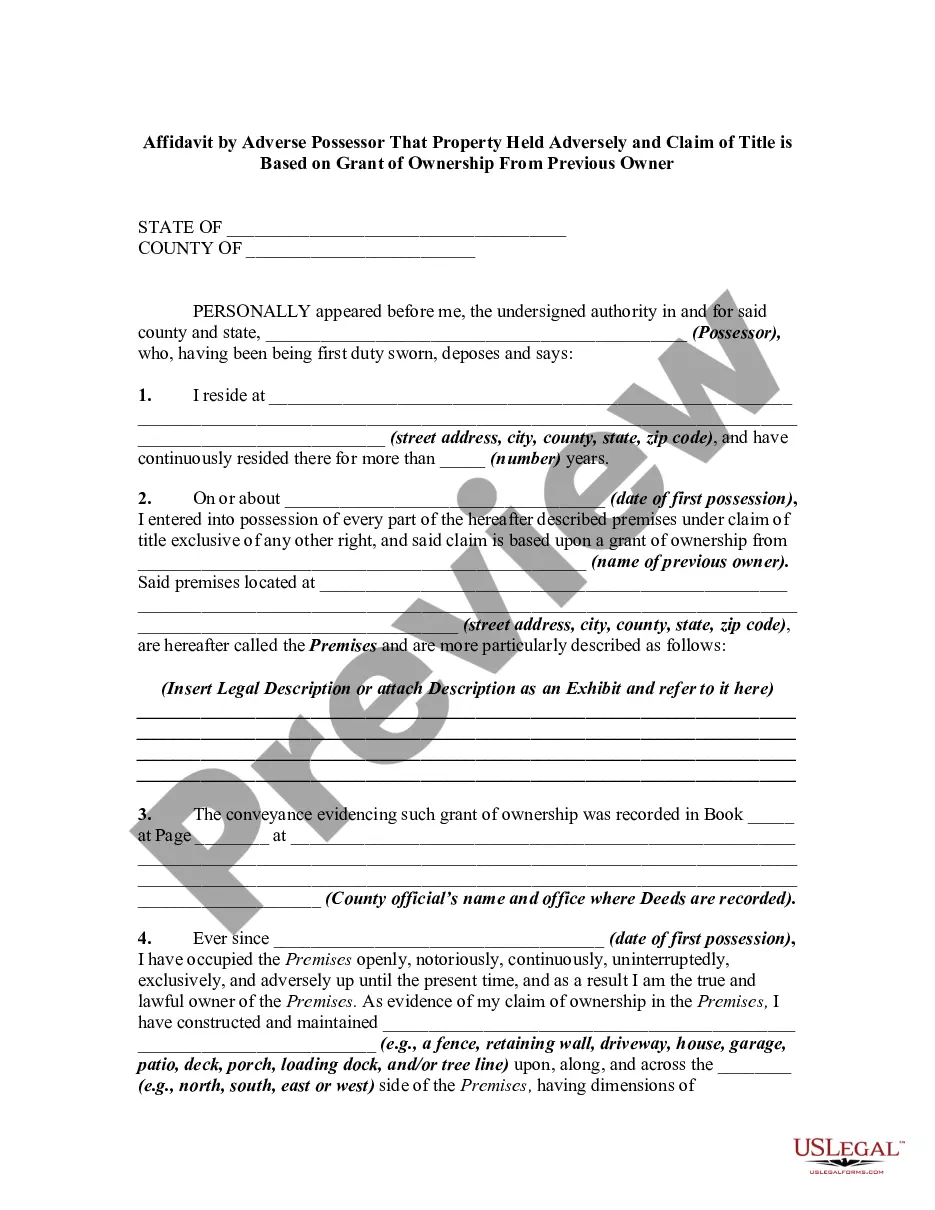
Get your form ready online
Our built-in tools help you complete, sign, share, and store your documents in one place.
Make edits, fill in missing information, and update formatting in US Legal Forms—just like you would in MS Word.
Download a copy, print it, send it by email, or mail it via USPS—whatever works best for your next step.
Sign and collect signatures with our SignNow integration. Send to multiple recipients, set reminders, and more. Go Premium to unlock E-Sign.
If this form requires notarization, complete it online through a secure video call—no need to meet a notary in person or wait for an appointment.
We protect your documents and personal data by following strict security and privacy standards.

Make edits, fill in missing information, and update formatting in US Legal Forms—just like you would in MS Word.

Download a copy, print it, send it by email, or mail it via USPS—whatever works best for your next step.

Sign and collect signatures with our SignNow integration. Send to multiple recipients, set reminders, and more. Go Premium to unlock E-Sign.

If this form requires notarization, complete it online through a secure video call—no need to meet a notary in person or wait for an appointment.

We protect your documents and personal data by following strict security and privacy standards.
Looking for another form?

How to fill out Texas Adverse Possession Affidavit - Squatters Rights?
The Texas Squatters Rights Documentation Request Without Lease Agreement presented on this page is a versatile legal template created by experienced attorneys in compliance with federal and state laws.
For over 25 years, US Legal Forms has assisted individuals, companies, and lawyers with more than 85,000 validated, state-specific documents for various business and personal situations. It’s the quickest, easiest, and most reliable way to acquire the documentation you need, as the service promises bank-level data protection and anti-malware safeguards.
Pick the format you want for your Texas Squatters Rights Documentation Request Without Lease Agreement (PDF, DOCX, RTF) and download the template to your device.
- Search for the document you require and assess it.
- Browse through the template you looked up and preview it or read the form description to confirm it meets your needs. If it doesn’t, use the search feature to find the correct one. Click Buy Now when you find the template you need.
- Register and sign in.
- Choose the pricing option that works for you and create an account. Use PayPal or a credit card to make a quick payment. If you already have an account, Log In and review your subscription to proceed.
- Obtain the editable template.
Form popularity
FAQ
Yes, you can evict a tenant in Texas without a lease agreement, but the process requires adherence to specific guidelines set by law. You must provide proper notice to the tenant and follow through with legal eviction proceedings at your local court. Employing resources like the Texas squatters rights form application without lease agreement aids in ensuring the process is smooth and compliant with state laws.
Becoming a squatter in Texas technically happens the moment someone occupies a property without the owner's permission. However, gaining legal rights as a squatter typically takes years, specifically ranging from 5 to 10 years of uninterrupted occupancy, depending on the circumstances. Utilizing the Texas squatters rights form application without lease agreement can help structure your case effectively.
The primary requirements for squatters rights in Texas include continuous, open, and notorious possession of the property for a specific time. You must act as if you are the owner and have no lease agreement with the actual owner. Using the Texas squatters rights form application without lease agreement can help you document your occupation and clarify your position.
To claim ownership of a property through squatters rights in Texas, you usually need to occupy it continuously for at least 10 years. However, if you can demonstrate good faith with no lease agreement, a shorter duration may occasionally apply. Understanding the Texas squatters rights form application without lease agreement is crucial to ensure you meet all legal requirements.
In Texas, someone can be considered a squatter if they occupy a property without permission from the owner. Generally, there is no specific time frame; it can happen as soon as they enter and stay without consent. Hence, being aware of the Texas squatters rights form application without lease agreement might be beneficial in managing such situations.
Yes, you can remove a squatter in Texas, but it involves following lawful eviction procedures. You need to provide proper notice and go through your local court system for an official eviction process. Using the Texas squatters rights form application without lease agreement can be helpful in navigating these legal steps effectively.
In Texas, the minimum time for squatters rights is typically 10 years if the squatter occupies the property openly and continuously. However, for a shorter duration claim, 5 years of continuous possession can also establish some rights. To ensure a thorough understanding, consider using the Texas squatters rights form application without lease agreement. This helps document the necessary details.
To evict someone in Texas without a lease, you must first provide the individual with a written notice to vacate. This notice typically gives the person a specific timeframe to leave the property. If they do not comply, you can file a forcible entry and detainer lawsuit at your local court. Additionally, navigating this process may involve completing a Texas squatters rights form application without lease agreement, which can help formalize your claim and expedite the eviction.
To file for squatters rights in Texas, start by gathering all necessary documents, including the Texas squatters rights form application without lease agreement. You must demonstrate an intention to possess the property, which can involve proving continuous occupancy. Next, submit your application through the appropriate local court. It is also beneficial to consult legal resources or platforms like US Legal Forms for accurate guidance and necessary legal forms.