Texas Squatter
Description
Get your form ready online
Our built-in tools help you complete, sign, share, and store your documents in one place.
Make edits, fill in missing information, and update formatting in US Legal Forms—just like you would in MS Word.
Download a copy, print it, send it by email, or mail it via USPS—whatever works best for your next step.
Sign and collect signatures with our SignNow integration. Send to multiple recipients, set reminders, and more. Go Premium to unlock E-Sign.
If this form requires notarization, complete it online through a secure video call—no need to meet a notary in person or wait for an appointment.
We protect your documents and personal data by following strict security and privacy standards.

Make edits, fill in missing information, and update formatting in US Legal Forms—just like you would in MS Word.

Download a copy, print it, send it by email, or mail it via USPS—whatever works best for your next step.

Sign and collect signatures with our SignNow integration. Send to multiple recipients, set reminders, and more. Go Premium to unlock E-Sign.

If this form requires notarization, complete it online through a secure video call—no need to meet a notary in person or wait for an appointment.

We protect your documents and personal data by following strict security and privacy standards.
Looking for another form?
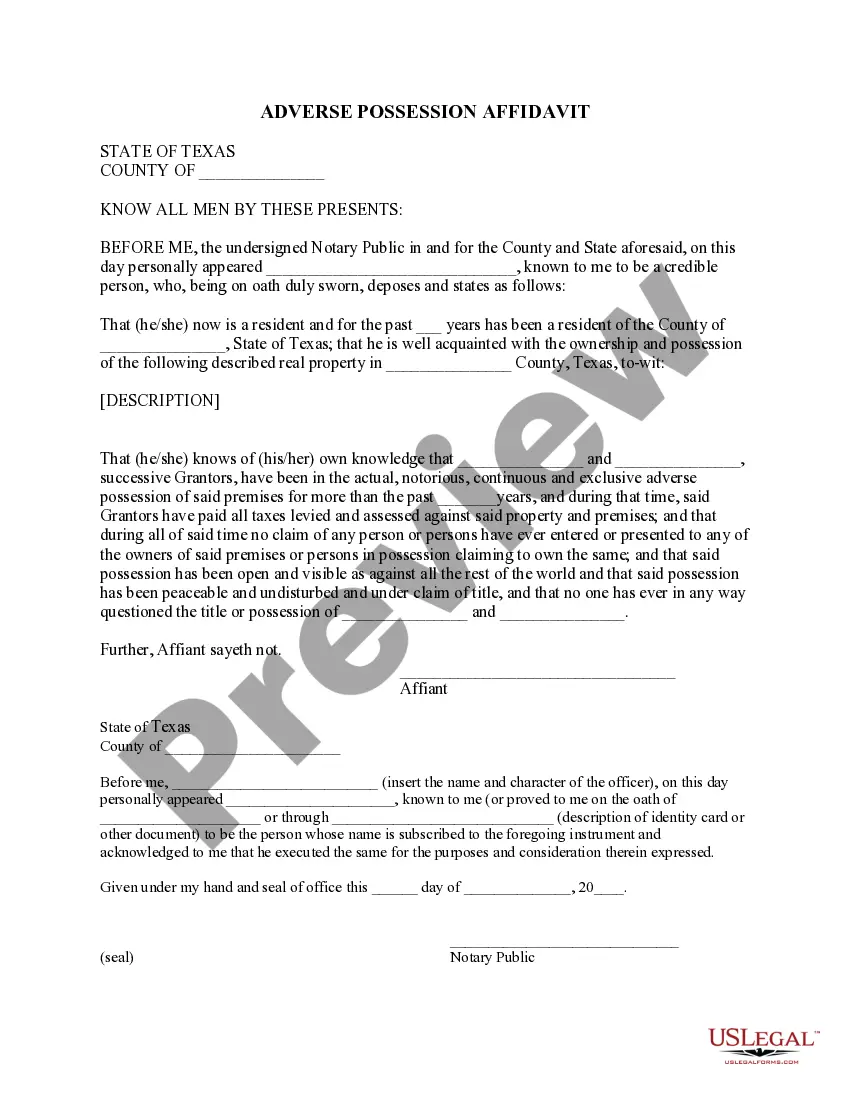
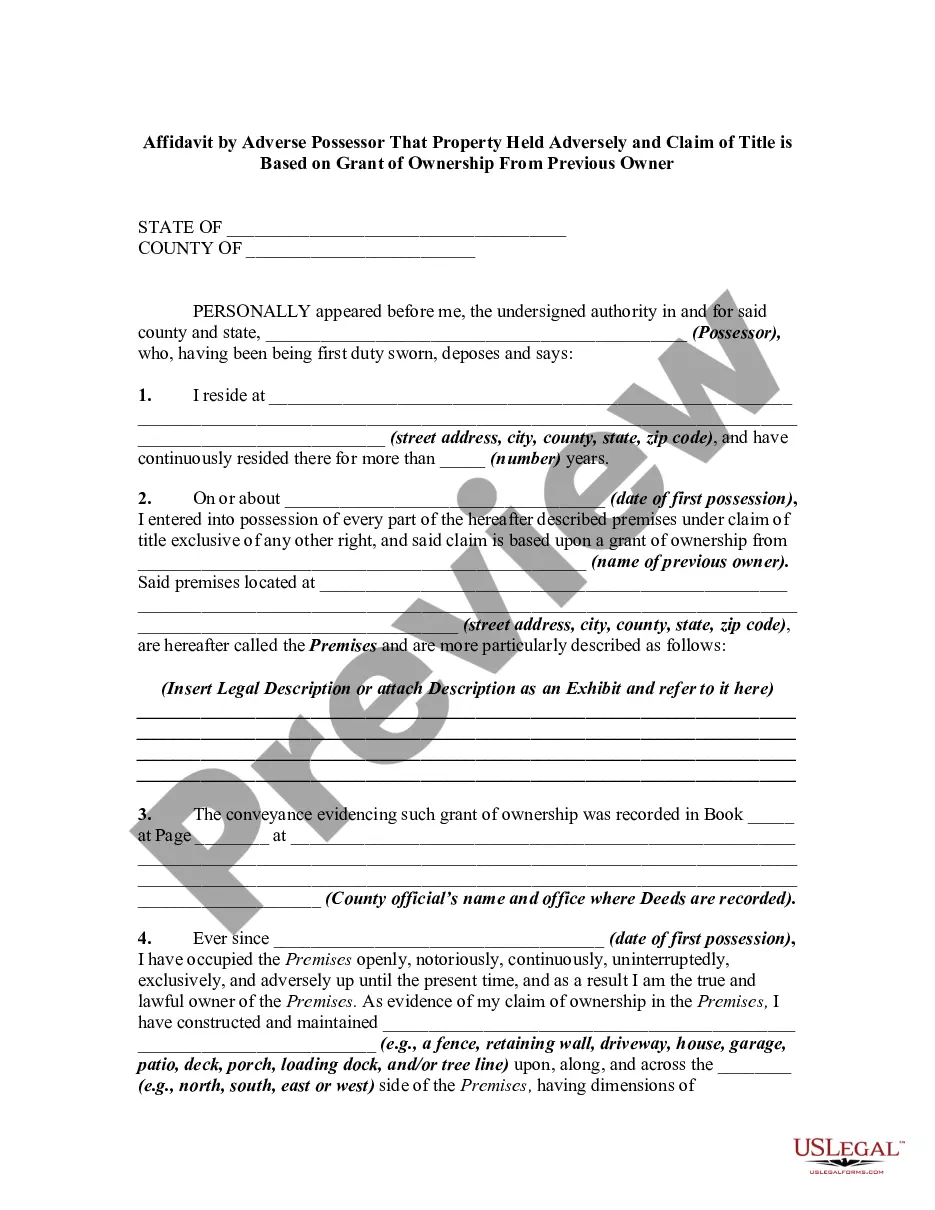
How to fill out Texas Adverse Possession Affidavit - Squatters Rights?
- Log in to your US Legal Forms account. If you haven't used our service before, simply create an account to get started.
- Browse the extensive legal form library. Use the search bar to find Texas squatter related forms that meet your jurisdiction's requirements.
- Review the available templates. Check the preview and descriptions to ensure you're selecting the right document.
- Select the desired form and make your purchase. Choose an appropriate subscription plan that fits your needs.
- Enter your billing information. You can use a credit card or PayPal to complete your payment.
- Download your completed form. Save it to your device and access it anytime through the 'My Forms' section of your account.
Using US Legal Forms not only speeds up the document creation process but also ensures that your forms are accurate and legally compliant. With over 85,000 templates available, you have plenty of choices at your fingertips.
Don't let legal hurdles overwhelm you. Start using US Legal Forms today to efficiently handle your Texas squatter issues!
Form popularity
FAQ
To file for squatters rights in Texas, first, you need to establish residency on the property. You must occupy the property continuously and openly for a specific period, usually around 10 years, to claim rights. It’s important to document your stay, such as keeping utility bills, or a rental agreement. Also, consider using platforms like US Legal Forms to get the proper legal documentation and guidance you need throughout the process.
Yes, it is possible to be a squatter in Texas, but this comes with various legal implications. A Texas squatter may claim rights to a property if they meet specific criteria, such as staying for a certain period and using the property openly. However, property owners have legal rights to reclaim their property. Engaging with legal support can help both squatters and property owners understand their rights.
Yes, you can take steps to kick out squatters in Texas, but it requires following the lawful eviction process. First, document the squatting and then provide a formal notice. If they do not leave, you may need to file for eviction in court. Using platforms like US Legal Forms can provide essential documents and guidance to streamline this process efficiently.
In Texas, removing someone from your house requires following specific legal procedures. You cannot simply force someone out, even if they are a squatter. You will likely need to provide legal notice and possibly go through the eviction process. Seeking help from legal resources like US Legal Forms can guide you through this process effectively.
Turning off utilities for a Texas squatter is not a straightforward action. Landowners must be cautious, as cutting off essential services can lead to legal repercussions. It is better to consult with a real estate attorney to understand your rights and obligations. Considering legal options can really help you in resolving the situation without risking potential legal trouble.
Becoming a squatter in Texas does not happen overnight; it requires occupying a property without permission for a specified amount of time, often five to ten years. During this period, your occupation must be continuous, visible, and without permission from the rightful owner. For anyone considering such a path, consulting legal resources like US Legal Forms can provide clarity on the requirements and implications.
In Texas, the minimum time to claim squatters rights, known as adverse possession, is typically for five years under specific conditions. However, this period might vary based on the circumstances surrounding the occupation and the property. If you find yourself in a similar situation, understanding the finer details is crucial, and resources like US Legal Forms can provide assistance.
Yes, you can remove a squatter from your property in Texas, but the process must follow legal procedures. Property owners cannot simply evict squatters without going through the court system, which usually involves filing a suit for eviction. It’s beneficial to familiarize yourself with the eviction process and seek help from platforms like US Legal Forms to ensure that you handle the situation legally.
To claim squatters rights in Texas, you must meet several conditions. Primarily, you need to occupy the property openly, without permission from the owner, for a certain duration, typically ten years. Moreover, your use of the property must be continuous and exclusive. Resources like US Legal Forms can guide you in understanding these legal requirements thoroughly.
In Texas, you usually must occupy a property continuously for at least ten years to establish a claim as a Texas squatter. This occupation must meet certain conditions, such as being open and notorious, meaning that it is visible and obvious to others. However, the duration might vary based on specific circumstances and local laws. It is essential to consult legal resources or platforms like US Legal Forms to understand the process better.