Texas Adverse Resident For Tax Purposes
Description
Get your form ready online
Our built-in tools help you complete, sign, share, and store your documents in one place.
Make edits, fill in missing information, and update formatting in US Legal Forms—just like you would in MS Word.
Download a copy, print it, send it by email, or mail it via USPS—whatever works best for your next step.
Sign and collect signatures with our SignNow integration. Send to multiple recipients, set reminders, and more. Go Premium to unlock E-Sign.
If this form requires notarization, complete it online through a secure video call—no need to meet a notary in person or wait for an appointment.
We protect your documents and personal data by following strict security and privacy standards.

Make edits, fill in missing information, and update formatting in US Legal Forms—just like you would in MS Word.

Download a copy, print it, send it by email, or mail it via USPS—whatever works best for your next step.

Sign and collect signatures with our SignNow integration. Send to multiple recipients, set reminders, and more. Go Premium to unlock E-Sign.

If this form requires notarization, complete it online through a secure video call—no need to meet a notary in person or wait for an appointment.

We protect your documents and personal data by following strict security and privacy standards.
Looking for another form?








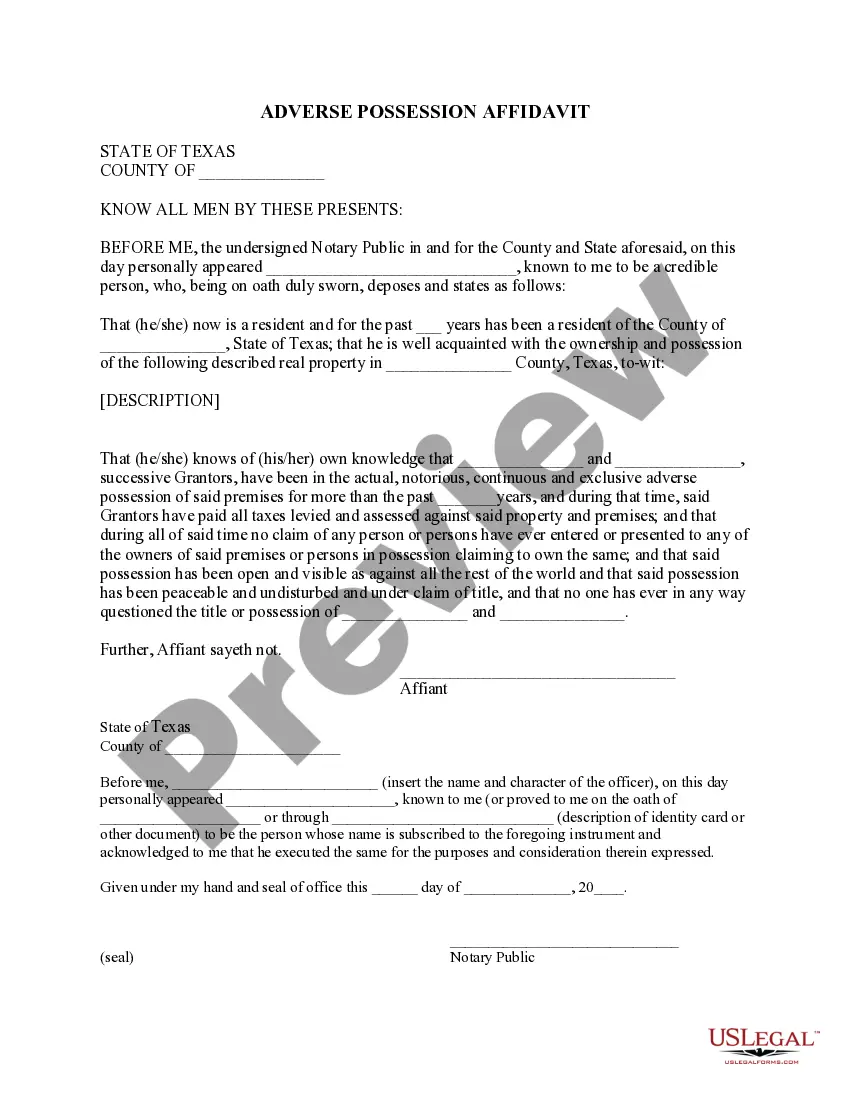
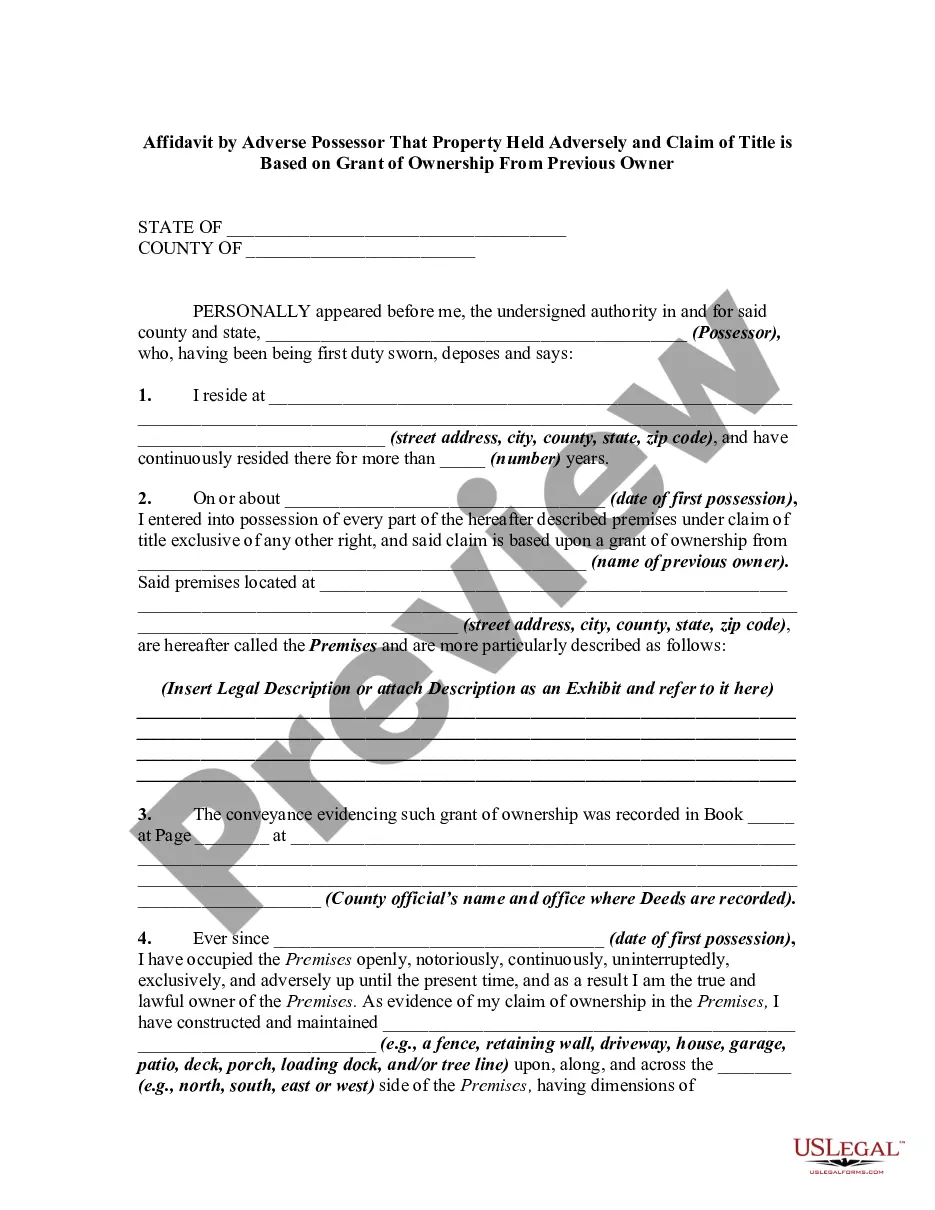
How to fill out Texas Adverse Possession Affidavit - Squatters Rights?
- If you previously used US Legal Forms, log in and download the required form by clicking the Download button. Check your subscription status; renew if necessary.
- For first-time users, start by browsing the Preview mode and form description to select the appropriate document that aligns with your needs and the legal requirements of your jurisdiction.
- If you can't find the right document, use the Search feature to find alternate templates that suit your needs.
- Once you've found the correct form, click on the Buy Now button and select your preferred subscription plan. You'll need to register for an account to access the full library.
- Complete your purchase by providing your payment details with either a credit card or PayPal.
- After the transaction, download your selected form to your device and access it anytime from the My Forms section of your profile.
Following these steps ensures you can navigate the complexities of legal document preparation effectively.
Utilize US Legal Forms today to empower your legal journey with confidence. Start your experience now!
Form popularity
FAQ
While it's possible to claim residency in two states, it can complicate your tax situation. Generally, each state has its criteria for residency, which may lead to double taxation if not managed carefully. Pursuing advice from a tax professional or utilizing resources like US Legal Forms can help clarify your status and ensure you comply with regulations as a Texas adverse resident for tax purposes.
You can usually live in another state for up to six months without becoming a resident, though this can vary based on state laws. During this period, maintaining ties to Texas, such as a permanent home and voting registration, is essential. Recognizing these nuances can help you avoid unintended consequences related to your status as a Texas adverse resident for tax purposes.
To quickly establish residency in Texas for tax purposes, first, find a permanent place to live. Next, get a Texas driver's license and register your vehicle in Texas. Engaging in community activities and obtaining local utilities are also effective steps. These actions demonstrate your intent to be a Texas adverse resident for tax purposes.
Establishing residency in Texas for tax purposes typically requires you to demonstrate physical presence and intent to make Texas your home. Generally, you need to be physically present in Texas for at least 12 consecutive months. This duration helps ensure you meet the criteria for being considered a Texas adverse resident for tax purposes. You should also consider obtaining a Texas driver's license and registering to vote.
To avoid capital gains tax when selling your home in Texas, you typically must live in the house for at least two of the five years prior to the sale. This residency rule applies to the primary residence exemption. Meeting this requirement allows you to exclude a significant amount of profit from taxes. If you’re unsure about the specifics, uslegalforms offers resources that can clarify these details.
To prove your residency for tax purposes in Texas, gather documents that demonstrate your physical presence and intent to stay. Acceptable documents include a Texas driver’s license, utility bills, and lease agreements that show your name and address. The more evidence you have, the clearer your residency status will be. For more information and forms, consider using uslegalforms to guide you through the process.
Qualifying as a Texas resident for taxes depends on various factors, including your physical presence and intention to stay in the state. Generally, living in Texas for over 12 months establishes your residency. Additionally, factors like registering to vote, obtaining a Texas driver's license, and having a permanent address can affirm your resident status. For assistance in understanding these criteria, uslegalforms can be a helpful tool.
To be recognized as a Texas resident for tax purposes, you generally need to establish residency for at least 12 months. This period allows the state to confirm that you have made Texas your primary dwelling. Establishing long-term residency helps minimize any confusion regarding your tax responsibilities. For more comprehensive information, consider reviewing resources on uslegalforms.
The 183 day rule in Texas states that if you spend 183 days or more in the state during a tax year, you may be considered a Texas resident for tax purposes. This rule is one way to determine residency, but it’s not the only factor. Other considerations include your intention to stay and your ties to the community. For those needing detailed information, uslegalforms can provide valuable insights.
Yes, it is possible to be considered a resident in two states for tax purposes, but it can complicate your tax situation. Each state has its own criteria for residency, which may include physical presence and intent to remain. You could be liable for taxes in both states, making it essential to understand the laws in each location. For tailored guidance, check out uslegalforms to better navigate these complexities.