Texas State Rp
Description
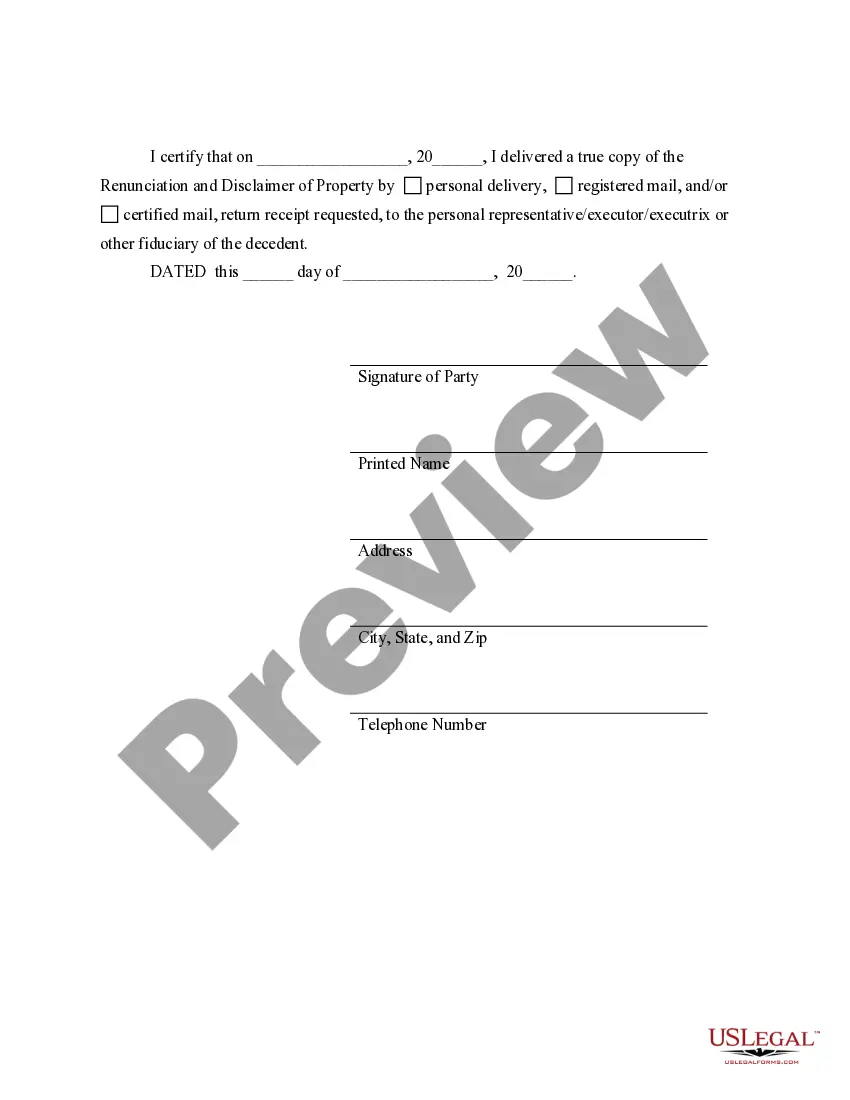
Get your form ready online
Our built-in tools help you complete, sign, share, and store your documents in one place.
Make edits, fill in missing information, and update formatting in US Legal Forms—just like you would in MS Word.
Download a copy, print it, send it by email, or mail it via USPS—whatever works best for your next step.
Sign and collect signatures with our SignNow integration. Send to multiple recipients, set reminders, and more. Go Premium to unlock E-Sign.
If this form requires notarization, complete it online through a secure video call—no need to meet a notary in person or wait for an appointment.
We protect your documents and personal data by following strict security and privacy standards.

Make edits, fill in missing information, and update formatting in US Legal Forms—just like you would in MS Word.

Download a copy, print it, send it by email, or mail it via USPS—whatever works best for your next step.

Sign and collect signatures with our SignNow integration. Send to multiple recipients, set reminders, and more. Go Premium to unlock E-Sign.

If this form requires notarization, complete it online through a secure video call—no need to meet a notary in person or wait for an appointment.

We protect your documents and personal data by following strict security and privacy standards.
Looking for another form?


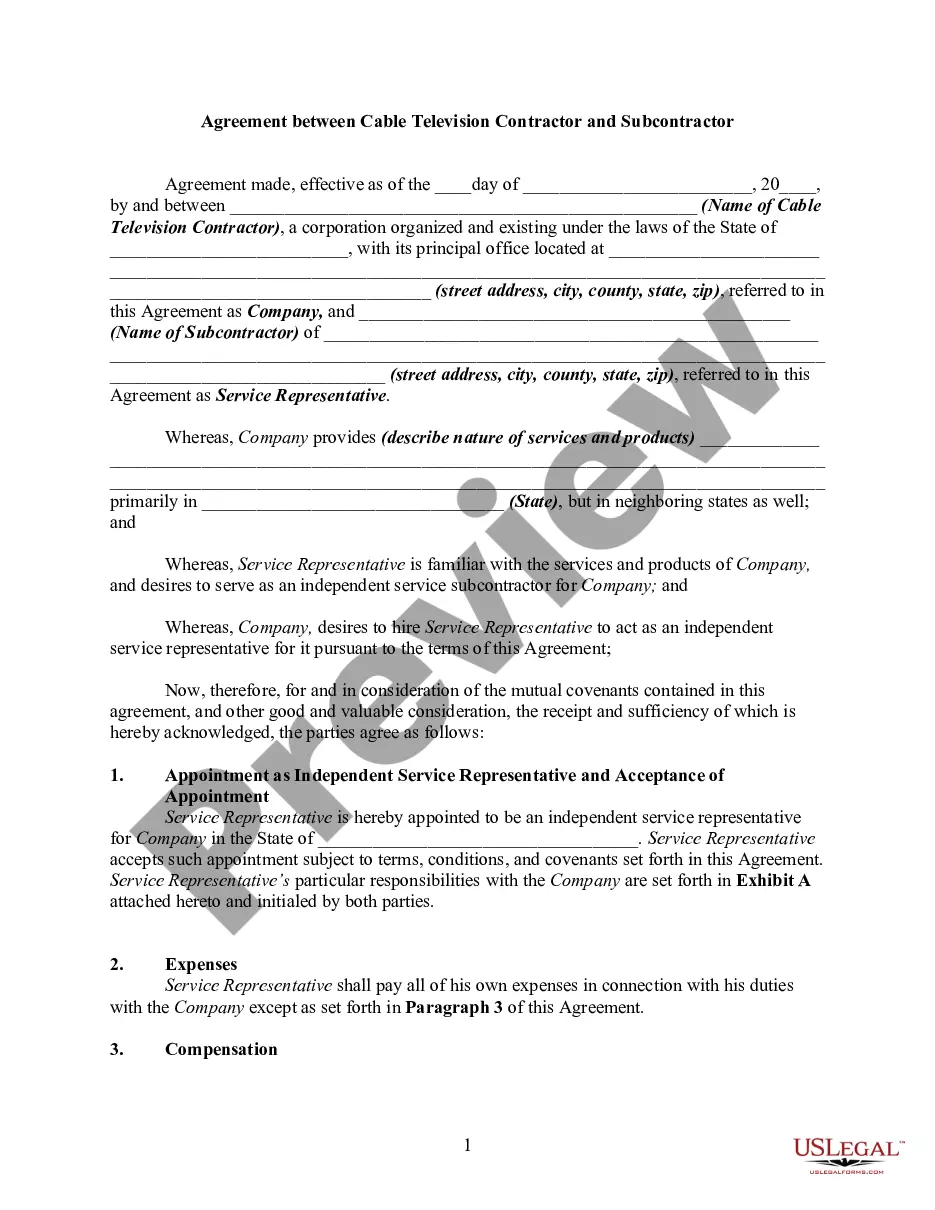



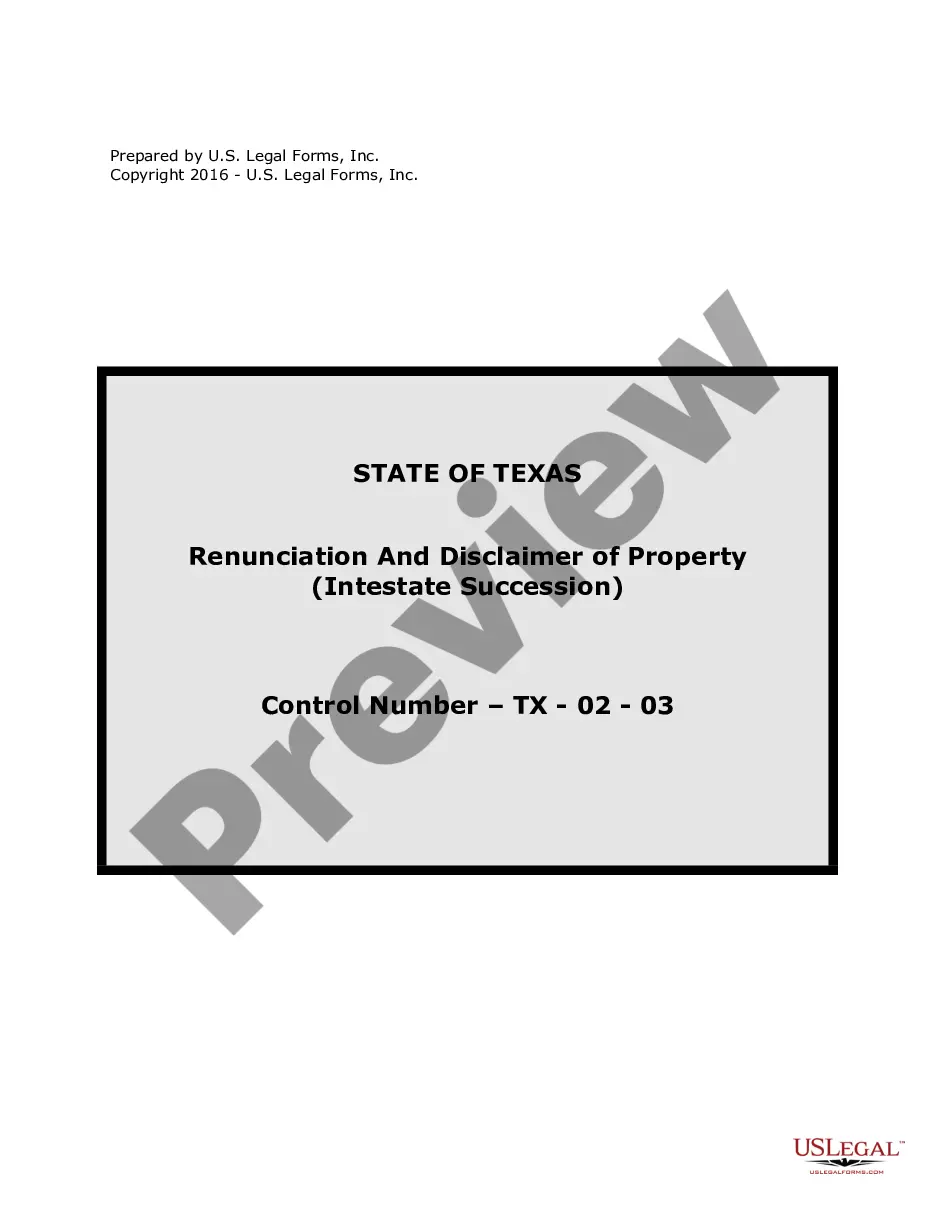
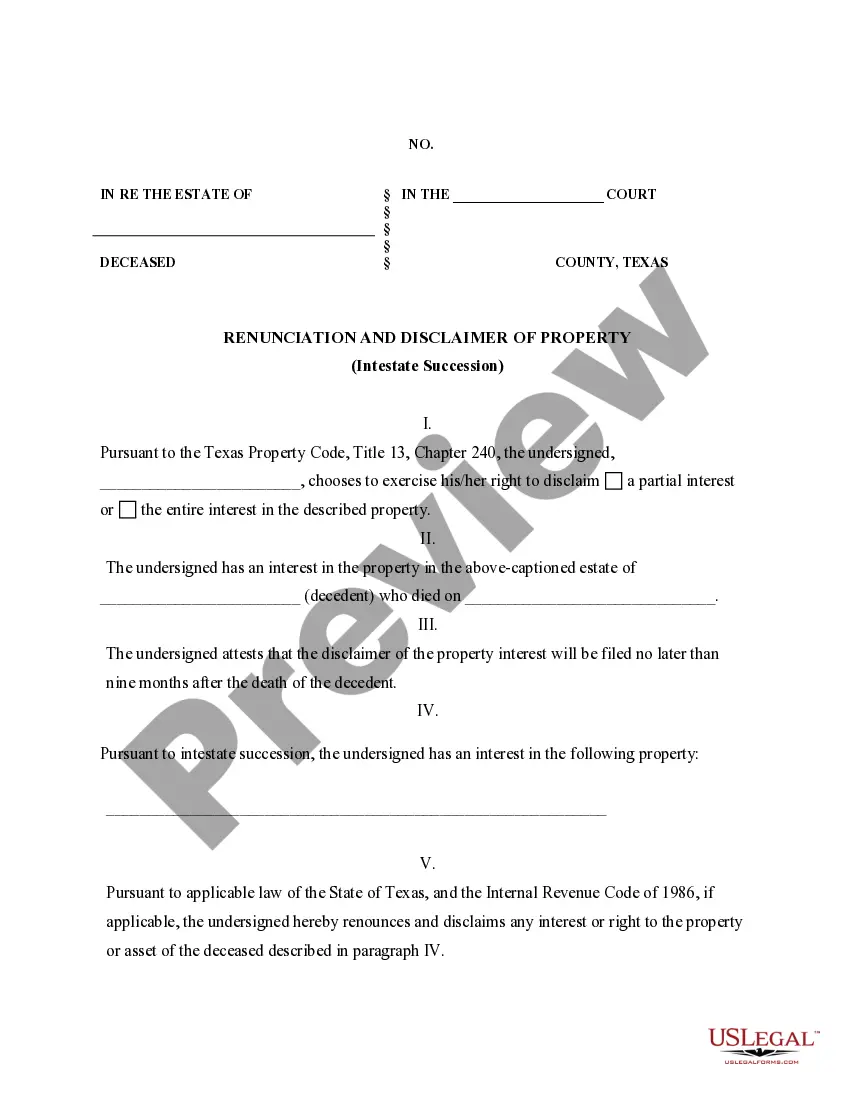
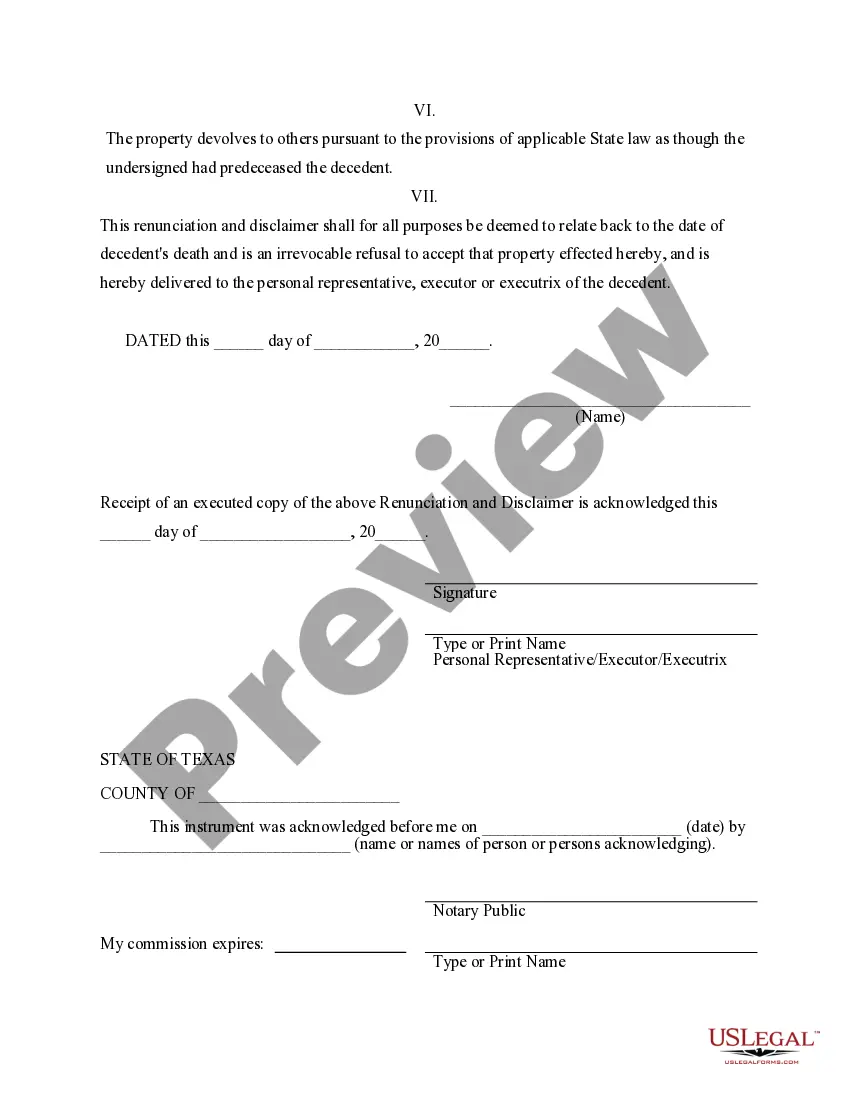
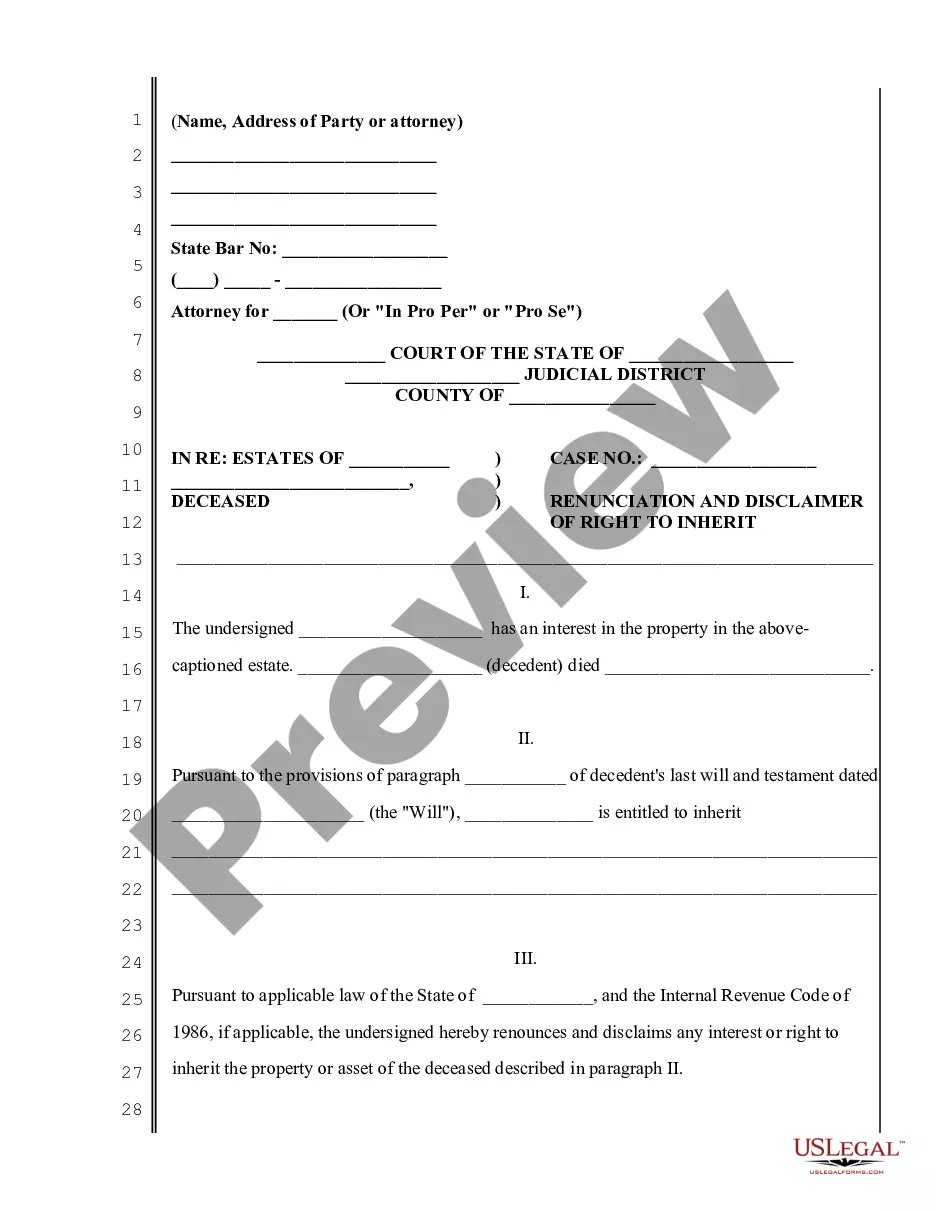
How to fill out Texas Renunciation And Disclaimer Of Property Received By Intestate Succession?
- Log in to your US Legal Forms account. Ensure your subscription is active for seamless access to the document library.
- Browse the extensive collection of forms available. Use Preview mode to confirm that your selected document meets all local jurisdiction requirements.
- If you encounter any issues, utilize the Search tool to find alternative templates that are more suited to your needs.
- Choose your desired form and select the Buy Now option. Here, you will be presented with various subscription plans to best suit your needs.
- Complete your purchase by entering your payment details, either via credit card or PayPal, to gain access to your chosen forms.
- Download the form directly to your device. You can easily return to these documents any time from the My Forms section in your account.
By following these steps, you will have access to a wide range of legal templates that can simplify your documentation process. The comprehensive library of US Legal Forms ensures that you have the necessary resources at your fingertips.
Don't miss out on the benefits of using Texas state rp—start your journey with US Legal Forms today for an effective and hassle-free legal experience!
Form popularity
FAQ
Calculating your GPA in Texas involves converting grades into grade points and averaging these points based on credit hours. Each course's grade contributes to your total quality points based on the number of credits it carries. This arithmetic provides a precise measurement of your academic performance. For detailed calculators and templates, USLegalForms offers specialized tools considering Texas state rp requirements.
Admission to Texas State University can be competitive, depending on several factors including your academic record and test scores. It's important to present a robust application that highlights your strengths and experiences. Researching the university’s admission requirements can provide clarity and improve your chances. For insights on the admissions process, Texas state rp resources from USLegalForms can be very beneficial.
To find your Texas State GPA, log into your student portal where your academic records are kept. Look for the GPA section, which outlines your cumulative GPA based on completed coursework. This information is essential for academic planning and is easily accessible at any time. For more guidance on understanding your GPA, refer to Texas state rp information available through USLegalForms.
Calculating your Texas State GPA involves converting your letter grades into grade points and then determining the weighted average. You will need to tally the total grade points and divide this total by the number of semester hours completed. This calculation provides a clear picture of your academic standing. To simplify this process, explore templates at USLegalForms tailored for Texas state rp users.
At Texas State University (TXST), GPA is calculated by taking the quality points earned for each course and dividing that by the total GPA hours. Each grade corresponds to a specific number of quality points based on the grading scale. Understanding this process is crucial for managing your academic performance effectively. For more detailed information, consult the Texas state rp guidelines provided by USLegalForms.
To calculate your overall GPA, first convert each of your course grades to grade points on a 4.0 scale. Next, multiply the grade points by the credit hours for each course. Finally, sum up all the grade points and divide by the total credit hours attempted. For detailed assistance, consider using the Texas state rp resources available at USLegalForms.
To fill out a Texas title registration form, start by gathering necessary documents, including your vehicle title and proof of insurance. Then, provide your personal information, vehicle details, and any lienholder information if applicable. After completing the form, submit it to your local county tax office along with the required fees. Utilizing resources like USLegalForms can guide you through this process smoothly.
To become a state trooper in Texas, the process typically takes about six to nine months. This period includes the application process, training at the Texas Department of Public Safety Academy, and field training. The training equips candidates with essential skills and knowledge necessary for law enforcement. For detailed information regarding Texas state rp and the requirements, consider visiting US Legal Forms for comprehensive support.
Yes, Texas has state troopers who are part of the Texas Department of Public Safety. These troopers enforce traffic laws, investigate accidents, and provide assistance in emergencies. They also play a crucial role in ensuring public safety throughout the state. If you are looking for more information about Texas state rp, our US Legal Forms platform can provide resources and guidance.
A PIR, or Public Information Report, is a document required by the Texas Comptroller for certain businesses. It provides financial information and helps determine franchise tax obligations. Understanding the requirements for a PIR can be essential for compliance. Using the resources available through uslegalforms can simplify the process of preparing and filing your Texas public information report.