Texas Intestate Succession With Us
Description
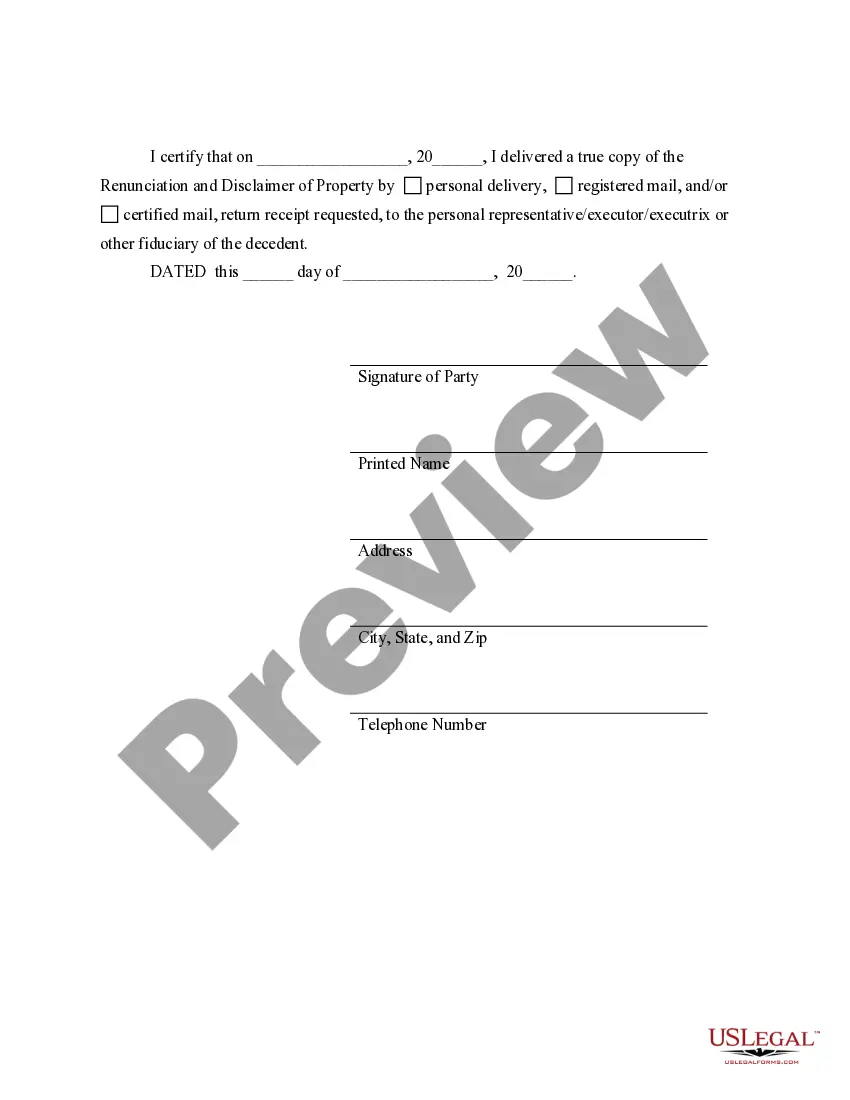
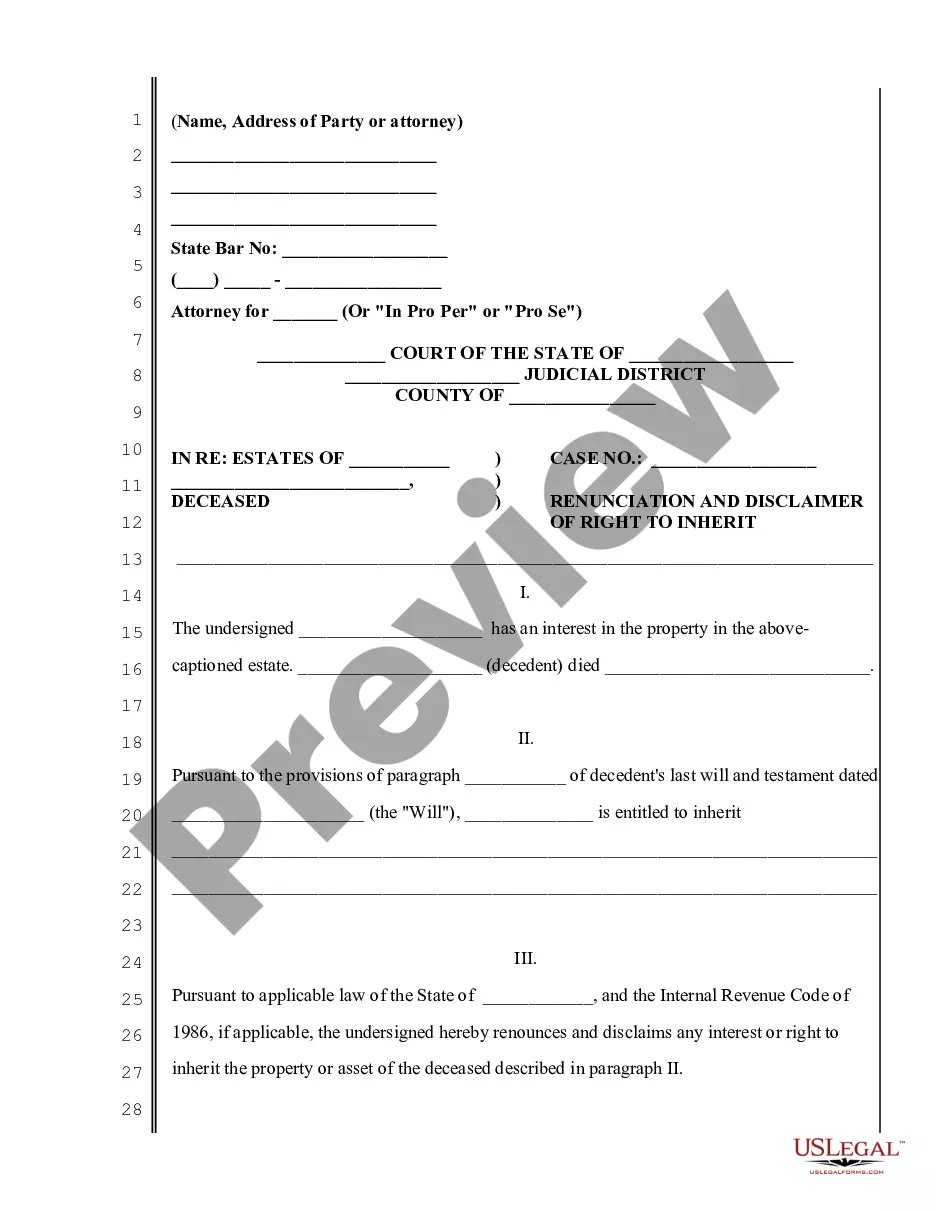
Get your form ready online
Our built-in tools help you complete, sign, share, and store your documents in one place.
Make edits, fill in missing information, and update formatting in US Legal Forms—just like you would in MS Word.
Download a copy, print it, send it by email, or mail it via USPS—whatever works best for your next step.
Sign and collect signatures with our SignNow integration. Send to multiple recipients, set reminders, and more. Go Premium to unlock E-Sign.
If this form requires notarization, complete it online through a secure video call—no need to meet a notary in person or wait for an appointment.
We protect your documents and personal data by following strict security and privacy standards.

Make edits, fill in missing information, and update formatting in US Legal Forms—just like you would in MS Word.

Download a copy, print it, send it by email, or mail it via USPS—whatever works best for your next step.

Sign and collect signatures with our SignNow integration. Send to multiple recipients, set reminders, and more. Go Premium to unlock E-Sign.

If this form requires notarization, complete it online through a secure video call—no need to meet a notary in person or wait for an appointment.

We protect your documents and personal data by following strict security and privacy standards.
Looking for another form?






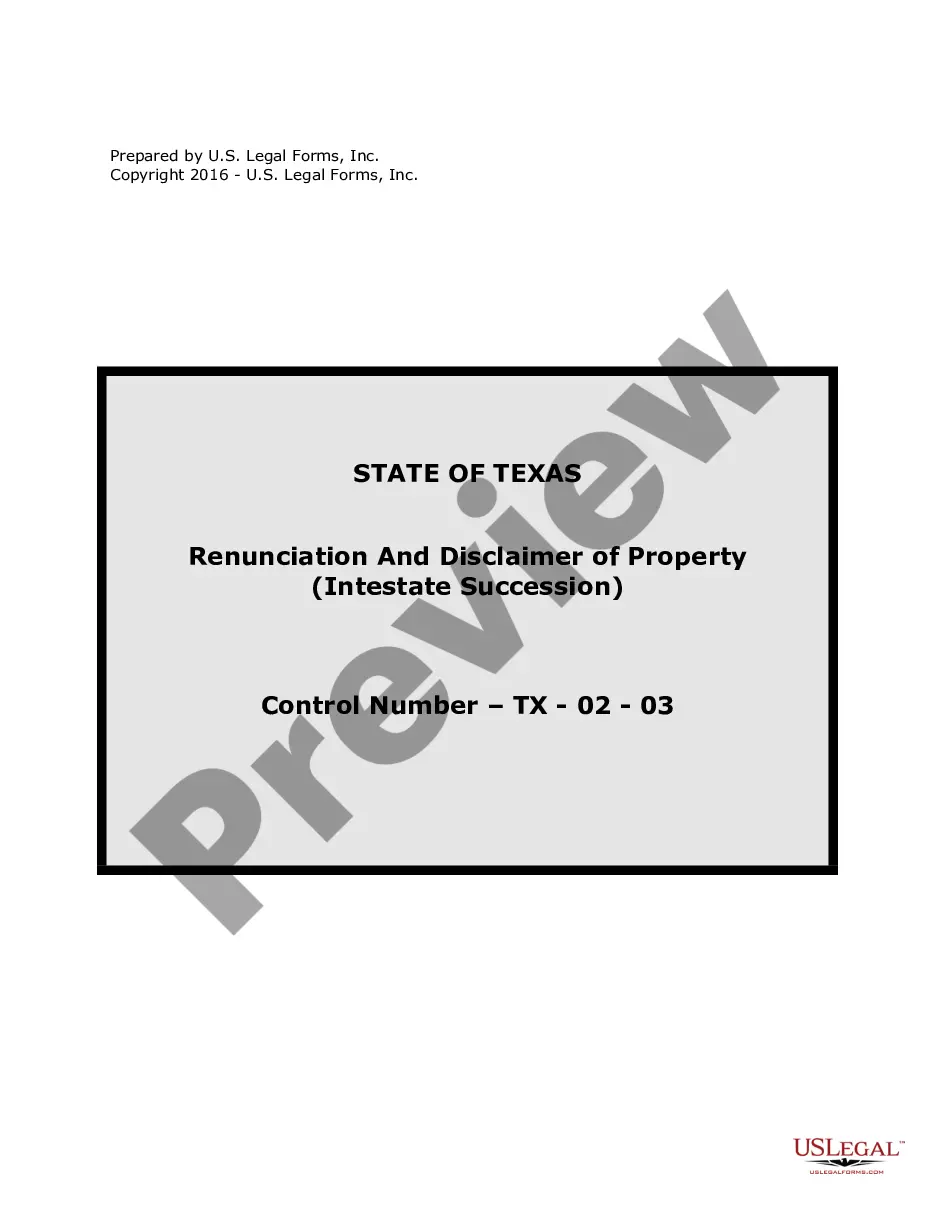
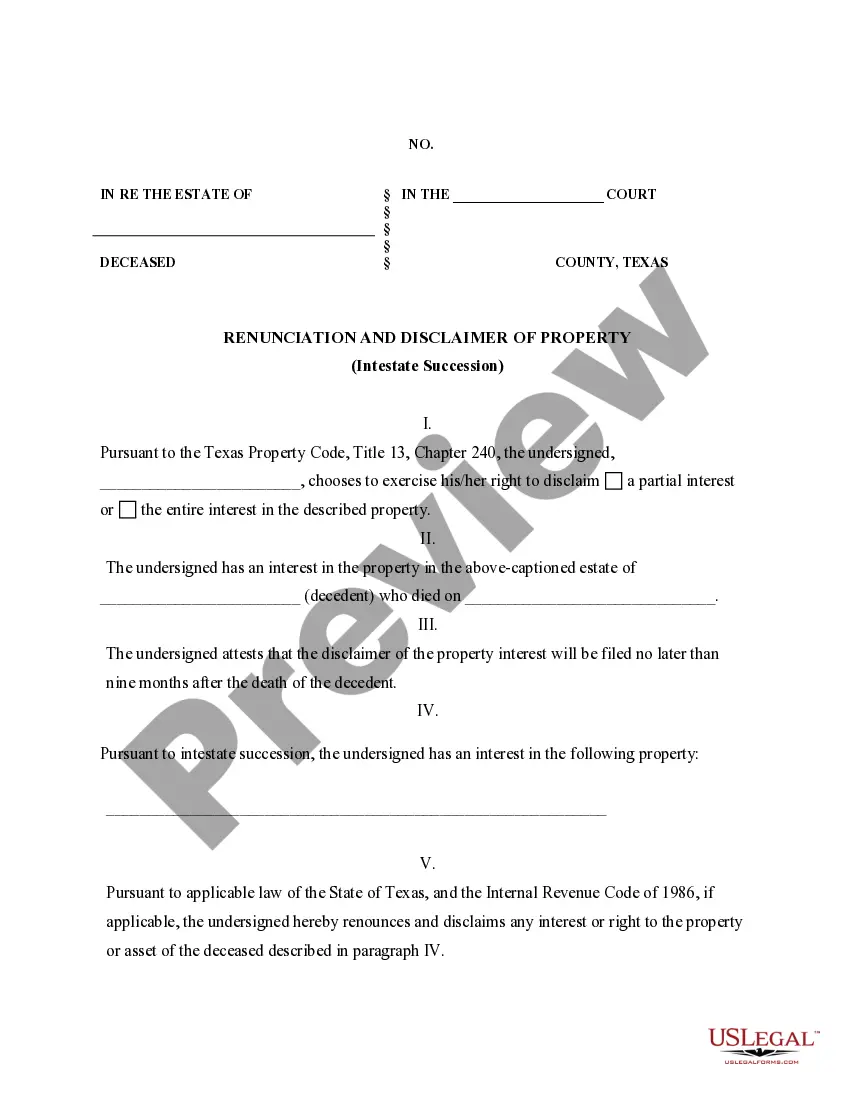
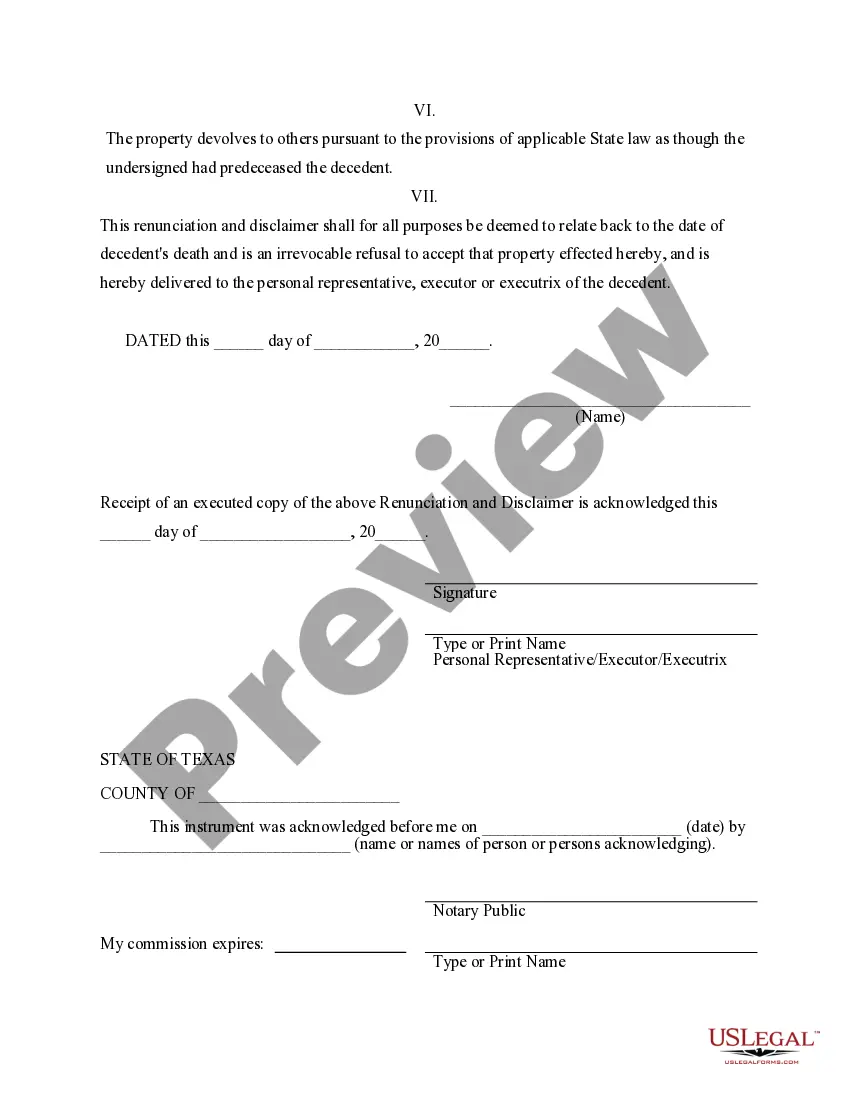
How to fill out Texas Renunciation And Disclaimer Of Property Received By Intestate Succession?
- If you're a returning user, log in to your account to download your required form. Make sure your subscription is current; renew if necessary.
- For first-time users, begin by previewing the forms available to ensure you select one that fits your legal needs and complies with local laws.
- Use the Search feature if you don't find an immediate match. Finding the right template may require browsing additional forms in our extensive library.
- Once you've identified the correct form, click on the Buy Now button and choose a subscription that suits your needs. You'll need to set up an account to access all documents.
- Complete your purchase using your credit card or PayPal account.
- Download the finalized form and save it to your device. Access it anytime through the My Forms section of your profile.
US Legal Forms empowers both individuals and legal professionals to efficiently create legal documents. Our catalog includes over 85,000 fillable forms, providing a significant advantage over competitors. Additionally, users can consult premium experts for assistance, ensuring accuracy in form completion.
Don't let legal paperwork stress you out. Start accessing your Texas intestate succession forms today with US Legal Forms!
Form popularity
FAQ
Texas does not impose an inheritance tax, allowing beneficiaries to inherit without worrying about state tax obligations. This means that regardless of how much you inherit, you can keep the full amount. If you're looking for support in navigating the implications of Texas intestate succession with us or if you have further questions, our platform provides the necessary tools and information.
Texas follows a per capita distribution method without representation, differing from per stirpes. This means that all heirs receive equal shares of the estate rather than distributing based on familial lineage. To navigate these specifics in Texas intestate succession with us and ensure every detail is covered, our resources can help you every step of the way.
Texas has recently updated its inheritance laws to clarify the distribution of assets in cases of intestate succession. These changes aim to streamline the process and ensure fair distribution among heirs. If you want to know how the new law impacts your situation, exploring Texas intestate succession with us can provide clarity and guidance.
Many states in the U.S. adhere to the per stirpes distribution method, including Texas. This approach applies when a deceased person leaves children or descendants who will inherit their share, ensuring that family lines are maintained. If you are interested in understanding how this affects Texas intestate succession with us, we can provide detailed insights.
In Texas, the terms per stirpes and per capita refer to different ways of distributing an estate among heirs. Per stirpes means that if a beneficiary passes away, their share goes to their descendants. In contrast, per capita means that each heir receives an equal share, regardless of family lines. Understanding these distinctions is vital in navigating Texas intestate succession with us.
If there is no will, Texas intestate succession laws determine who can inherit based on kinship. Typically, spouses, children, and parents are prioritized, but further relatives may also be considered depending on the circumstances. Understanding your rights and the succession process is vital, and we can guide you on Texas intestate succession with us.
In Texas, a surviving spouse usually does not automatically inherit everything, especially if there are children involved. The estate is divided according to Texas intestate succession laws, which may allocate portions to children or other relatives. Knowing how this process works can provide peace of mind, and exploring Texas intestate succession with us can offer valuable insights.
If there is no will, an executor cannot unilaterally decide who receives what; they must follow the intestate succession laws of the state. In Texas, the court will oversee the distribution process to ensure compliance with these laws. It is crucial for an executor to be well-informed about these rules, and you can benefit from learning more about Texas intestate succession with us.
The order of inheritance in the US can vary by state, but it generally follows similar patterns. Typically, a surviving spouse and children inherit first, followed by parents and siblings. In Texas, if no direct descendants exist, more distant relatives may inherit next. Understanding the specifics of Texas intestate succession with us can help you navigate these complexities.
In Texas, the legal next of kin is typically the closest relative of the deceased. This can include spouses, children, parents, or siblings, depending on the family structure. The state’s intestacy laws determine the order of inheritance, which can influence who inherits the estate. Knowing the dynamics of Texas intestate succession with us can ease your concerns during this difficult time.