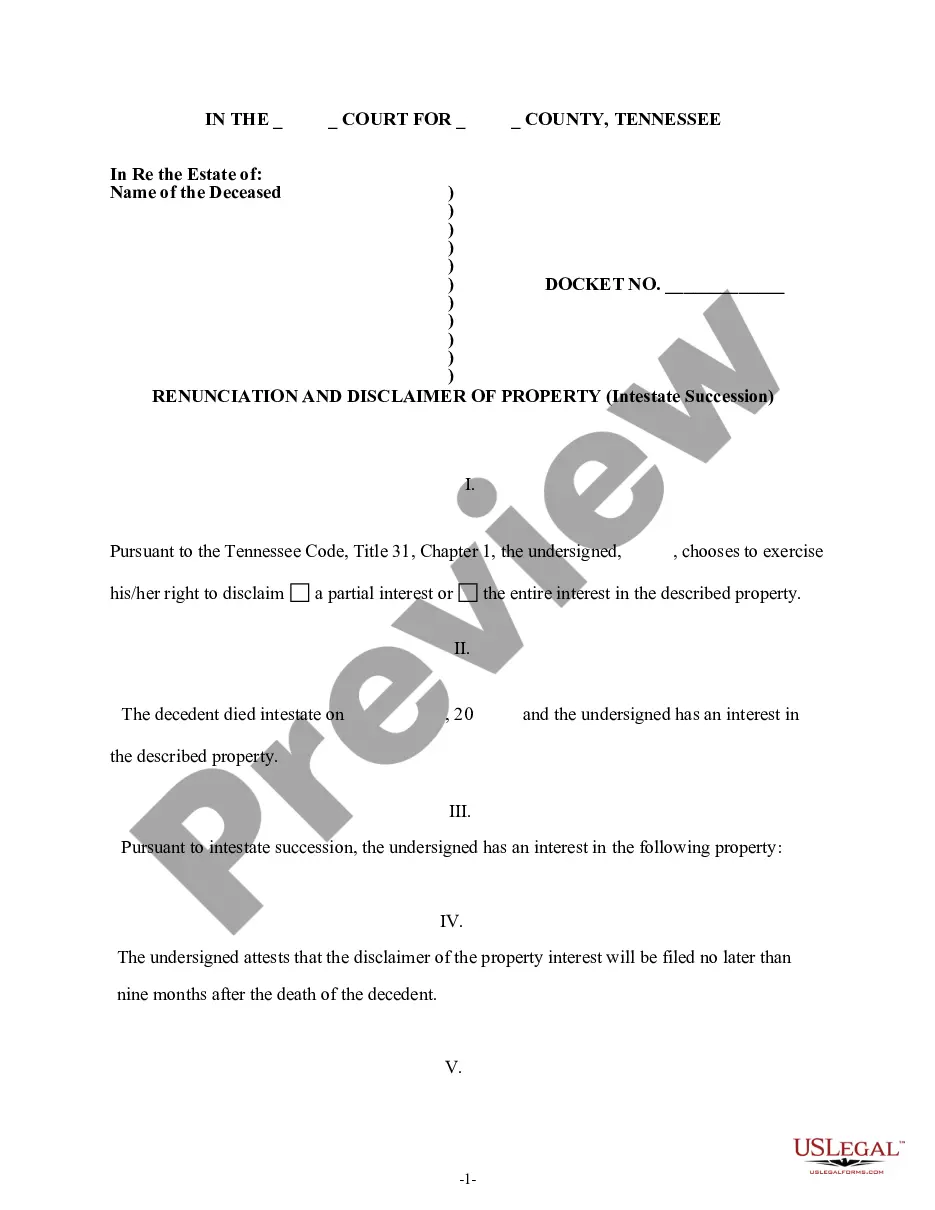
Tennessee Renunciation Intestate For Us
Description


Get your form ready online
Our built-in tools help you complete, sign, share, and store your documents in one place.
Make edits, fill in missing information, and update formatting in US Legal Forms—just like you would in MS Word.
Download a copy, print it, send it by email, or mail it via USPS—whatever works best for your next step.
Sign and collect signatures with our SignNow integration. Send to multiple recipients, set reminders, and more. Go Premium to unlock E-Sign.
If this form requires notarization, complete it online through a secure video call—no need to meet a notary in person or wait for an appointment.
We protect your documents and personal data by following strict security and privacy standards.

Make edits, fill in missing information, and update formatting in US Legal Forms—just like you would in MS Word.

Download a copy, print it, send it by email, or mail it via USPS—whatever works best for your next step.

Sign and collect signatures with our SignNow integration. Send to multiple recipients, set reminders, and more. Go Premium to unlock E-Sign.

If this form requires notarization, complete it online through a secure video call—no need to meet a notary in person or wait for an appointment.

We protect your documents and personal data by following strict security and privacy standards.
Looking for another form?



How to fill out Tennessee Renunciation And Disclaimer Of Property Received By Intestate Succession?
- If you’re a returning user, log in to your account and download the form template you need by clicking the Download button, ensuring your subscription is active. If it’s expired, be sure to renew it based on your payment plan.
- For new users, start by browsing the Preview mode and form description to confirm you have selected the correct document that aligns with your needs and local jurisdiction.
- If you find discrepancies, use the Search tab to locate the appropriate template. Ensure it accurately meets your requirements before moving forward.
- Next, click on the Buy Now button to purchase the document and select your preferred subscription plan. Registration is required to access our expansive library.
- Complete your purchase by entering your credit card information or using your PayPal account securely.
- Finally, download your document and save it to your device. You can always find this form again in the My Forms section of your profile whenever needed.
In summary, US Legal Forms empowers both individuals and attorneys in executing legal documents precisely and efficiently through its extensive collection. With over 85,000 forms readily available, you can easily complete your legal tasks without hassle.
Ready to get started? Visit US Legal Forms today to access your documents and ensure you have everything you need for your Tennessee renunciation intestate process.
Form popularity
FAQ
A letter of renunciation serves as a formal document indicating your decision to decline an inheritance. In the context of Tennessee renunciation intestate for us, this letter helps clarify your intentions to the probate court and other parties involved. It provides a clear record that prevents misunderstandings regarding your stance on the estate. Such documentation can facilitate smoother probate proceedings.
Renunciation in probate refers to the legal act of refusing inherited assets from an estate. When you make a Tennessee renunciation intestate for us, you effectively declare that you do not wish to accept your share of the estate. This act can influence how the remaining assets are distributed among other heirs. It is a strategic choice that can help maintain family harmony.
The point of renunciation is to allow individuals to step back from inheriting assets that may come with burdens. By making a Tennessee renunciation intestate for us, you can avoid liabilities or conflicts associated with the estate. This legal choice is beneficial for those who believe that accepting an inheritance may complicate their financial or personal situation. It ensures clarity and simplicity in estate proceedings.
In probate, renunciation implies a formal decision to refuse an inheritance. When you file a Tennessee renunciation intestate for us, you voluntarily relinquish your rights to the estate. This can occur for various reasons, such as wanting to avoid tax implications or family disputes. It is a legal step that impacts the distribution of assets.
After you file your Tennessee renunciation intestate for us, the court will evaluate your claim. This process can lead to the redistribution of assets according to state laws. You will not inherit anything from the deceased, allowing their estate to move forward without your involvement. This can simplify the probate process for everyone involved.
When a person dies intestate in Tennessee, the order of inheritance follows a clear hierarchy. First, a surviving spouse shares in the estate, followed by children, if any. From there, parents and siblings are next in line. Familiarizing yourself with these provisions can be empowering, and uslegalforms offers tools to help you navigate the complexities of Tennessee renunciation intestate for us.
Avoiding probate in Tennessee can often simplify the estate management process. One effective way is to establish trusts, since property held in a trust generally does not go through probate. Additionally, joint ownership or naming beneficiaries on accounts can sidestep probate delays. To learn more about these options, you may want to visit uslegalforms for valuable insights on Tennessee renunciation intestate for us.
In the absence of a will, Tennessee law dictates the order of inheritance. Typically, a surviving spouse and children inherit first. If there are no descendants, the estate moves to other relatives like parents or siblings. Such scenarios can prompt individuals to explore their options through uslegalforms, particularly regarding Tennessee renunciation intestate for us.
If someone dies without a will in Tennessee, their assets distribute according to intestacy laws. Generally, the estate will go to the closest relatives, such as a spouse, children, or parents. This standard can lead to outcomes that differ from what the deceased intended. To ensure clarity and avoid confusion, consider utilizing uslegalforms for information on Tennessee renunciation intestate for us.
In Tennessee, when someone passes away without a will, the court appoints an administrator to manage the estate. This individual is often a close family member or a beneficiary of the estate. Their role involves collecting assets, paying debts, and distributing what remains according to Tennessee laws. The process can be complex, which is where uslegalforms can provide helpful resources for navigating Tennessee renunciation intestate for us.