North Carolina Law For Divorce
Description

Get your form ready online
Our built-in tools help you complete, sign, share, and store your documents in one place.
Make edits, fill in missing information, and update formatting in US Legal Forms—just like you would in MS Word.
Download a copy, print it, send it by email, or mail it via USPS—whatever works best for your next step.
Sign and collect signatures with our SignNow integration. Send to multiple recipients, set reminders, and more. Go Premium to unlock E-Sign.
If this form requires notarization, complete it online through a secure video call—no need to meet a notary in person or wait for an appointment.
We protect your documents and personal data by following strict security and privacy standards.

Make edits, fill in missing information, and update formatting in US Legal Forms—just like you would in MS Word.

Download a copy, print it, send it by email, or mail it via USPS—whatever works best for your next step.

Sign and collect signatures with our SignNow integration. Send to multiple recipients, set reminders, and more. Go Premium to unlock E-Sign.

If this form requires notarization, complete it online through a secure video call—no need to meet a notary in person or wait for an appointment.

We protect your documents and personal data by following strict security and privacy standards.
Looking for another form?








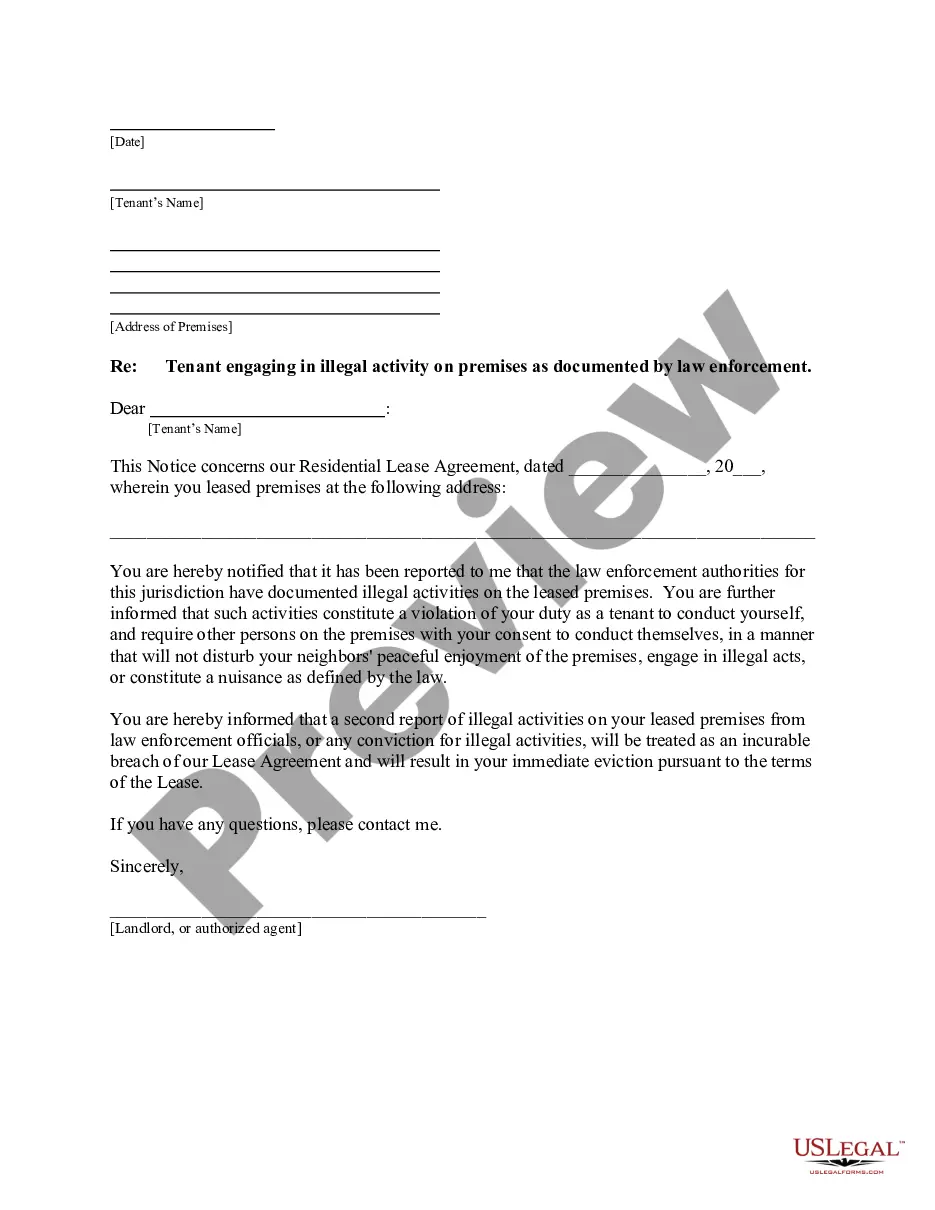
How to fill out South Carolina Letter From Landlord To Tenant About Tenant Engaging In Illegal Activity In Premises As Documented By Law Enforcement And If Repeated, Lease Terminates?
Finding a go-to place to access the most current and relevant legal templates is half the struggle of working with bureaucracy. Choosing the right legal papers requirements accuracy and attention to detail, which is the reason it is very important to take samples of North Carolina Law For Divorce only from reputable sources, like US Legal Forms. A wrong template will waste your time and hold off the situation you are in. With US Legal Forms, you have very little to be concerned about. You can access and see all the details concerning the document’s use and relevance for the circumstances and in your state or county.
Consider the listed steps to complete your North Carolina Law For Divorce:
- Use the library navigation or search field to locate your sample.
- View the form’s description to see if it fits the requirements of your state and region.
- View the form preview, if there is one, to make sure the form is definitely the one you are interested in.
- Return to the search and find the appropriate document if the North Carolina Law For Divorce does not fit your requirements.
- If you are positive about the form’s relevance, download it.
- If you are a registered user, click Log in to authenticate and access your picked forms in My Forms.
- If you do not have a profile yet, click Buy now to obtain the template.
- Choose the pricing plan that suits your preferences.
- Proceed to the registration to finalize your purchase.
- Finalize your purchase by choosing a payment method (bank card or PayPal).
- Choose the file format for downloading North Carolina Law For Divorce.
- Once you have the form on your gadget, you may modify it with the editor or print it and finish it manually.
Remove the inconvenience that accompanies your legal documentation. Check out the comprehensive US Legal Forms library to find legal templates, check their relevance to your circumstances, and download them immediately.
Form popularity
FAQ
In NC divorces, assets are typically divided by equitable division (which could be a 50/50 distribution of assets if that is considered equitable). In some cases, courts divide assets by community property division (where both spouses get ownership).
To file for divorce, you must file the following documents with the clerk of court in the county where either you or your spouse lives: A complaint, stating the facts of your case and your request for a divorce. ... A summons. A Domestic Civil Action Cover Sheet.
One of the most significant ways moving out can influence your divorce is when it comes to child custody. If you move out, it means you don't spend as much time with your kids. Not only can this harm your relationship, but it can also damage your custody claims.
File a Divorce Complaint with the Clerk of Court in Your County. The next step in how to get divorce in NC is to obtain an absolute divorce. To reach this final termination of marriage, one spouse must file a divorce complaint with the Clerk of Court in the county of their residence.
In North Carolina, you can file for a no-fault divorce once you and your spouse have lived separately for one year and one day prior to filing. You do not need your spouse's consent. Though they must be served with the appropriate paperwork, you will not need their signatures or cooperation.