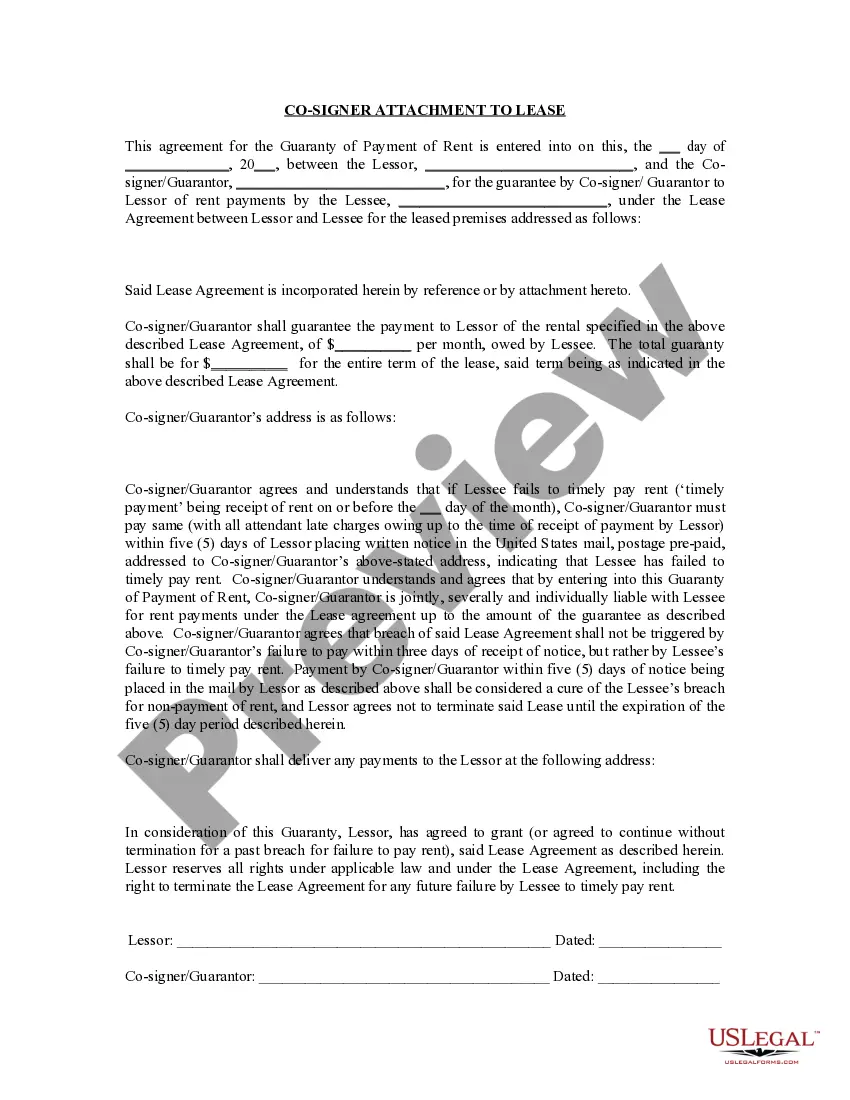
Co-signer Or Guarantor On Any Debt
Description
Get your form ready online
Our built-in tools help you complete, sign, share, and store your documents in one place.
Make edits, fill in missing information, and update formatting in US Legal Forms—just like you would in MS Word.
Download a copy, print it, send it by email, or mail it via USPS—whatever works best for your next step.
Sign and collect signatures with our SignNow integration. Send to multiple recipients, set reminders, and more. Go Premium to unlock E-Sign.
If this form requires notarization, complete it online through a secure video call—no need to meet a notary in person or wait for an appointment.
We protect your documents and personal data by following strict security and privacy standards.

Make edits, fill in missing information, and update formatting in US Legal Forms—just like you would in MS Word.

Download a copy, print it, send it by email, or mail it via USPS—whatever works best for your next step.

Sign and collect signatures with our SignNow integration. Send to multiple recipients, set reminders, and more. Go Premium to unlock E-Sign.

If this form requires notarization, complete it online through a secure video call—no need to meet a notary in person or wait for an appointment.

We protect your documents and personal data by following strict security and privacy standards.
Looking for another form?






How to fill out Oregon Guaranty Attachment To Lease For Guarantor Or Cosigner?
Regardless of whether for corporate reasons or personal matters, everyone must confront legal issues at some stage in their lives. Filling out legal paperwork requires meticulous focus, beginning with selecting the right template. For instance, if you choose an incorrect version of a Co-signer Or Guarantor On Any Debt, it will be rejected once submitted. Therefore, it is crucial to obtain a trustworthy source of legal documents such as US Legal Forms.
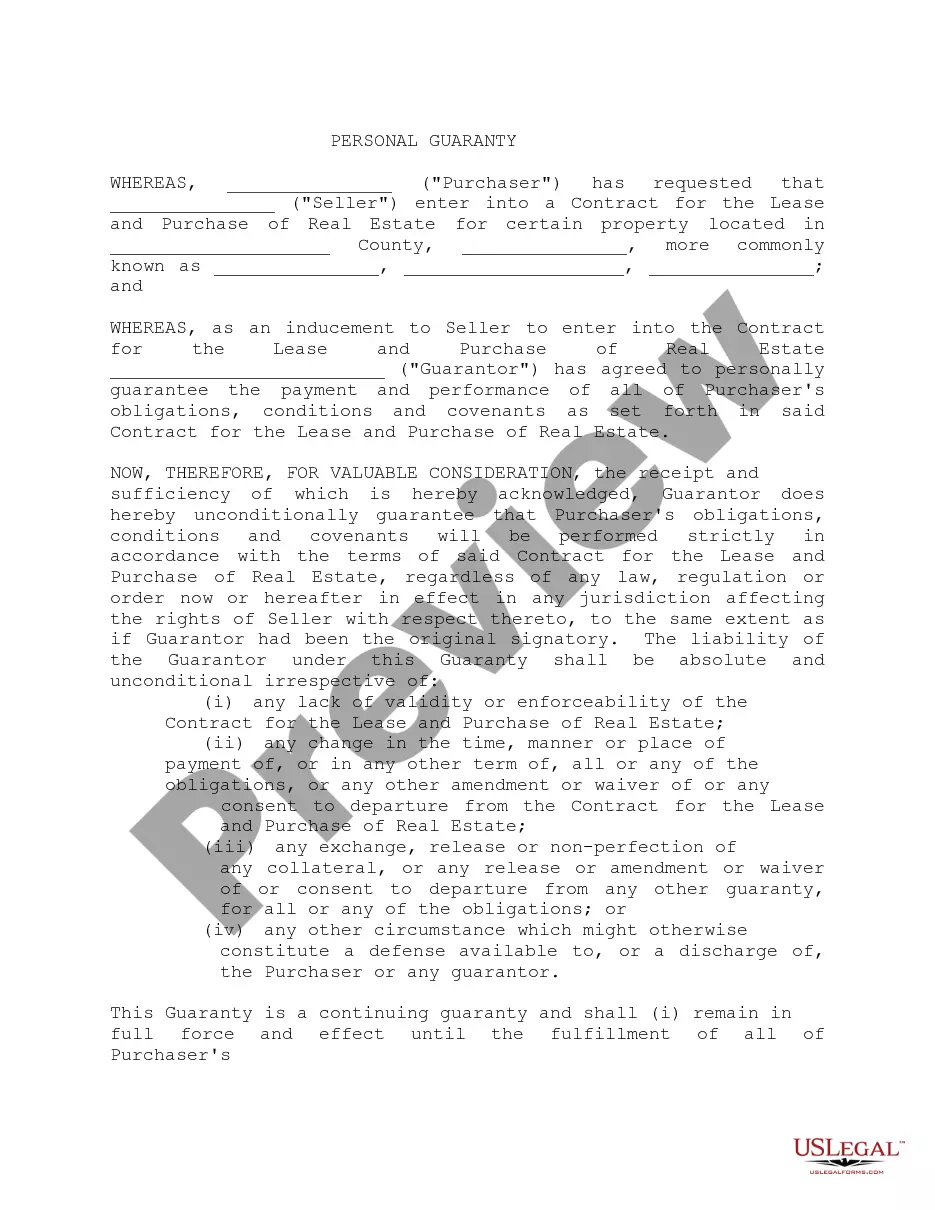
If you need to acquire a Co-signer Or Guarantor On Any Debt template, follow these straightforward steps.
With a comprehensive US Legal Forms catalog available, you will never need to waste time searching for the right template online. Utilize the library’s straightforward navigation to find the appropriate form for any circumstance.
- Obtain the required template using the search bar or catalog navigation.
- Review the form’s details to confirm it corresponds with your situation, state, and county.
- Click on the form’s preview to examine it.
- If it is the incorrect document, return to the search feature to locate the Co-signer Or Guarantor On Any Debt template you require.
- Download the template once it satisfies your criteria.
- If you already possess a US Legal Forms account, simply click Log in to access previously saved templates in My documents.
- If you do not yet have an account, you can download the form by clicking Buy now.
- Select the suitable pricing option.
- Fill out the account registration form.
- Select your payment method: use a credit card or PayPal account.
- Select the document format you desire and download the Co-signer Or Guarantor On Any Debt.
- Once it is saved, you can complete the form with the assistance of editing software or print it out and fill it in manually.
Form popularity
FAQ
To fill out a guarantor form, start by gathering the necessary information, such as your personal details and the details of the debt involved. Next, ensure you understand the responsibilities that come with being a co-signer or guarantor on any debt. Carefully read through the form, and fill it out accurately, providing all required information. If you have any questions, consider using platforms like US Legal Forms, which can guide you through the process.
Being a guarantor on any debt carries certain risks that you should consider carefully. If the borrower defaults, you may be responsible for the entire debt, which can strain your finances. Additionally, your credit score can suffer if payments are missed, impacting future borrowing opportunities. To mitigate risks, consider using platforms like US Legal Forms to understand your obligations and ensure you are making informed decisions when agreeing to be a co-signer or guarantor.
What does being a guarantor mean? Being a guarantor involves helping someone else get credit, such as a loan or mortgage. Acting as a guarantor, you ?guarantee? someone else's loan or mortgage by promising to repay the debt if they can't afford to. It's wise to only agree to being a guarantor for someone you know well.
A cosigner on a rental property is someone who signs a lease with you and assumes equal liability for paying the rent, while a guarantor is only liable to make payments when the primary borrower can't or won't pay.
Write out your qualifications as a guarantor -- your income, assets and other personal details supporting why you would be able to take responsibility should the tenant or borrower fail to do so. You can also list your accountant to testify to your financial state, as well as other character references.
A guarantor's form should include a space to fill in the home address, work address, phone number, and email address. The contact details are what will be used to contact the guarantor in the future if the principal fails to meet agreement terms.
The primary difference between a co-signer and a guarantor is how soon each individual becomes responsible for the borrower's debt. A co-signer is responsible for every payment that a borrower misses. However, a guarantor only assumes responsibility if the borrower falls into total default.