Letter For Refusal
Description

Get your form ready online
Our built-in tools help you complete, sign, share, and store your documents in one place.
Make edits, fill in missing information, and update formatting in US Legal Forms—just like you would in MS Word.
Download a copy, print it, send it by email, or mail it via USPS—whatever works best for your next step.
Sign and collect signatures with our SignNow integration. Send to multiple recipients, set reminders, and more. Go Premium to unlock E-Sign.
If this form requires notarization, complete it online through a secure video call—no need to meet a notary in person or wait for an appointment.
We protect your documents and personal data by following strict security and privacy standards.

Make edits, fill in missing information, and update formatting in US Legal Forms—just like you would in MS Word.

Download a copy, print it, send it by email, or mail it via USPS—whatever works best for your next step.

Sign and collect signatures with our SignNow integration. Send to multiple recipients, set reminders, and more. Go Premium to unlock E-Sign.

If this form requires notarization, complete it online through a secure video call—no need to meet a notary in person or wait for an appointment.

We protect your documents and personal data by following strict security and privacy standards.
Looking for another form?
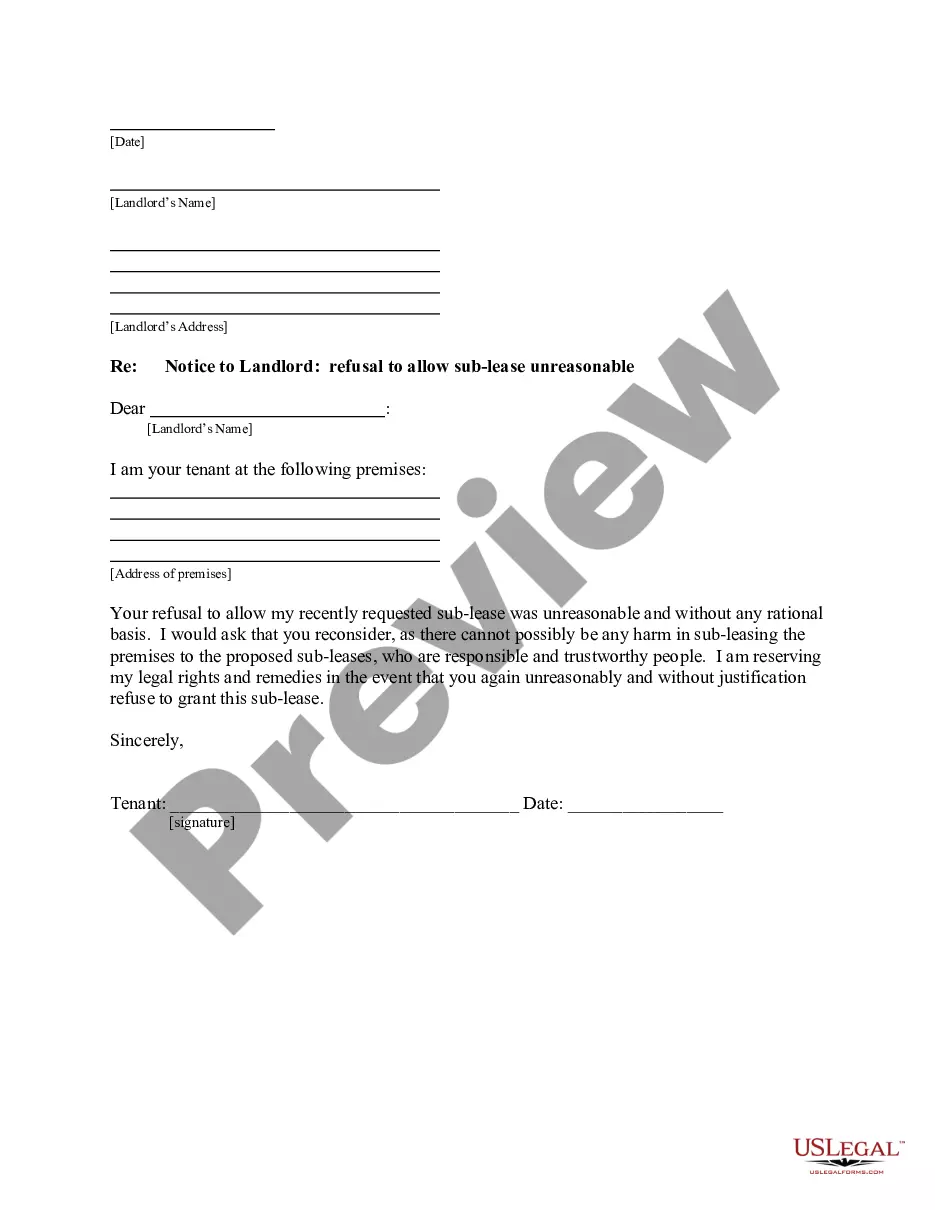
How to fill out Oregon Letter From Tenant To Landlord About Landlord's Refusal To Allow Sublease Is Unreasonable?
Bureaucracy necessitates exactness and correctness.
If you do not engage with completing documents such as Letter For Refusal regularly, it may lead to some misunderstanding.
Selecting the appropriate sample from the start will guarantee that your document submission proceeds smoothly and avert any troubles of re-submitting a document or repeating the same task from the beginning.
If you are not a subscribed user, finding the required sample will take a few extra steps: Locate the template using the search bar. Ensure that the Letter For Refusal you’ve found is applicable to your state or district. Open the preview or read the description containing the details on how to use the sample. When the outcome corresponds to your search, click the Buy Now button. Choose the suitable option among the proposed pricing plans. Sign in to your account or create a new one. Complete the purchase using a credit card or PayPal option. Obtain the form in the file format you prefer. Gaining the correct and updated samples for your documentation takes just a few minutes with an account at US Legal Forms. Sidestep bureaucratic uncertainties and enhance your efficiency with forms.
- Acquire the suitable sample for your documentation from US Legal Forms.
- US Legal Forms is the largest online collection of forms that holds over 85,000 templates for various fields.
- You can find the most current and pertinent version of the Letter For Refusal by merely searching it on the website.
- Locate, store, and preserve templates in your account or refer to the description to confirm you have the correct one available.
- With an account at US Legal Forms, it is simple to obtain, keep in one location, and navigate through the templates you save for easy access.
- While on the site, click the Log In button to sign in.
- Then, go to the My documents section, where the history of your forms is maintained.
- Review the descriptions of the forms and save those you need at any time.
Form popularity
FAQ
An example of a refusal can be when someone requests a letter of recommendation, but you feel unable to provide one. You might say that due to your current commitments, you cannot write a supportive letter at this time. This forms a clear letter for refusal, as it directly addresses the request while providing a valid explanation. Using platforms like US Legal Forms can help you draft an appropriate refusal in a consistent manner.
To politely reject a letter request, start by expressing gratitude for the ask. Then, clearly state that you cannot fulfill the request, offering a brief reason if appropriate. It is important to maintain a respectful tone, so your response feels considerate. Ending your message positively can leave the door open for future requests, while effectively addressing the situation with a letter for refusal.
Writing a letter against refusal involves a clear and respectful tone. Begin with a polite introduction and express your disagreement with the refusal. Use specific examples or reasons to support your position. If you are unsure how to format your arguments correctly, consider using a template from the US Legal Forms platform, which can guide you in drafting an effective letter for refusal.
To start a refusal letter, begin with a warm greeting to set a friendly tone. Next, provide context about the request you are refusing. For instance, you might say, 'I appreciate your interest in our services.' This approach makes it easier for the recipient to digest the following refusal. Crafting an effective letter for refusal starts with a positive opening.
An example of a refusal letter could be a letter to an applicant, stating, 'Thank you for your application for the position. After careful consideration, we regret to inform you that we will not be moving forward with your application.' This example communicates the message clearly while remaining courteous. Such communication is essential in a letter for refusal.
The best beginning of a rejection letter is a thoughtful acknowledgment of the proposal or request. Start with a phrase like, 'I appreciate the opportunity to consider your offer.' This shows respect for the effort put forth by the other party while smoothly transitioning into the refusal. A good start is essential in a letter for refusal.
A good example of a rejection letter might include a brief acknowledgment of the request being declined, followed by a clear statement of refusal. For instance, you might say, 'Thank you for your offer, but I must decline at this time.' Including a reason for your refusal can help maintain a positive relationship. This structure will align well with a letter for refusal.
To start a decline letter, begin with a polite greeting. You may want to mention the context of the initial request or offer you are declining. Clearly state your decision early in the letter to set the tone. This strategy makes it easier for the recipient to understand your position regarding the letter for refusal.
Writing a letter for refusal requires clarity and professionalism. Start by clearly stating the reason for the refusal, ensuring the recipient understands your decision. Include relevant details, such as dates and any prior communications, to support your position. Using a template can simplify the process, and platforms like US Legal Forms provide tailored templates that help you create an effective letter for refusal with ease.
When writing a refusal claim letter, clearly state the claim being denied along with the reasons for the decision. Be straightforward yet courteous, and attach any relevant documents that support your statement. This clarity helps the recipient understand the letter of refusal and their options moving forward.
