Ohio Theft Laws
Description
Get your form ready online
Our built-in tools help you complete, sign, share, and store your documents in one place.
Make edits, fill in missing information, and update formatting in US Legal Forms—just like you would in MS Word.
Download a copy, print it, send it by email, or mail it via USPS—whatever works best for your next step.
Sign and collect signatures with our SignNow integration. Send to multiple recipients, set reminders, and more. Go Premium to unlock E-Sign.
If this form requires notarization, complete it online through a secure video call—no need to meet a notary in person or wait for an appointment.
We protect your documents and personal data by following strict security and privacy standards.

Make edits, fill in missing information, and update formatting in US Legal Forms—just like you would in MS Word.

Download a copy, print it, send it by email, or mail it via USPS—whatever works best for your next step.

Sign and collect signatures with our SignNow integration. Send to multiple recipients, set reminders, and more. Go Premium to unlock E-Sign.

If this form requires notarization, complete it online through a secure video call—no need to meet a notary in person or wait for an appointment.

We protect your documents and personal data by following strict security and privacy standards.
Looking for another form?







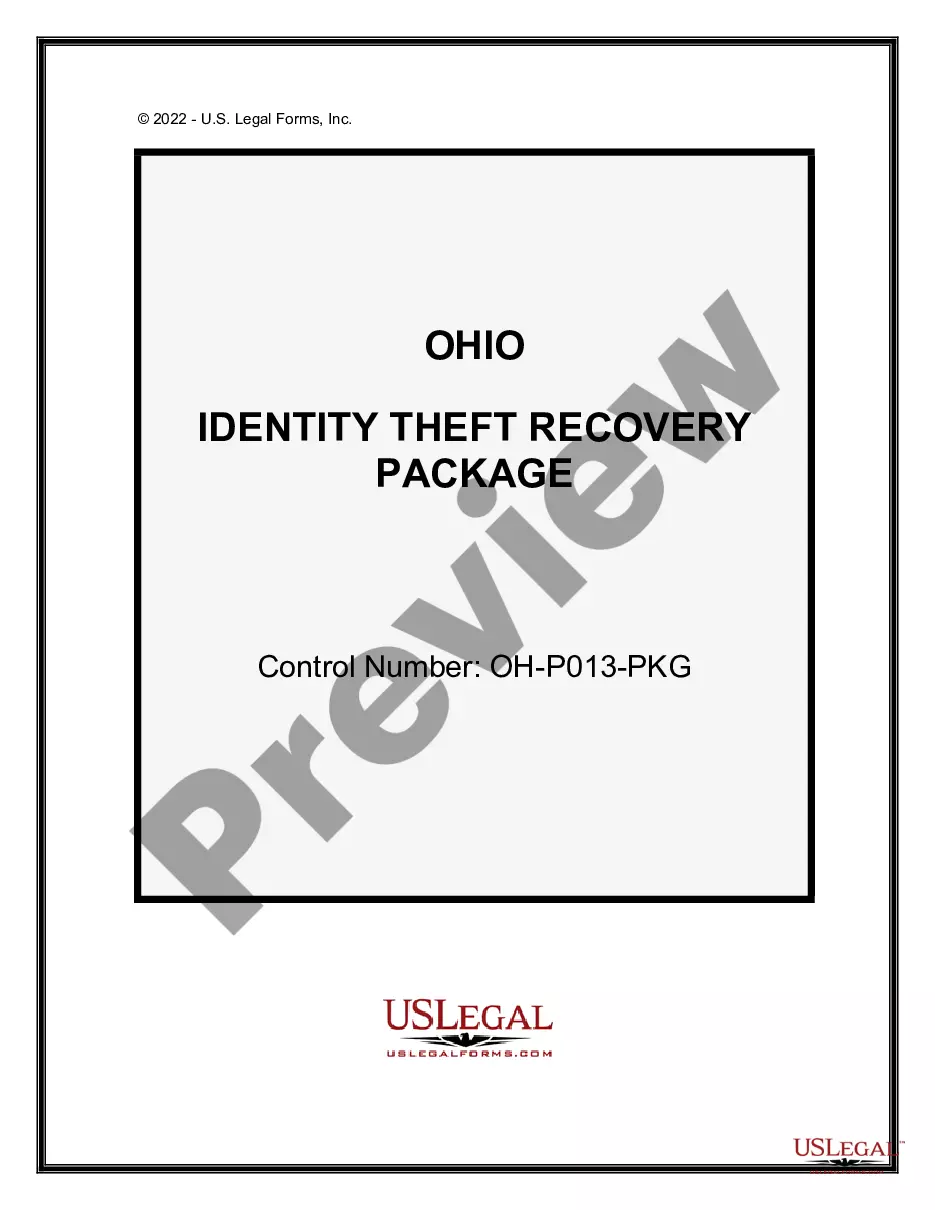
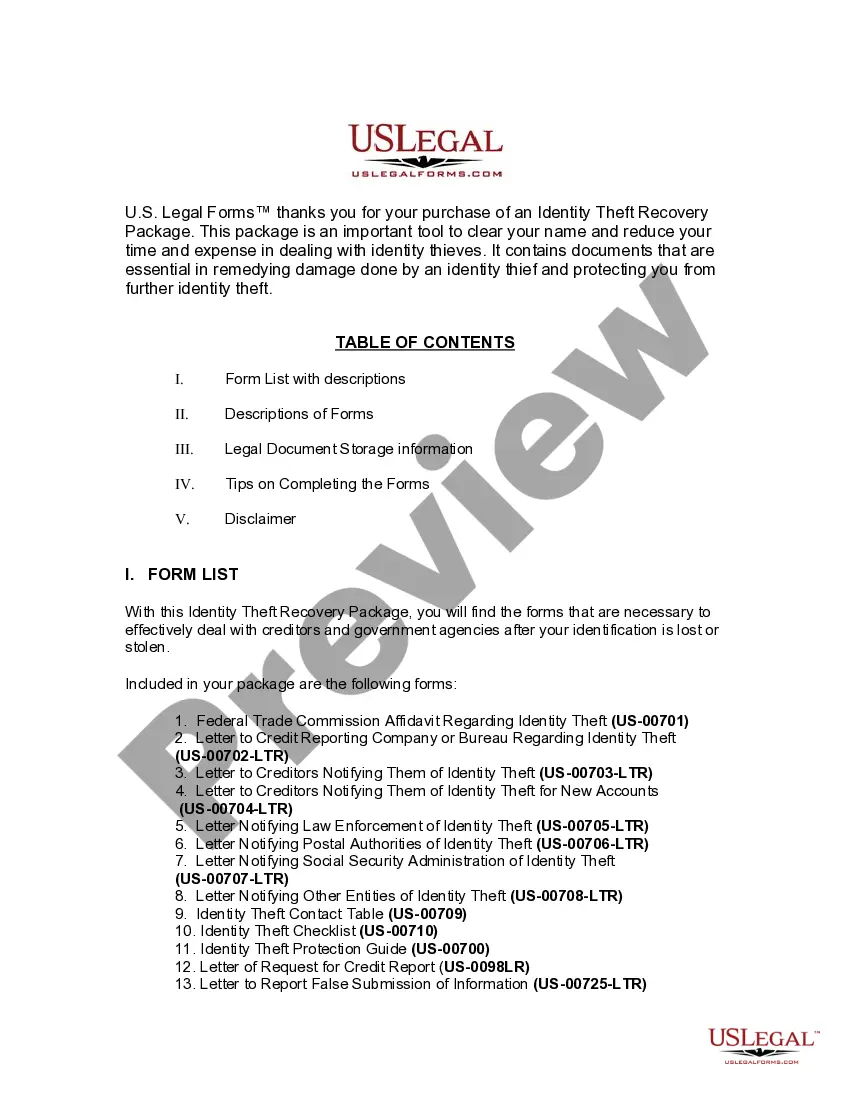
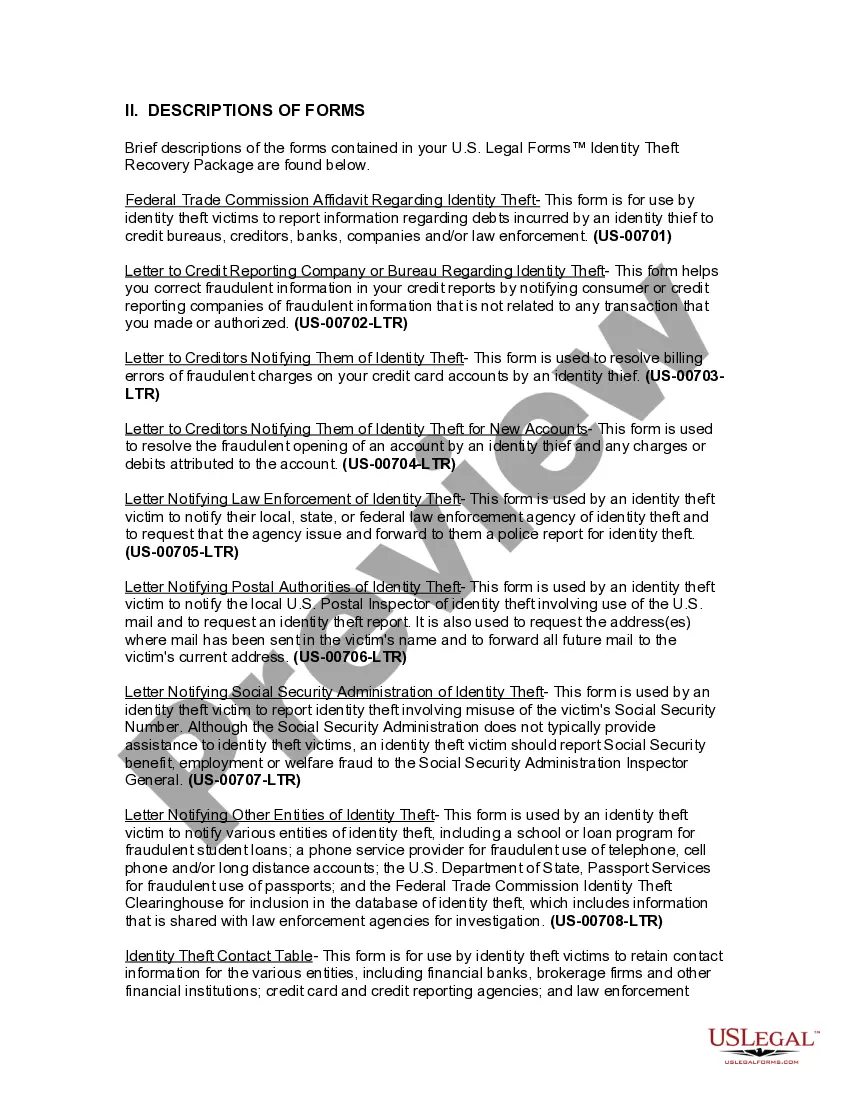
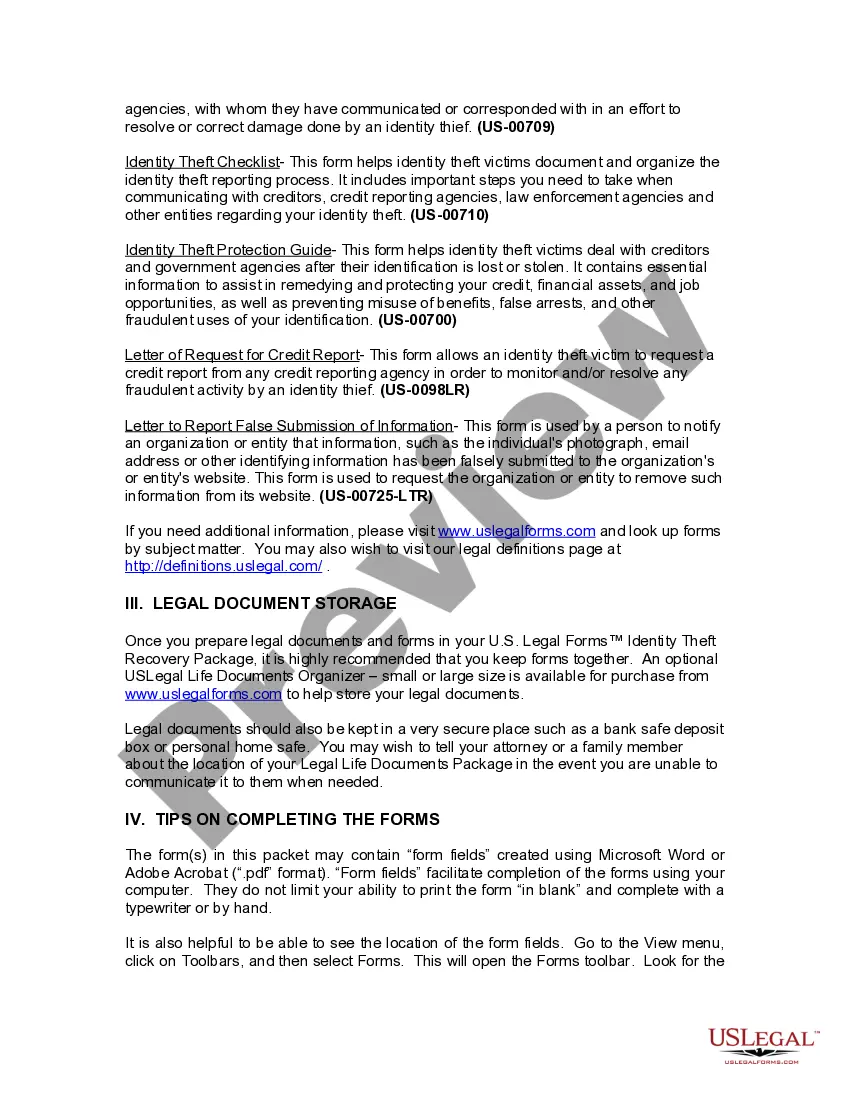
How to fill out Ohio Identity Theft Recovery Package?
Identifying a reliable source to obtain the most up-to-date and pertinent legal templates is a significant part of dealing with administrative processes.
Acquiring the correct legal documentation requires accuracy and meticulousness, which is why it is essential to take examples of Ohio Theft Laws solely from trusted providers, such as US Legal Forms. An incorrect template can squander your time and prolong the issue you are facing.
Eliminate the inconvenience associated with your legal documents. Explore the comprehensive US Legal Forms library where you can find legal templates, assess their applicability to your situation, and download them instantly.
- Use the library navigation or search bar to find your sample.
- Review the form's description to determine if it meets the criteria of your state and locale.
- Access the form preview, if available, to ensure the form is the one you need.
- Return to the search to identify the appropriate template if the Ohio Theft Laws do not meet your requirements.
- If you are certain about the form's relevance, download it.
- If you are a registered user, click Log in to verify your identity and access your selected forms in My documents.
- If you lack an account, click Buy now to obtain the form.
- Choose the pricing plan that suits your needs.
- Proceed with registration to complete your purchase.
- Finish your purchase by selecting a payment method (credit card or PayPal).
- Select the file format for downloading Ohio Theft Laws.
- Once you have the form on your device, you can edit it using the editor or print it and complete it manually.
Form popularity
FAQ
Theft in Ohio is defined as knowingly obtaining or exerting control over someone else's property with the intent to deprive them of it. This includes stealing, shoplifting, or even understate property value during a transaction. Ohio theft laws encompass various scenarios, emphasizing the importance of understanding these definitions to safeguard yourself. If you need assistance navigating theft-related legal issues, our platform offers resources that can help clarify your rights and options.
In Ohio, theft becomes a felony when the value of the items stolen exceeds $1,000. Additionally, if the theft involves certain property types, like firearms or drugs, it may also be classified as a felony regardless of the value. Understanding these thresholds is crucial under Ohio theft laws, as they can significantly affect the penalties you might face. If you find yourself in a situation related to theft charges, consider consulting legal resources for guidance and support.
In Ohio, the value of the stolen property plays a vital role in determining the consequences under Ohio theft laws. If the value exceeds $1,000, it can lead to felony charges, potentially resulting in time in prison. For lesser amounts, such as those below $1,000, penalties might include jail time or fines. Understanding these thresholds is essential for anyone facing charges, and you can rely on platforms like Uslegalforms to guide you through your options.
To prove theft under Ohio theft laws, specific types of evidence are essential. This includes documentation like receipts, witness statements, or surveillance footage, which show the act of taking property without permission. Law enforcement may also look for any items that link a suspect to the crime. Gathering strong evidence is crucial, as it helps establish facts in legal proceedings.
The terms 'theft' and 'stealing' are often used interchangeably, but there is a subtle difference. Legally, theft is the formal term used in Ohio theft laws to describe the unlawful taking of property. Stealing can refer to the act itself, without the legal implications that theft carries, such as potential charges or consequences. Knowing this distinction can help you navigate legal discussions more effectively.
Ohio theft laws define theft as taking someone else's property with the intent to permanently deprive them of it. This includes actions like stealing, shoplifting, or even fraud. The penalties can vary based on the value of the property taken, with serious consequences for more valuable items. Understanding these laws is crucial, as they can significantly impact your future if you're accused of theft.
In order to commit theft under this law, a person must: With the purpose to deprive the owner of property or services; Knowingly obtain or exert control over either the property or services in any of the following ways: Without the consent of the owner; -or- Deception; -or- Threat; -or- Intimidation.
Penalties for Theft Offenses in Ohio 1st Degree Misdemeanor ? 6 month jail term and a $1000 fine. 5th Degree Felony ? 6 ? 12 month prison term and a $2500 fine. 4th Degree Felony ? 6 ? 18 prison term and a $5000 fine. 3rd Degree Felony ? 9 months ? 5 year prison term and a $10,000 fine.
Section 2913.02 | Theft. ... ever violates this section is guilty of theft. (2) Except as otherwise provided in this division or division (B)(3), (4), (5), (6), (7), (8), or (9) of this section, a violation of this section is misdemeanor theft, a misdemeanor of the first degree.