Quit Claim Deed Form For Texas
Description


Get your form ready online
Our built-in tools help you complete, sign, share, and store your documents in one place.
Make edits, fill in missing information, and update formatting in US Legal Forms—just like you would in MS Word.
Download a copy, print it, send it by email, or mail it via USPS—whatever works best for your next step.
Sign and collect signatures with our SignNow integration. Send to multiple recipients, set reminders, and more. Go Premium to unlock E-Sign.
If this form requires notarization, complete it online through a secure video call—no need to meet a notary in person or wait for an appointment.
We protect your documents and personal data by following strict security and privacy standards.

Make edits, fill in missing information, and update formatting in US Legal Forms—just like you would in MS Word.

Download a copy, print it, send it by email, or mail it via USPS—whatever works best for your next step.

Sign and collect signatures with our SignNow integration. Send to multiple recipients, set reminders, and more. Go Premium to unlock E-Sign.

If this form requires notarization, complete it online through a secure video call—no need to meet a notary in person or wait for an appointment.

We protect your documents and personal data by following strict security and privacy standards.
Looking for another form?





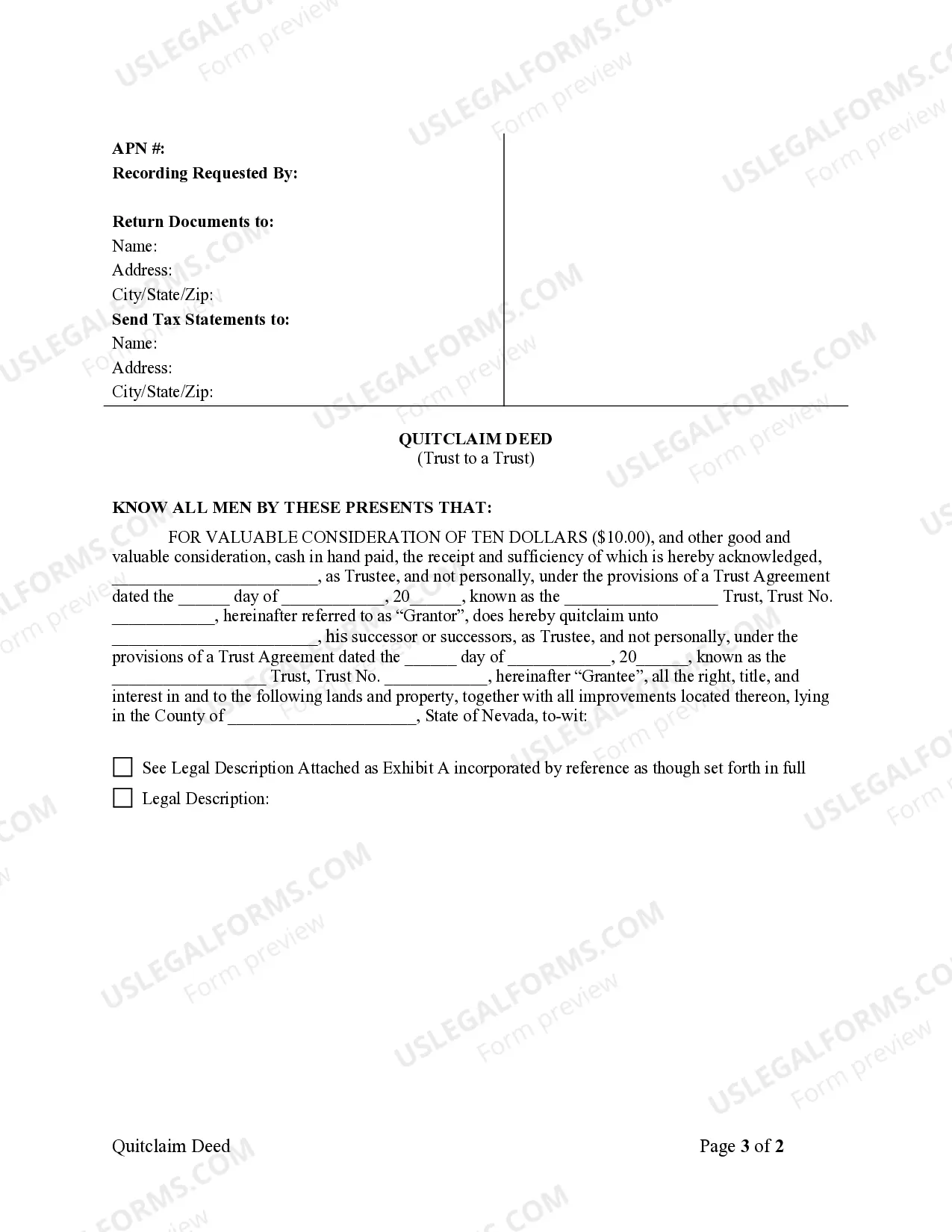
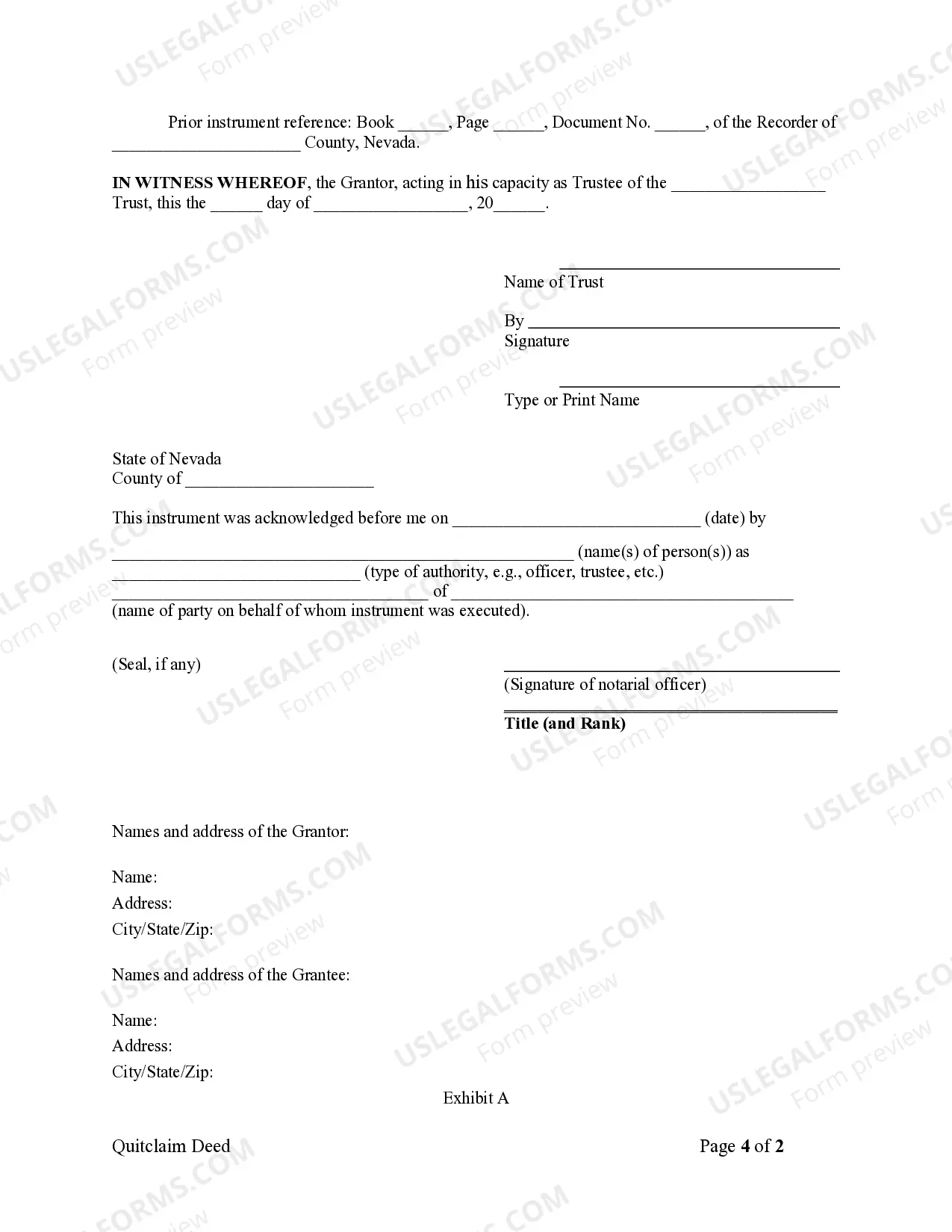
How to fill out Nevada Quitclaim Deed - Trust To A Trust?
- Start by visiting the US Legal Forms website. If you already have an account, simply log in to your profile and check your subscription status.
- For new users, browse the extensive library of over 85,000 legal forms. Look for the quit claim deed form and read through the preview and description to ensure it meets your specific needs.
- If the form is not suitable, utilize the Search feature to find other relevant templates that comply with local regulations.
- Once you've chosen the correct document, click on the Buy Now button to select from available subscription plans. You will need to create an account to access the forms.
- Complete your purchase by entering your payment information via credit card or PayPal.
- After the payment is processed, download your quit claim deed form to your device for immediate use. You can also find this document later in the My Forms section of your account.
In conclusion, obtaining a quit claim deed form for Texas is simple and efficient with US Legal Forms. This service not only provides a vast collection of forms but also guarantees support from premium experts if you need assistance.
Ready to get started? Visit US Legal Forms today and take advantage of their comprehensive legal resources!
Form popularity
FAQ
While many notaries can notarize a quit claim deed, it is crucial to select one authorized in Texas. The notary must ensure that all signers are present and verify their identities. Using a qualified notary helps in safeguarding the legitimacy of the quit claim deed form for Texas. If you need assistance on finding a notary or completing the form, consider reaching out to US Legal Forms for guidance.
The laws governing quit claim deeds in Texas emphasize the necessity for clear intent and proper execution. According to Texas Property Code, the quit claim deed form for Texas should clearly identify the parties involved, describe the property, and be notarized. It’s essential to follow these legal requirements to uphold the validity of the deed. Understanding these laws can help you navigate property transfers smoothly.
A quit claim deed form for Texas can be deemed invalid for several reasons. Common issues include a lack of notarization, missing signatures, or improper completion of the form. Additionally, if the property in question has liens or encumbrances not disclosed, the deed may also face challenges. Ensuring all details are accurate can prevent complications.
In Texas, a quit claim deed form for Texas must be notarized to be valid. This step ensures that the identities of the parties involved are properly verified. After signing, the notarized document should be filed with the county clerk to establish public record. This process helps protect both parties in the transaction.
To obtain a quit claim deed in Texas, you can either draft the document yourself or seek assistance from a legal professional. It’s vital to include specific information such as the property description and the names of both parties. You can find a reliable quit claim deed form for Texas on legal document platforms like USLegalForms, ensuring you have a properly formatted and legally binding document.
A quitclaim deed is commonly used to transfer property ownership without warranties. This means that the person granting the deed does not guarantee clear title to the property. Many people use a quit claim deed form for Texas when transferring property between family members or in divorce settlements. It's a straightforward way to clarify ownership without extensive legal processes.
To file a quit claim deed in Texas, obtain a quit claim deed form for Texas from a reputable source, like US Legal Forms. Fill out the form accurately, then sign it in front of a notary public. Once notarized, file the completed deed with your county's clerk office to formalize the transfer. This process ensures your property records reflect the change of ownership correctly.
Yes, Texas does recognize quit claim deeds, and they are often used to transfer property ownership quickly. However, it is important to understand that a quit claim deed form for Texas offers no warranties or guarantees regarding the property title. Therefore, anyone considering this method should carefully assess their situation and possibly seek legal advice to ensure a smooth transfer. US Legal Forms provides various templates to streamline this process.
While a quit claim deed form for Texas can simplify property transfers, it has some disadvantages. One key concern is that it does not guarantee the quality of the title; if there are existing liens or issues, the grantee may inherit those problems. Additionally, using a quit claim deed can lead to misunderstandings among family members or parties involved, as it transfers ownership without warranties. Therefore, it's crucial to consider your options carefully.
Yes, when using a quit claim deed form for Texas, it must be notarized to be considered valid. Notarization provides an extra layer of protection for both the grantor and the grantee. Although the actual transfer of ownership happens when the deed is signed, having it notarized ensures that the document meets the legal requirements for recording. This can help prevent any future disputes regarding the property.