Declaratory Judgment Court For Trust
Description

Get your form ready online
Our built-in tools help you complete, sign, share, and store your documents in one place.
Make edits, fill in missing information, and update formatting in US Legal Forms—just like you would in MS Word.
Download a copy, print it, send it by email, or mail it via USPS—whatever works best for your next step.
Sign and collect signatures with our SignNow integration. Send to multiple recipients, set reminders, and more. Go Premium to unlock E-Sign.
If this form requires notarization, complete it online through a secure video call—no need to meet a notary in person or wait for an appointment.
We protect your documents and personal data by following strict security and privacy standards.

Make edits, fill in missing information, and update formatting in US Legal Forms—just like you would in MS Word.

Download a copy, print it, send it by email, or mail it via USPS—whatever works best for your next step.

Sign and collect signatures with our SignNow integration. Send to multiple recipients, set reminders, and more. Go Premium to unlock E-Sign.

If this form requires notarization, complete it online through a secure video call—no need to meet a notary in person or wait for an appointment.

We protect your documents and personal data by following strict security and privacy standards.
Looking for another form?


How to fill out Missouri Declaratory Judgment Through The Circuit Court Ordering The Department Of Revenue To Issue A Certificate Of Title To Complainant?
Creating legal documents from the ground up can frequently be somewhat daunting.
Certain cases may require extensive research and substantial financial investment.
If you’re in search of a simpler and more economical means of drafting a Declaratory Judgment Court For Trust or any other documents without dealing with unnecessary complications, US Legal Forms is always readily available.
Our online repository of over 85,000 current legal forms covers nearly every aspect of your financial, legal, and personal affairs.
- With a mere few clicks, you can immediately access templates that are compliant with state and county regulations, meticulously prepared by our legal experts.
- Utilize our service whenever you need a dependable and trustworthy resource to effortlessly locate and download the Declaratory Judgment Court For Trust.
- If you're an existing user of our site and have set up an account previously, just Log In, find the template, and download or re-download it anytime from the My documents tab.
- Not yet registered? No worries. Establishing an account is quick and easy, allowing you to browse our catalog.
Form popularity
FAQ
Yes, a declaratory judgment is generally binding on the parties involved. Once rendered, it carries legal weight and sets a precedent for how similar disputes may be handled in the future. This binding nature provides reassurance to those navigating trust issues, ensuring they have a definitive resolution to rely on.
To obtain a declaratory judgment, a party must demonstrate an actual controversy concerning rights or legal status. Importantly, the issue must be ripe for judicial determination, not speculative. If you're considering this avenue, consult a declaratory judgment court for trust to analyze your specific situation and meet these critical requirements.
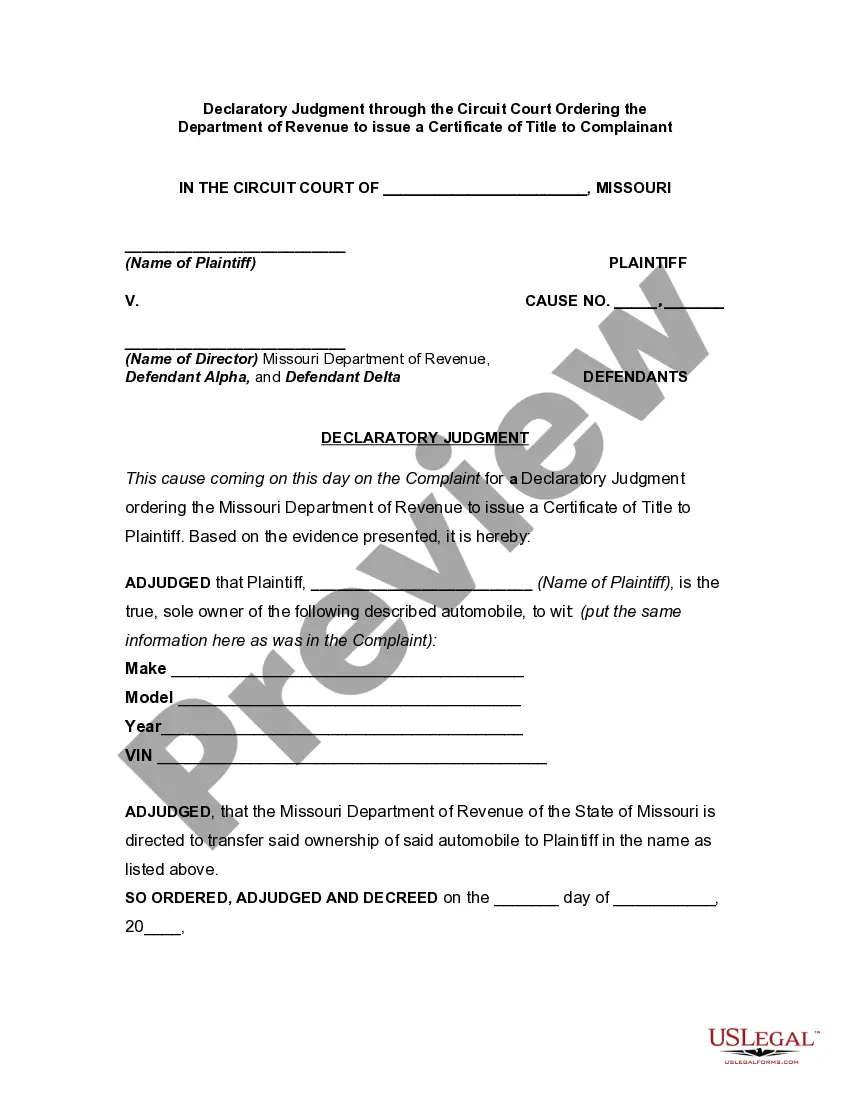
A declaratory judgment action is a legal procedure where a court determines the rights and obligations of parties involved in a dispute, without providing any financial damages or enforcement orders. In the context of a declaratory judgment court for trust, this action clarifies the validity of trust documents or the powers of trustees, ensuring that all parties understand their roles. This type of judgment helps prevent potential conflicts before they escalate into more significant legal battles.
For example, a policyholder believes that their denied claim is unjust. As a result, they inform the insurer that they are considering a lawsuit to recover losses. The insurer seeks a declaratory judgment to clarify its rights and obligations with hopes of preventing the lawsuit.
A declaratory judgment is typically requested when a party is threatened with a lawsuit but the lawsuit has not yet been filed; or when a party or parties believe that their rights under law and/or contract might conflict; or as part of a counterclaim to prevent further lawsuits from the same plaintiff (for example, ...
A declaratory judgment is a binding judgment from a court defining the legal relationship between parties and their rights in a matter before the court. When there is uncertainty as to the legal obligations or rights between two parties, a declaratory judgment offers an immediate means to resolve this uncertainty.
A declaratory judgment is typically requested when a party is threatened with a lawsuit but the lawsuit has not yet been filed; or when a party or parties believe that their rights under law and/or contract might conflict; or as part of a counterclaim to prevent further lawsuits from the same plaintiff (for example, ...
The declaratory judgment plaintiffhas the burden of proving an actual controversy exists. 12 However, it is the declaratory judgment defendant who has the burden of proving patent infringement exists. That is, the burden of proving patent infringement is on the patentee, regardless of who brings the lawsuit.