Transfer On Death Deed For Vehicles
Description

Get your form ready online
Our built-in tools help you complete, sign, share, and store your documents in one place.
Make edits, fill in missing information, and update formatting in US Legal Forms—just like you would in MS Word.
Download a copy, print it, send it by email, or mail it via USPS—whatever works best for your next step.
Sign and collect signatures with our SignNow integration. Send to multiple recipients, set reminders, and more. Go Premium to unlock E-Sign.
If this form requires notarization, complete it online through a secure video call—no need to meet a notary in person or wait for an appointment.
We protect your documents and personal data by following strict security and privacy standards.

Make edits, fill in missing information, and update formatting in US Legal Forms—just like you would in MS Word.

Download a copy, print it, send it by email, or mail it via USPS—whatever works best for your next step.

Sign and collect signatures with our SignNow integration. Send to multiple recipients, set reminders, and more. Go Premium to unlock E-Sign.

If this form requires notarization, complete it online through a secure video call—no need to meet a notary in person or wait for an appointment.

We protect your documents and personal data by following strict security and privacy standards.
Looking for another form?










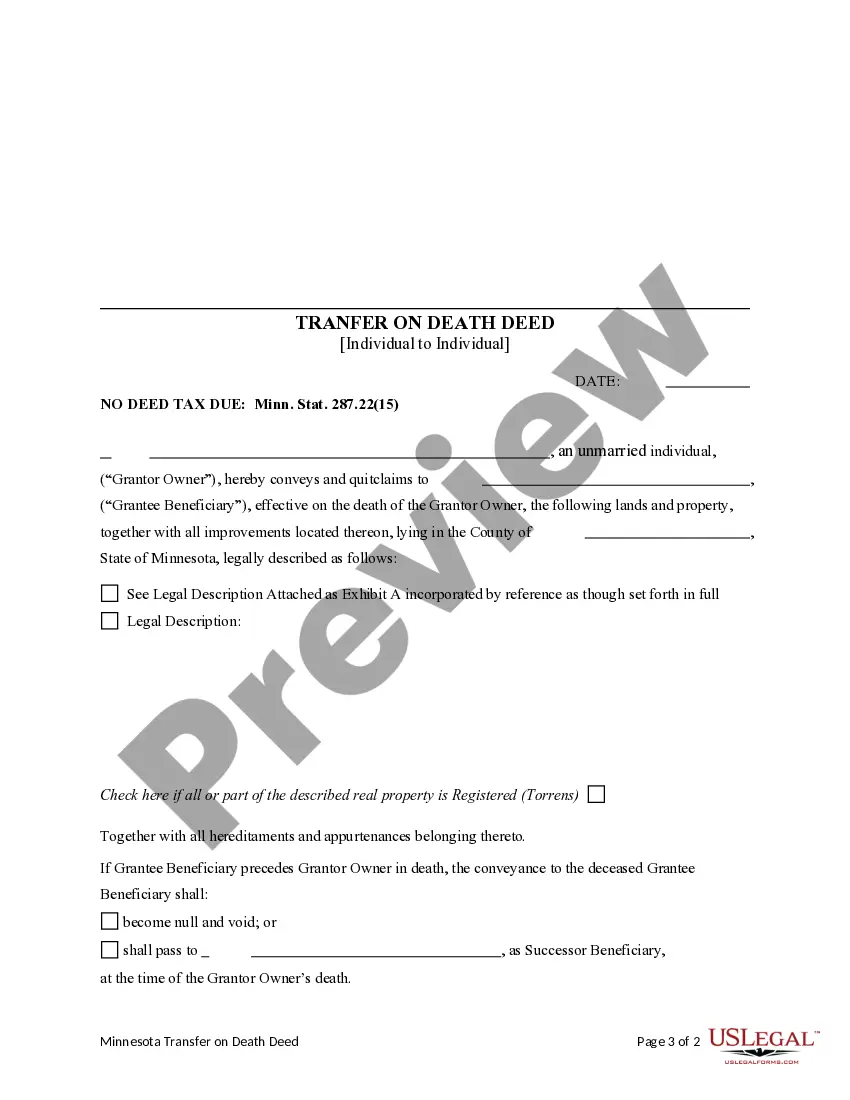
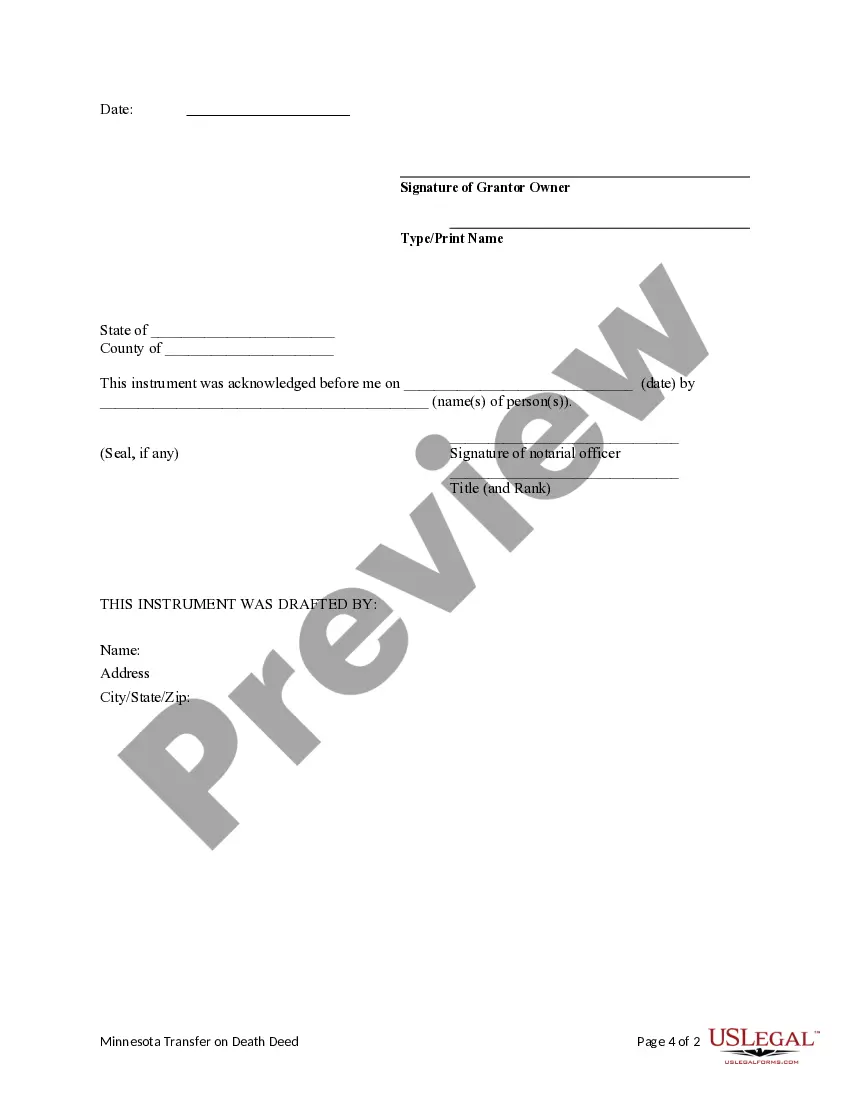
How to fill out Minnesota Transfer On Death Deed - Individual To Individual?
- If you're an existing user, log in to access your account and download the necessary template by clicking the Download button. Make sure your subscription is up to date, and renew it if necessary.
- For new users, start by checking the Preview mode and form description. Ensure that you've selected the correct template that aligns with your local legal requirements.
- If adjustments are needed, utilize the Search tab above to locate the appropriate template. Once you find a match, proceed to the next step.
- Purchase the document by clicking on the Buy Now button, selecting your preferred subscription plan, and registering an account for access to the full library.
- Complete your transaction by entering your payment information or using your PayPal account to finalize the purchase.
- Download your form and save it directly to your device, giving you access anytime through the My Forms section of your profile.
In conclusion, US Legal Forms offers a robust collection of over 85,000 easy-to-edit legal documents, making it the ideal solution for ensuring your transfer on death deed for vehicles is executed flawlessly.
Don’t wait—visit US Legal Forms today to secure your legal documents and empower your estate planning process.
Form popularity
FAQ
The disadvantages of a transfer on death deed for vehicles include potential disputes among beneficiaries and the fact that it does not protect the vehicle from creditors. Additionally, if the vehicle's beneficiary predeceases you, the transfer may become complicated. While this deed provides benefits, it's essential to weigh these factors carefully. Using platforms like uslegalforms can ease the process and ensure everything is in order.
A transfer on death deed for vehicles generally does not avoid inheritance tax, as the asset is still considered part of your estate at your death. However, some states may have exemptions or specific rules regarding inheritance tax. It's important to check with your state laws and possibly consult a tax professional for clarity on how inheritance tax may apply to your overall estate plan.
Currently, several states in the US recognize the transfer on death deed for vehicles, including Texas, California, and Michigan. Each state has specific regulations and requirements for this type of deed. It's wise to check the local laws governing your state, as this can influence how effectively you'll be able to transfer your vehicle upon death. Consulting resources like uslegalforms can be beneficial for navigating these complexities.
Choosing between a transfer on death deed for vehicles and a beneficiary designation often depends on your specific situation. A transfer on death deed provides a seamless transfer of ownership without going through probate, while a beneficiary designation might not apply to all assets. Consider your estate planning goals and consult a legal expert to determine the best choice for your needs.
Transfer on death accounts may face challenges, including potential disputes among heirs or beneficiaries. If not executed properly, a transfer on death deed for vehicles might lead to confusion concerning ownership. Furthermore, financial institutions might have different policies in place regarding these accounts. It's crucial to ensure accurate documentation to avoid issues.
In Texas, a transfer on death deed for vehicles allows you to designate a beneficiary who will receive your vehicle upon your death. It must be signed and notarized, then recorded with the county clerk. Importantly, the deed must specifically mention the vehicle and the beneficiary. Additionally, you can revoke or change this deed during your lifetime, providing flexibility.
When a parent dies, the car typically goes to the heirs specified in their will or, if there is no will, according to state probate laws. This process may require a legal title transfer to complete. Planning ahead with a transfer on death deed for vehicles can make this process easier for everyone involved.
When someone dies, their car generally becomes part of their estate. The car cannot be sold or transferred until the legal ownership is established or the estate is settled. Using a transfer on death deed for vehicles can prevent confusion and help ensure the vehicle goes to the right beneficiaries.
When your mother passes away, ownership of her car will typically be managed through her estate. If the car is not part of a legal transfer process, you may encounter challenges in title transfer. Securing a transfer on death deed for vehicles can ease this burden and clarify ownership.
You can drive your deceased mom's car under certain conditions. First, you may need to provide proof of ownership before using the vehicle. It is often recommended to complete the transfer of the title, especially if you are planning to keep the car long-term. Utilizing a transfer on death deed for vehicles can facilitate this process.