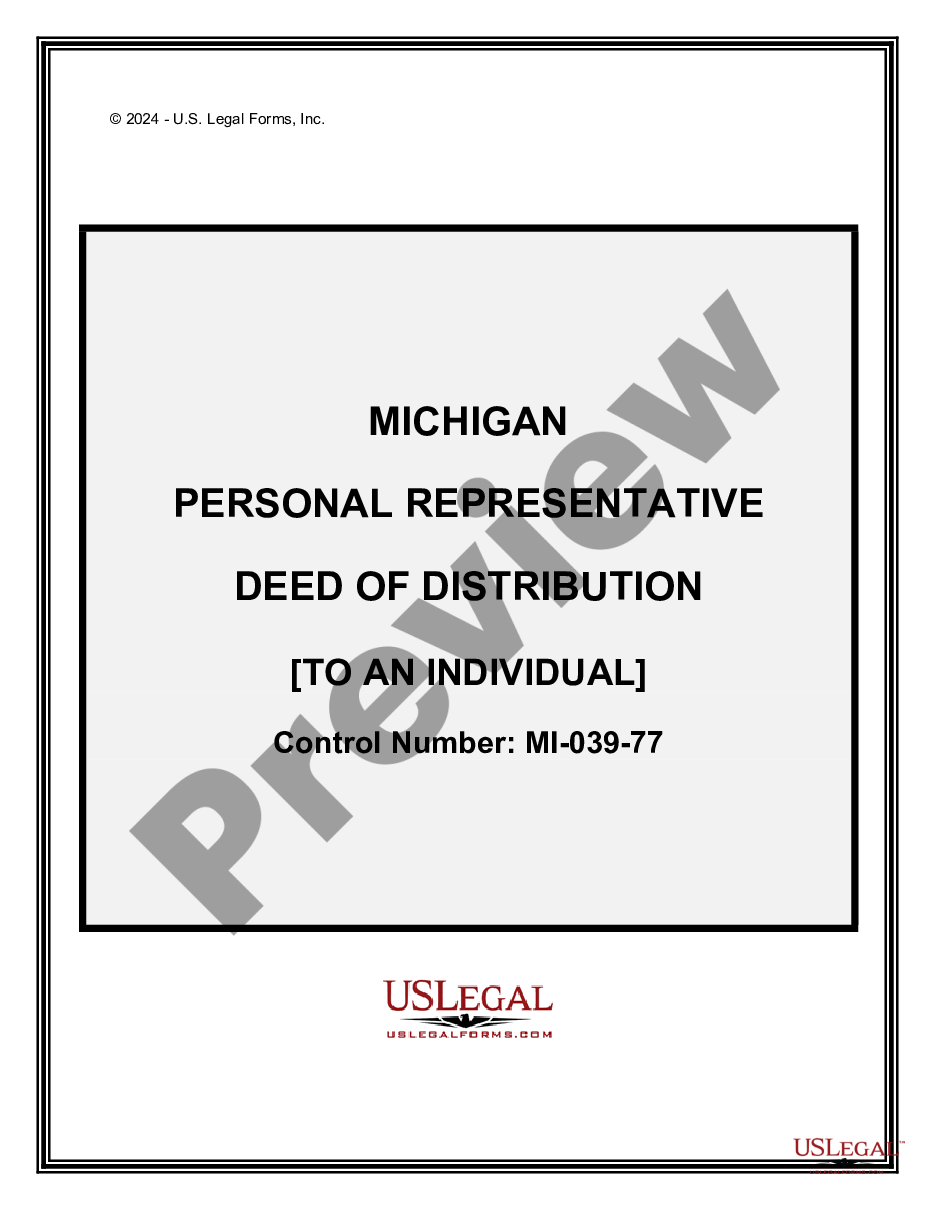
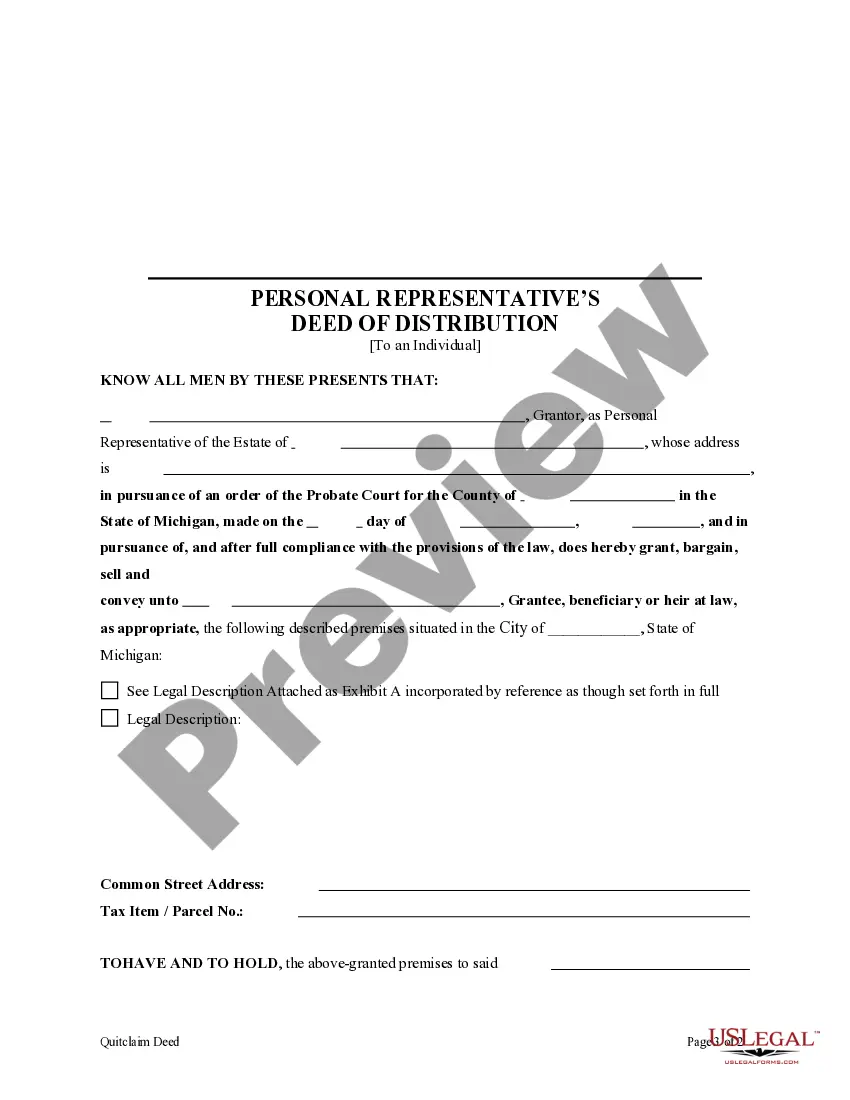
Michigan Personal Representative Deed Without Warranty
Description


Get your form ready online
Our built-in tools help you complete, sign, share, and store your documents in one place.
Make edits, fill in missing information, and update formatting in US Legal Forms—just like you would in MS Word.
Download a copy, print it, send it by email, or mail it via USPS—whatever works best for your next step.
Sign and collect signatures with our SignNow integration. Send to multiple recipients, set reminders, and more. Go Premium to unlock E-Sign.
If this form requires notarization, complete it online through a secure video call—no need to meet a notary in person or wait for an appointment.
We protect your documents and personal data by following strict security and privacy standards.

Make edits, fill in missing information, and update formatting in US Legal Forms—just like you would in MS Word.

Download a copy, print it, send it by email, or mail it via USPS—whatever works best for your next step.

Sign and collect signatures with our SignNow integration. Send to multiple recipients, set reminders, and more. Go Premium to unlock E-Sign.

If this form requires notarization, complete it online through a secure video call—no need to meet a notary in person or wait for an appointment.

We protect your documents and personal data by following strict security and privacy standards.
Looking for another form?

How to fill out Michigan Personal Representative's Deed Of Distribution To An Individual?
Legal documentation administration can be daunting, even for the most adept professionals.
When searching for a Michigan Personal Representative Deed Without Warranty and lacking the time to find the correct and current version, the process can be stressful.
US Legal Forms addresses any needs you might have, ranging from personal to business documentation, all in one place.
Utilize advanced tools to fill out and manage your Michigan Personal Representative Deed Without Warranty.
Here are the steps to follow after accessing the form you require: Confirm it is the correct form by previewing it and reviewing its details. Ensure that the template is accepted in your state or county. Click Buy Now when you are ready. Select a subscription plan. Choose the file format you need, and Download, complete, sign, print, and send your documents. Leverage the US Legal Forms online repository, supported by 25 years of experience and reliability. Transform your daily document management into a seamless and user-friendly process today.
- Access a resource hub of articles, guides, and materials pertinent to your situation and needs.
- Conserve time and effort searching for the documents you require, and use US Legal Forms’ sophisticated search and Review feature to locate the Michigan Personal Representative Deed Without Warranty and obtain it.
- If you hold a monthly subscription, Log In to your US Legal Forms account, search for the form, and retrieve it.
- Check the My documents tab to view the documents you have downloaded previously and to manage your files as you see fit.
- If it’s your first experience with US Legal Forms, create an account and gain unlimited access to all the platform's advantages.
- A robust online form repository could be transformative for anyone aiming to handle these matters effectively.
- US Legal Forms stands as a prominent provider in digital legal documents, offering over 85,000 state-specific legal forms accessible at any time.
- With US Legal Forms, you have the ability to access state- or county-specific legal and business documents.
Form popularity
FAQ
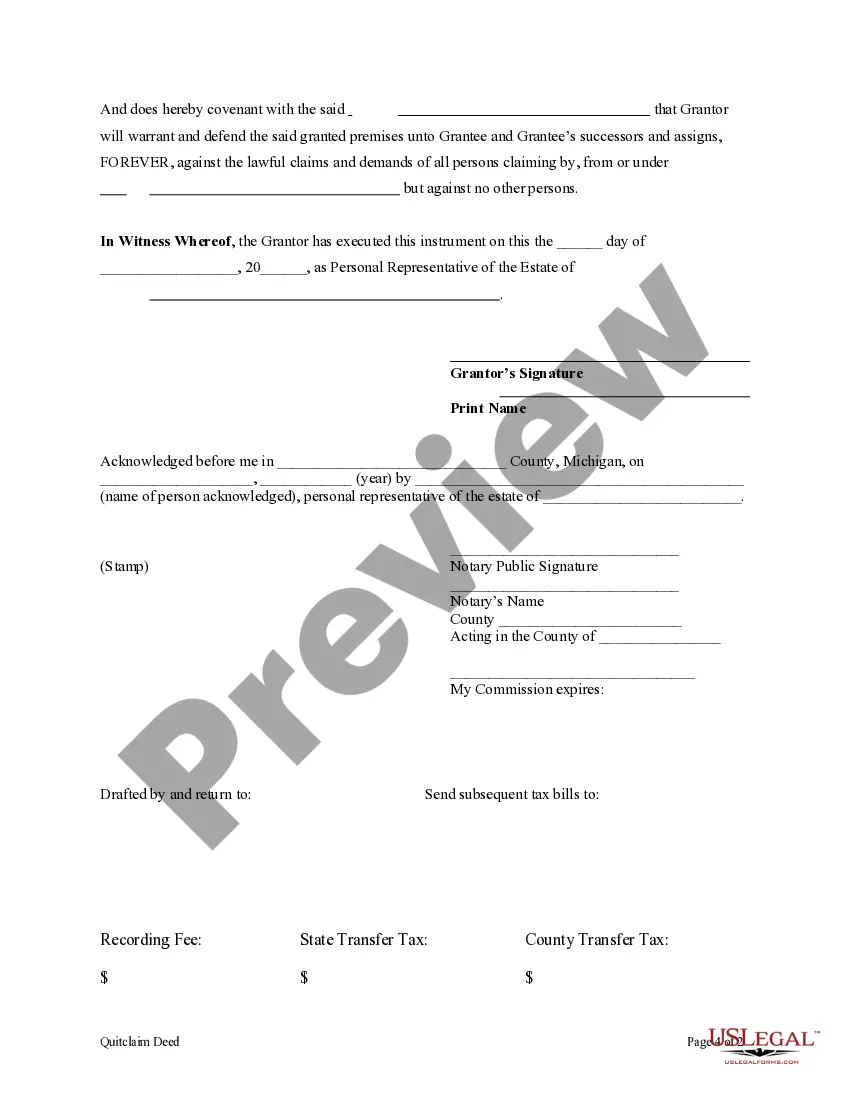
In Michigan, a deed must be signed by the grantor, notarized, and recorded to the Register of Deeds for the property transfer to be considered valid and effective.
RECORDING REQUIREMENTS Documents must have all original signatures and the names must be printed, stamped, or typed beneath the signatures. Documents executed in Michigan which convey or encumber real estate require a notary's acknowledgment.
Selling Property Without Court Authority In Michigan, the probate court will either grant an estate representative the right to sell property during the probate proceeding or they won't. Without the court's authority, the property cannot transfer.
PR's fiduciary duties include undivided loyalty, impartiality, care and prudence and segregation of assets. PR may not disclose facts or knowledge about estate property or heirs, devisees, and beneficiaries unless required by law or with consent of affected persons.
How to Create a Michigan Warranty Deed Form The parties' names; An accurate legal description of the property; A statement of consideration; and. The co-ownership form the new owners will use to hold title (if there are multiple new owners).