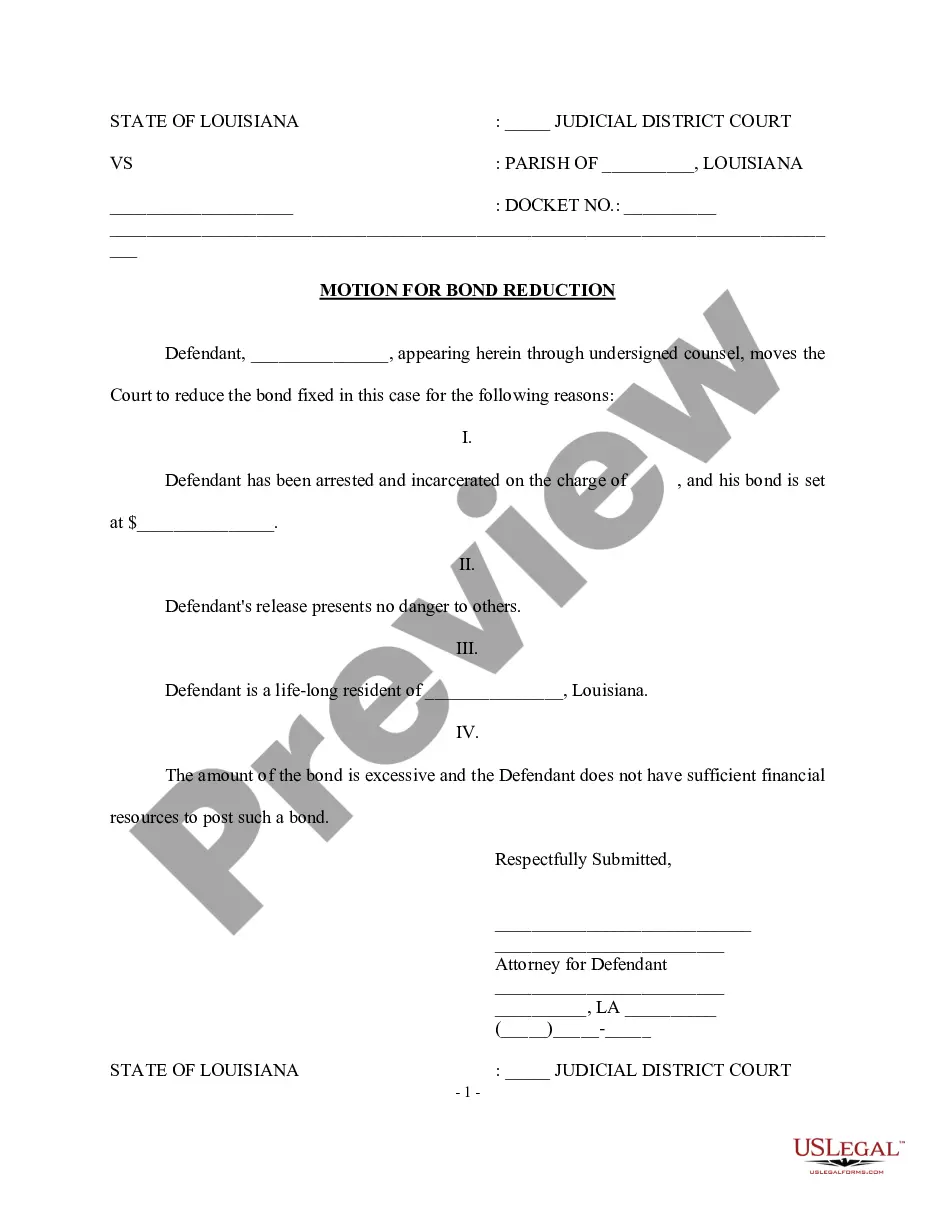
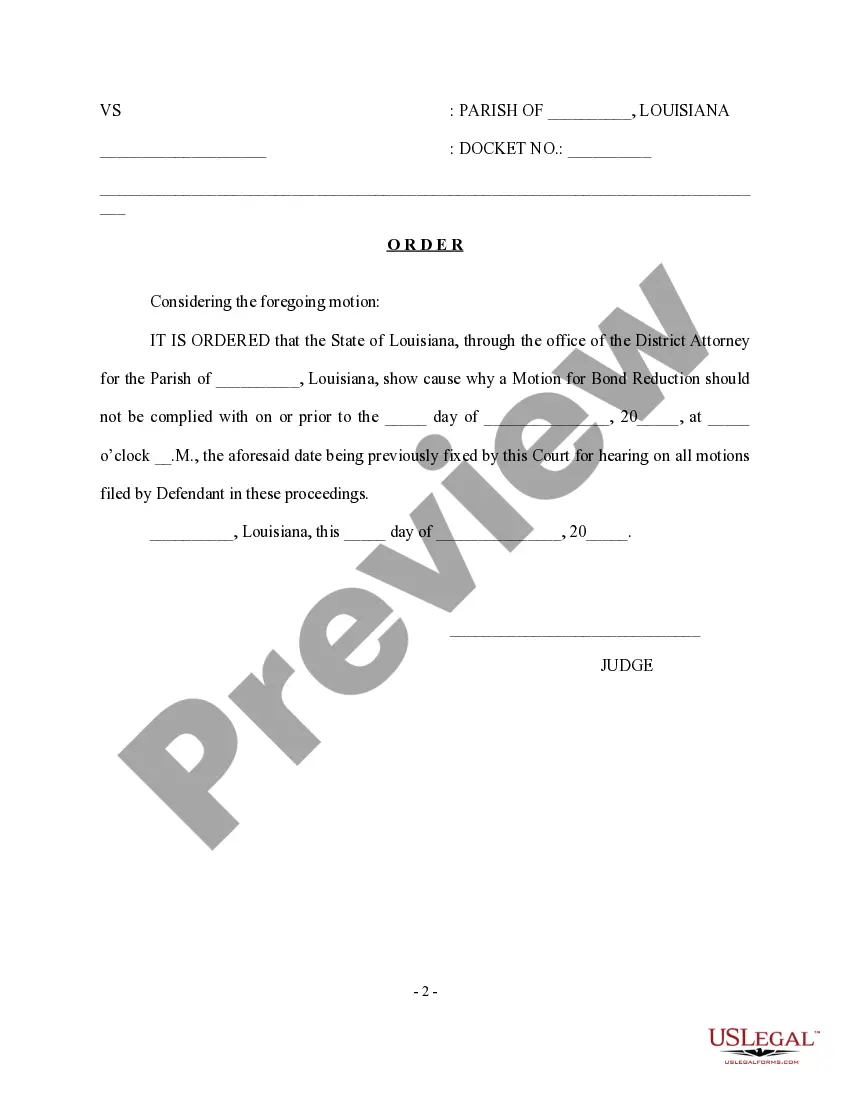
Motion For Bond Reduction With Sodium Borohydride
Description
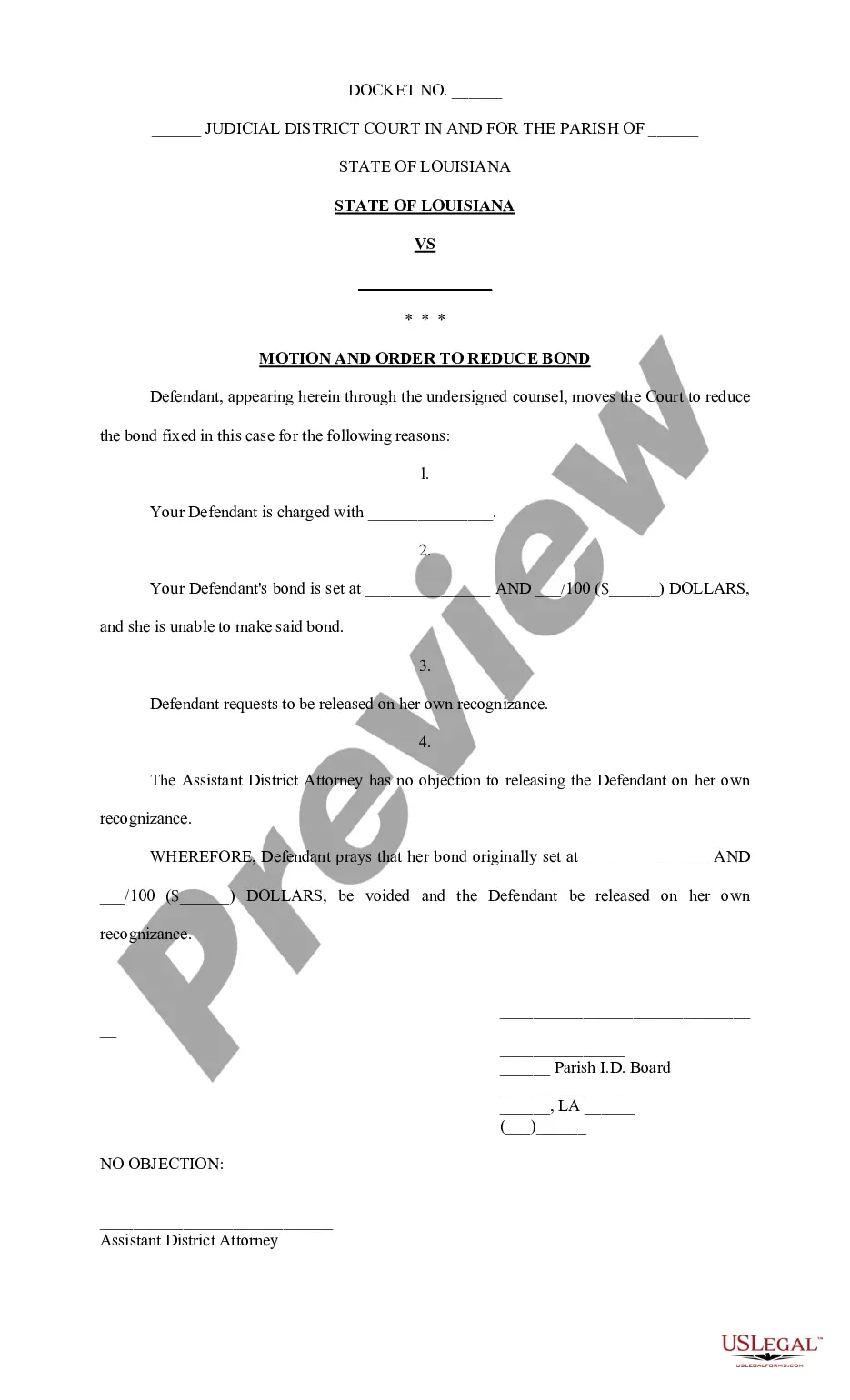
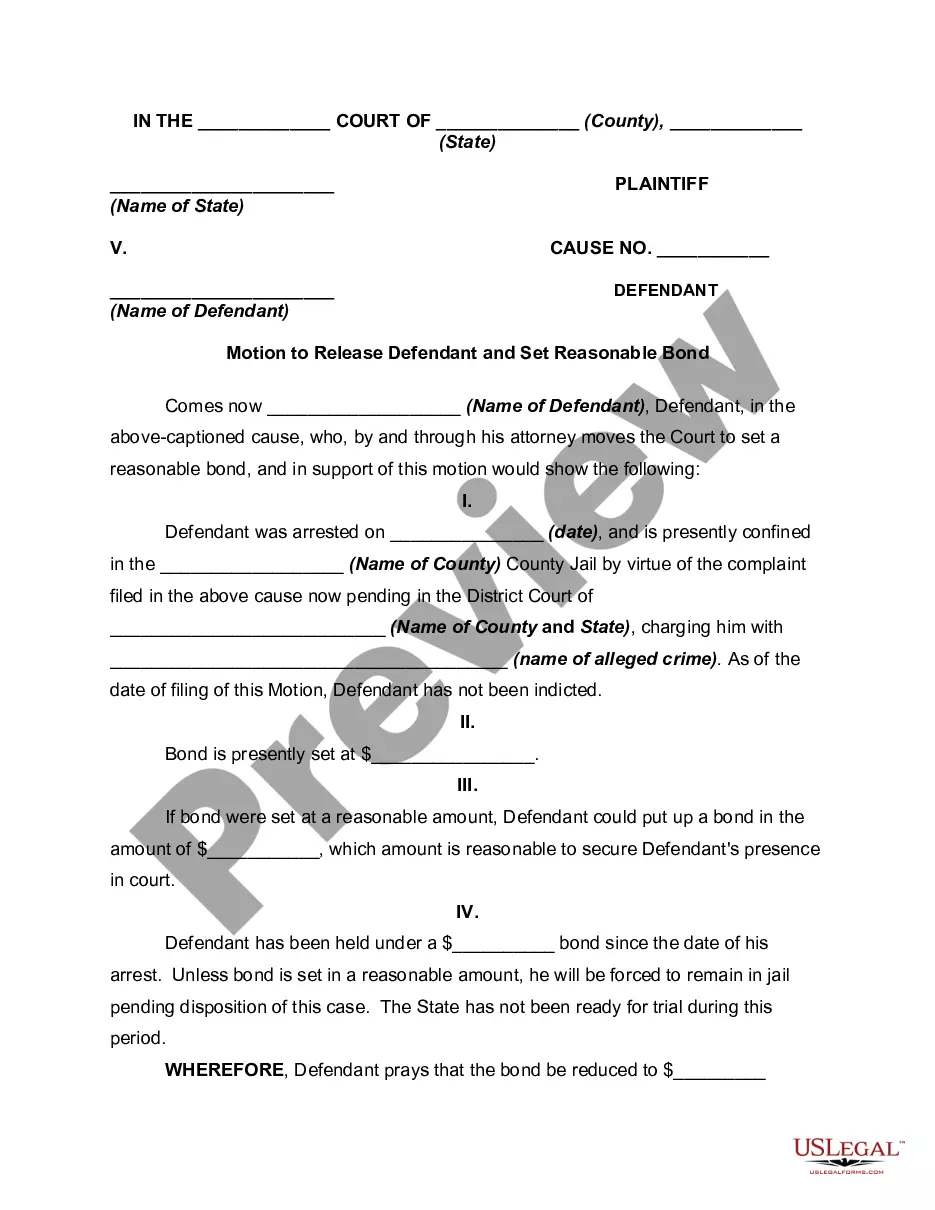
Get your form ready online
Our built-in tools help you complete, sign, share, and store your documents in one place.
Make edits, fill in missing information, and update formatting in US Legal Forms—just like you would in MS Word.
Download a copy, print it, send it by email, or mail it via USPS—whatever works best for your next step.
Sign and collect signatures with our SignNow integration. Send to multiple recipients, set reminders, and more. Go Premium to unlock E-Sign.
If this form requires notarization, complete it online through a secure video call—no need to meet a notary in person or wait for an appointment.
We protect your documents and personal data by following strict security and privacy standards.

Make edits, fill in missing information, and update formatting in US Legal Forms—just like you would in MS Word.

Download a copy, print it, send it by email, or mail it via USPS—whatever works best for your next step.

Sign and collect signatures with our SignNow integration. Send to multiple recipients, set reminders, and more. Go Premium to unlock E-Sign.

If this form requires notarization, complete it online through a secure video call—no need to meet a notary in person or wait for an appointment.

We protect your documents and personal data by following strict security and privacy standards.
Looking for another form?









How to fill out Louisiana Motion For Bond Reduction And Order?
It’s clear that you cannot become a legal expert instantly, nor can you comprehend how to swiftly create a Motion For Bond Reduction With Sodium Borohydride without possessing a specialized skill set.
Drafting legal documents is an extensive journey that necessitates specific training and expertise.
So why not entrust the preparation of the Motion For Bond Reduction With Sodium Borohydride to the professionals.
You can revisit your documents from the My documents tab at any time.
If you are an existing customer, you can easily Log In and find and download the template from the same tab.
- Find the document you require using the search bar positioned at the top of the webpage.
- Examine it (if this option is available) and review the accompanying description to ascertain whether Motion For Bond Reduction With Sodium Borohydride is what you’re seeking.
- If you need a different document, restart your search.
- Sign up for a free account and select a subscription plan to purchase the document.
- Click Buy now. After completing the payment, you can download the Motion For Bond Reduction With Sodium Borohydride, fill it out, print it, and send it or post it to the appropriate individuals or organizations.
Form popularity
FAQ
For reducing double bonds effectively, agents such as lithium aluminum hydride or hydrogen with a catalyst are often preferred. In contrast to sodium borohydride, these alternatives efficiently convert alkenes and alkynes to their corresponding saturated compounds. When forming a motion for bond reduction with sodium borohydride, it's essential to recognize that other reducing agents may suit your needs better for specific reactions. Understanding these options can greatly influence your success in organic chemistry.
Using method of the present invention is: after the reduction reaction of sodium borohydride terminates, under normal temperature, stir, this cancellation system is slowly added drop-wise in reaction mixture until the pH=7 of reaction solution, after being spin-dried for reaction solvent (such as methyl alcohol, ...
Sodium borohydride is a relatively selective reducing agent. Ethanolic solutions of sodium borohydride reduce aldehydes and ketones in the presence of epoxides, esters, lactones, acids, nitriles, or nitro groups. Reduction of aldehydes is straightforward.
The Bayer Process is a one-pot synthesis combining borax, metallic sodium, and hydrogen in the presence of silica to produce sodium borohydride. Na2B4O7 + 16 Na + 8 H2 + 7 SiO2 ? 4 NaBH4 + 7 Na2SiO3 (2a) 4 Page 7 DOE Cooperative Agreement DE-FC36-04GO14008 The reaction takes place at about 700 °C.
NaBH4 is usually used in hydroxylic solvents such as MeOH, EtOH, and H2O. Sometimes THF is used as a solvent, either alone or as a solvent mixture (ex. THF/MeOH or THF/EtOH). In MeOH and EtOH, NaBH4 decomposes over time to give the respective borates.
Sodium borohydride (NaBH4) was synthesized by reacting sodium metaborate (NaBO2) with magnesium hydride (MgH2) or magnesium silicide (Mg2Si) by annealing at 350-750° under a high H2 pressure of 0.1-7 MPa for 2-4 h.