Secured Overnight Financing Rate (sofr)
Description

Get your form ready online
Our built-in tools help you complete, sign, share, and store your documents in one place.
Make edits, fill in missing information, and update formatting in US Legal Forms—just like you would in MS Word.
Download a copy, print it, send it by email, or mail it via USPS—whatever works best for your next step.
Sign and collect signatures with our SignNow integration. Send to multiple recipients, set reminders, and more. Go Premium to unlock E-Sign.
If this form requires notarization, complete it online through a secure video call—no need to meet a notary in person or wait for an appointment.
We protect your documents and personal data by following strict security and privacy standards.

Make edits, fill in missing information, and update formatting in US Legal Forms—just like you would in MS Word.

Download a copy, print it, send it by email, or mail it via USPS—whatever works best for your next step.

Sign and collect signatures with our SignNow integration. Send to multiple recipients, set reminders, and more. Go Premium to unlock E-Sign.

If this form requires notarization, complete it online through a secure video call—no need to meet a notary in person or wait for an appointment.

We protect your documents and personal data by following strict security and privacy standards.
Looking for another form?








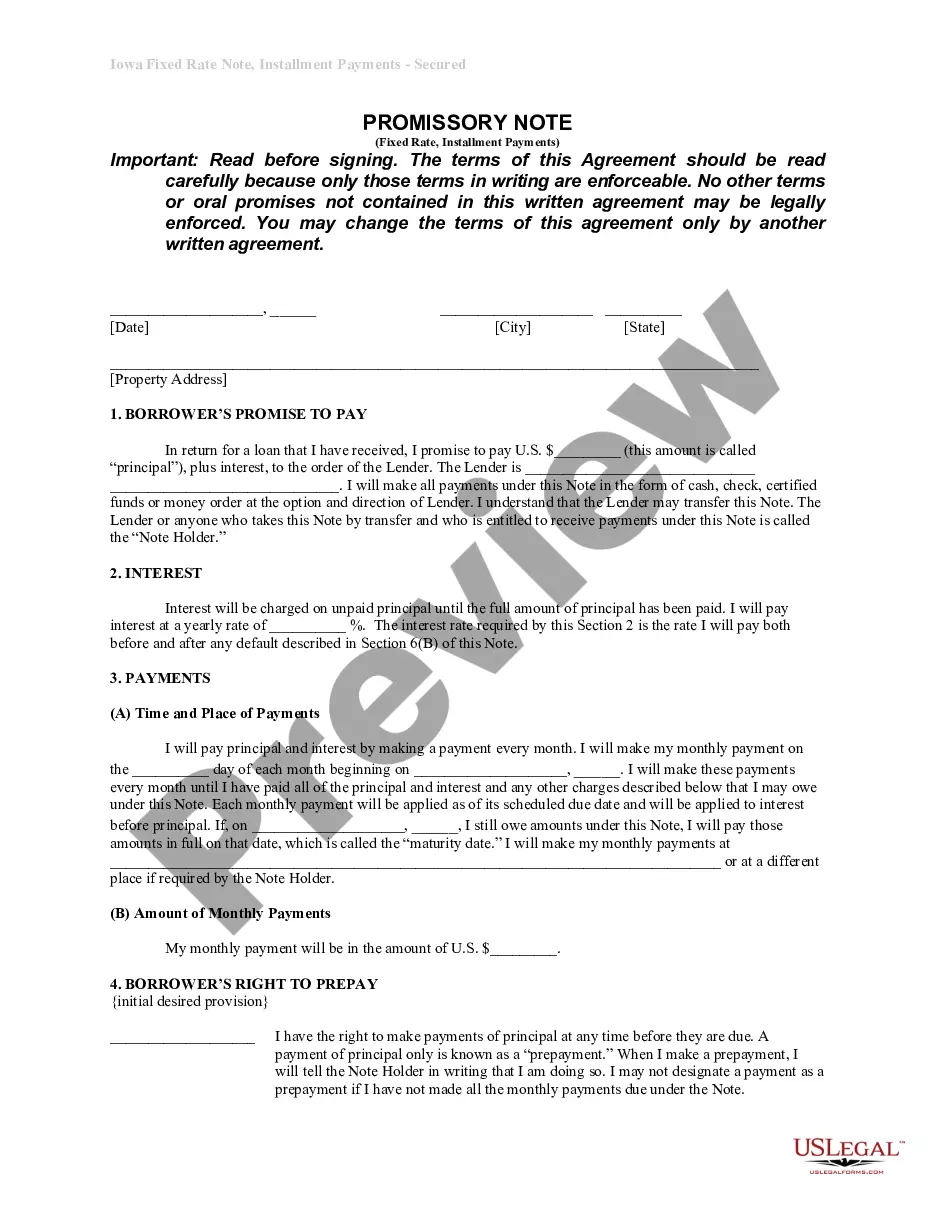
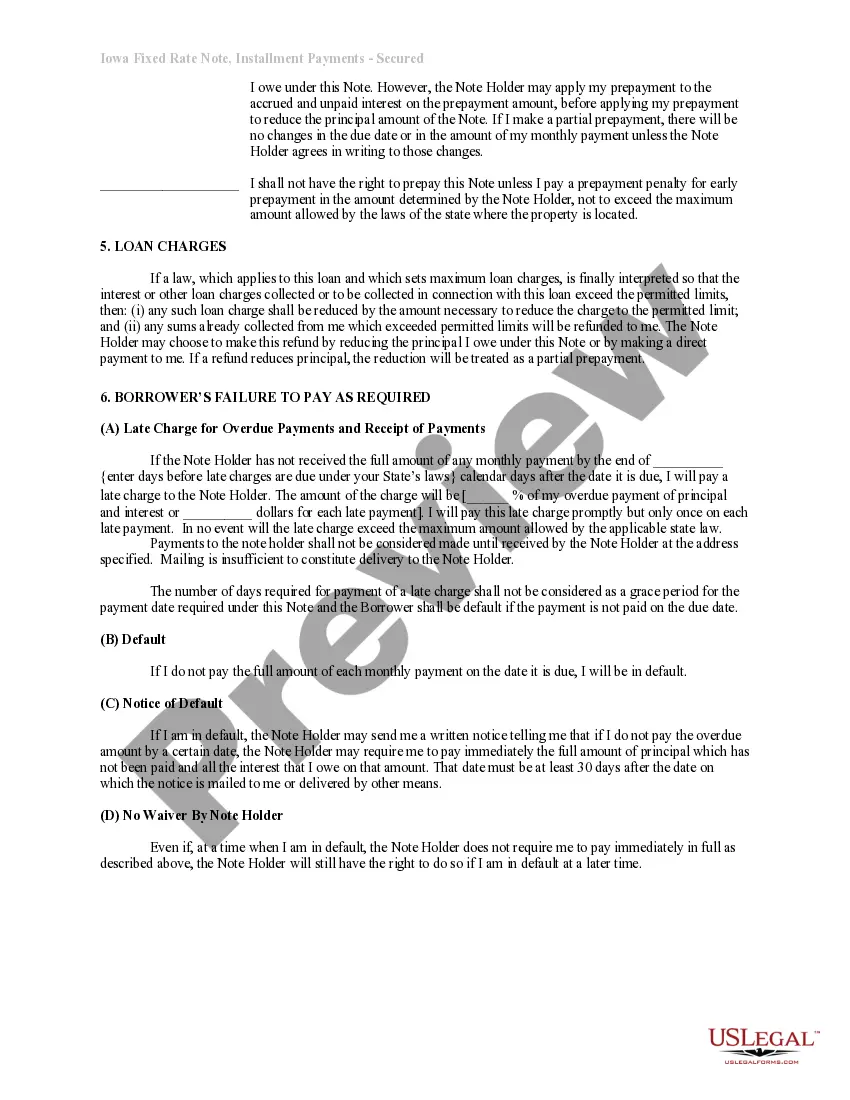
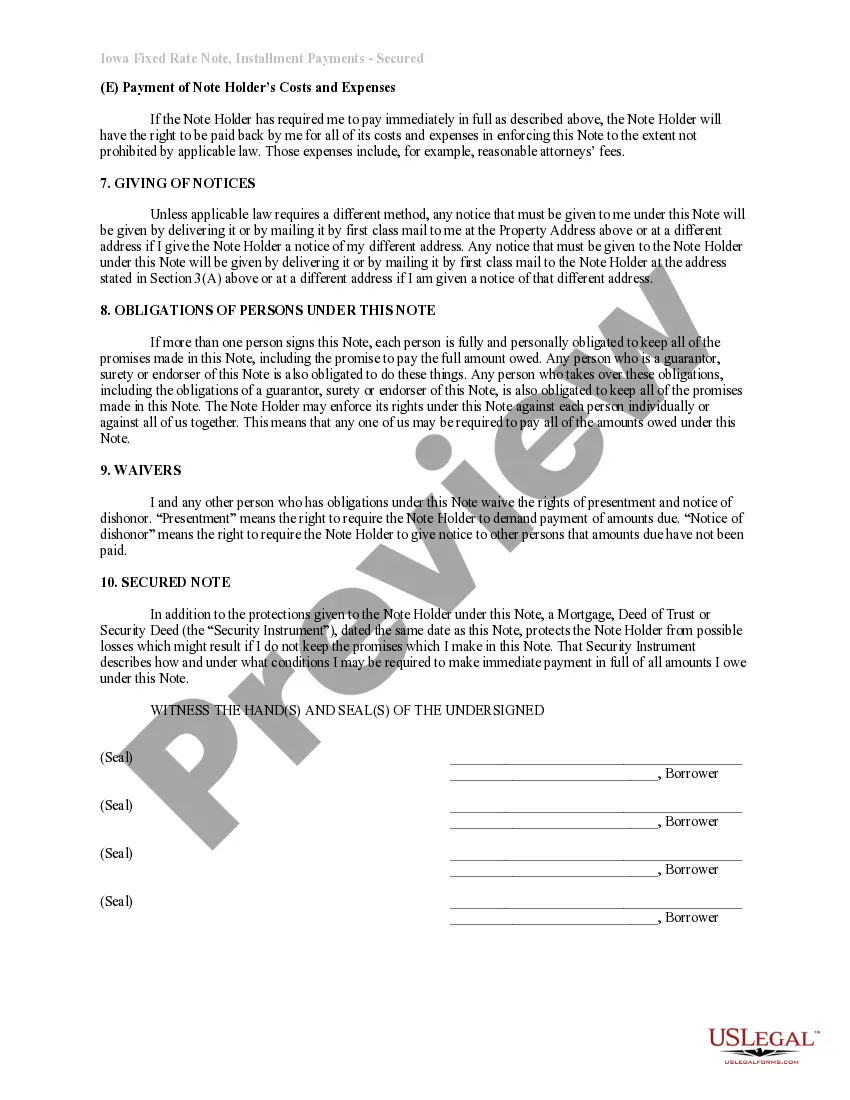
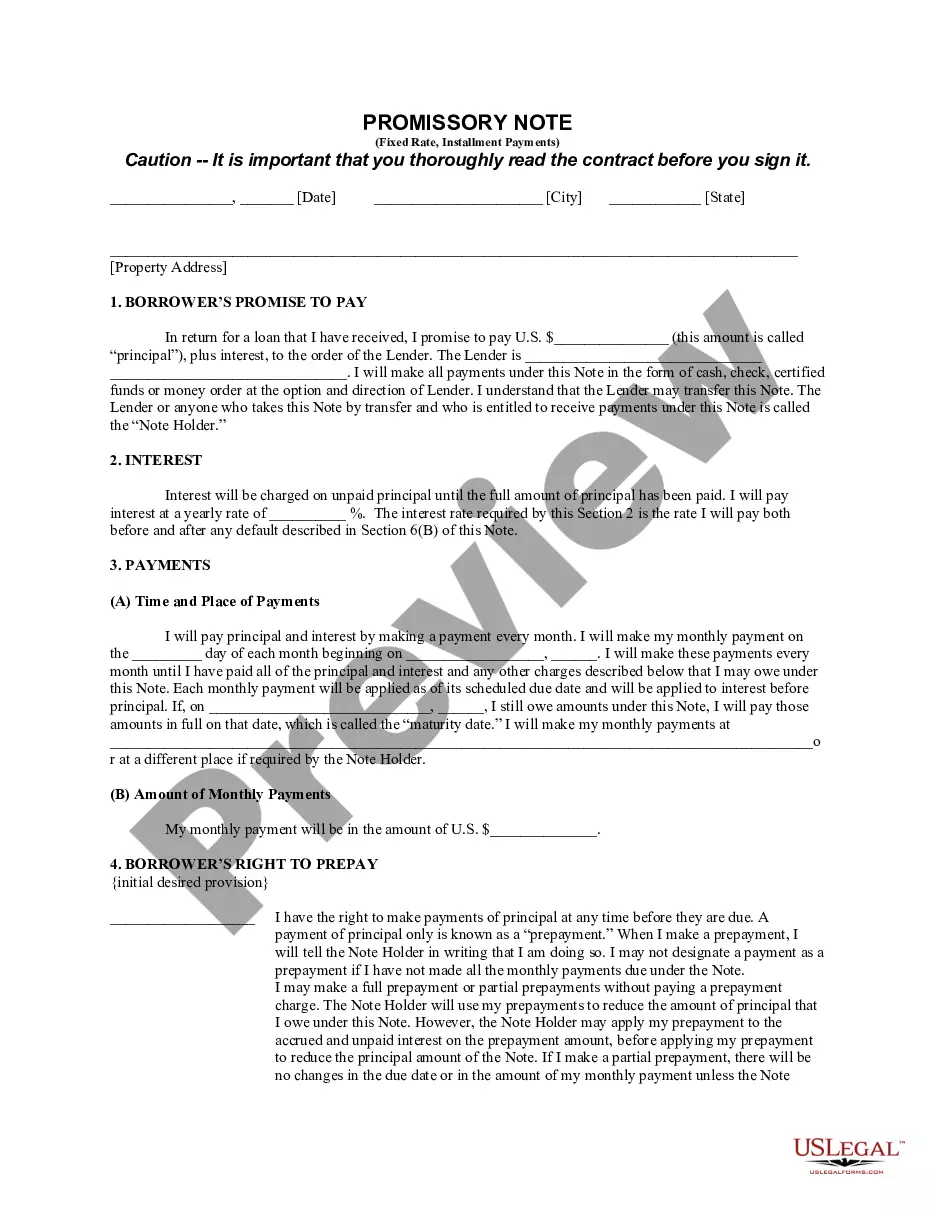
How to fill out Iowa Installments Fixed Rate Promissory Note Secured By Residential Real Estate?
- Start by logging into your account. If you're a returning user, simply log in and verify your subscription is active.
- Preview your chosen form. Click on the desired template to check its description and ensure it meets your legal needs and local regulations.
- Search for alternatives. If the selected document doesn't fit, utilize the Search tab to find a better match.
- Purchase the form. Click 'Buy Now' to select your subscription plan and create an account for full access to their resources.
- Complete your transaction. Enter your payment details using a credit card or PayPal to finalize your purchase.
- Download your document. Save the form to your device for ongoing access, also retrievable anytime under the My Forms section.
US Legal Forms empowers its users, providing over 85,000 editable templates that guarantee compliance and ease. Whether you are an individual or an attorney, their robust collection ensures you get your forms done right the first time.
Start your journey with US Legal Forms today and experience the benefits of efficient legal documentation. Explore the vast library that caters to your legal needs!
Form popularity
FAQ
The Federal Reserve Bank of New York is responsible for publishing the secured overnight financing rate (SOFR). They release this information every business day, ensuring that you have access to the most current rates. By monitoring SOFR, you can make informed financial decisions and better manage your investment strategies.
The secured overnight financing rate (SOFR) is often reported as both overnight and term rates. Overnight SOFR reflects the borrowing costs for a one-day period, while term SOFR provides rates for various future periods, typically ranging from one month to one year. Understanding these differences can help you select the most suitable financing term for your specific needs.
The secured overnight financing rate (SOFR) is administered by the Federal Reserve Bank of New York. They publish SOFR based on transactions in the overnight repo market. This administration ensures the integrity and accuracy of SOFR as a key benchmark for both institutional and retail lending activities.
The secured overnight financing rate (SOFR) differs from LIBOR primarily in its calculation method. SOFR is based on actual transactions in the repo market, while LIBOR is based on estimates provided by banks. This makes SOFR a more transparent, reliable benchmark since it reflects real market activity, reducing manipulation risks associated with LIBOR.
To find the most current value of the secured overnight financing rate (SOFR), you can check financial news platforms, the Federal Reserve Bank of New York's website, or reliable market tracking services. SOFR is published daily, giving you an up-to-date measure of short-term borrowing costs in the U.S. economy. Keeping track of SOFR can better inform your financial decisions and investments.
The calculation of the Secured Overnight Financing Rate (SOFR) is based on actual transactions in the overnight repurchase agreement market. The Federal Reserve Bank of New York gathers data on these transactions, which involves U.S. Treasury securities, and uses this information to compute a volume-weighted rate. This method ensures that SOFR reflects current market conditions accurately.
LIBOR was replaced by the Secured Overnight Financing Rate (SOFR) due to its susceptibility to manipulation and decreased transaction volumes. SOFR is based on real transactional data from a robust and active market, making it a more reliable benchmark. This transition enhances market transparency and improves financial stability, which is vital for borrowers and lenders alike.
While the Secured Overnight Financing Rate (SOFR) offers a reliable alternative to LIBOR, it does have some disadvantages. Primarily, SOFR is an overnight rate, which may not fully reflect longer-term borrowing costs. Additionally, the market for SOFR is still developing, which can lead to volatility in certain circumstances.
The calculation of the secured overnight financing rate (SOFR) is based on actual transactions in the overnight repo market. It takes into account the rates of overnight loans secured by U.S. Treasury securities. This methodology provides a robust and reliable rate that is crucial for various financial instruments and contracts.
To find the current secured overnight financing rate (SOFR), you can check official financial news websites or the Federal Reserve Bank of New York’s website. The rate changes daily and reflects the latest market conditions. Staying updated on the SOFR rate allows you to make informed financial decisions.