Amend 4
Description
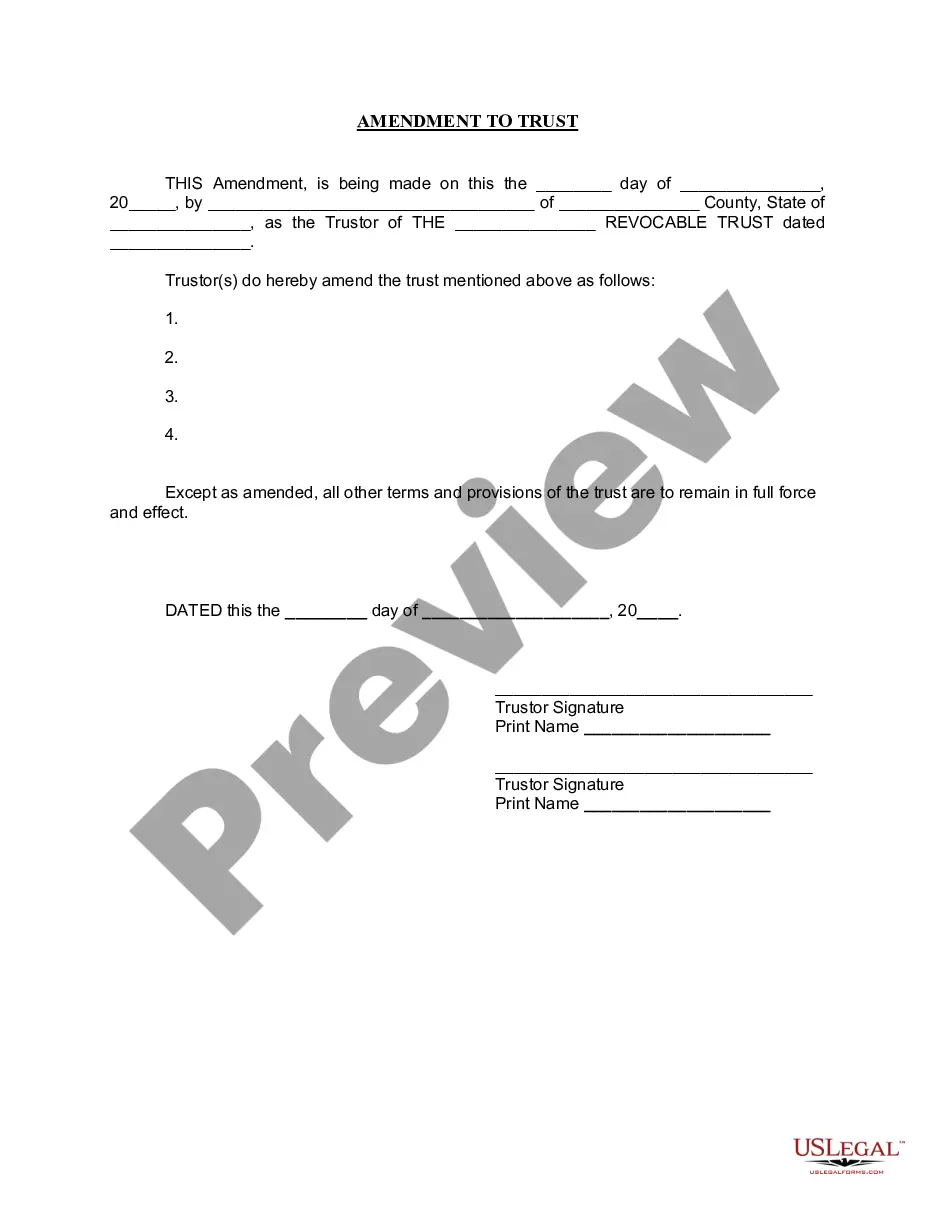


Get your form ready online
Our built-in tools help you complete, sign, share, and store your documents in one place.
Make edits, fill in missing information, and update formatting in US Legal Forms—just like you would in MS Word.
Download a copy, print it, send it by email, or mail it via USPS—whatever works best for your next step.
Sign and collect signatures with our SignNow integration. Send to multiple recipients, set reminders, and more. Go Premium to unlock E-Sign.
If this form requires notarization, complete it online through a secure video call—no need to meet a notary in person or wait for an appointment.
We protect your documents and personal data by following strict security and privacy standards.

Make edits, fill in missing information, and update formatting in US Legal Forms—just like you would in MS Word.

Download a copy, print it, send it by email, or mail it via USPS—whatever works best for your next step.

Sign and collect signatures with our SignNow integration. Send to multiple recipients, set reminders, and more. Go Premium to unlock E-Sign.

If this form requires notarization, complete it online through a secure video call—no need to meet a notary in person or wait for an appointment.

We protect your documents and personal data by following strict security and privacy standards.
Looking for another form?






How to fill out Georgia Amendment To Living Trust?
- Log into your existing US Legal Forms account to access your previous documents or to start fresh.
- In the Preview mode, carefully review the form description to ensure you've selected the right template that meets your needs.
- If you notice any discrepancies, utilize the Search tab to find the correct form tailored to your specific requirements.
- Choose the appropriate subscription plan by clicking 'Buy Now' and following the registration prompts to create your account.
- Complete your purchase by entering your payment information—credit card or PayPal—securely.
- Download your amended form directly to your device and store it in the 'My Forms' section for easy retrieval in the future.
By following these straightforward steps, you can efficiently manage your legal documentation with confidence. US Legal Forms stands out with its robust collection of customizable forms, more than competitors at an equivalent cost.
Don’t wait any longer—get started today to take advantage of US Legal Forms' exceptional features for all your legal needs!
Form popularity
FAQ
Yes, you can file your amended return electronically, but only if you meet specific conditions set by the IRS. Certain software programs, like TurboTax, allow for this seamless process. Filing electronically can save you time and provides confirmation that your amended 4 has been submitted. Always check the IRS guidelines to ensure compliance when filing electronically.
To file an amended form, first complete Form 1040X, providing the details of the original return and the changes you wish to make. You will need to include relevant documentation that supports your amendments. If you want an efficient way to handle this, consider using uslegalforms, which offers resources on how to file and what steps to follow. Taking the right actions will help ensure your tax records are accurate.
Yes, you can file an amended return on your own. It requires completing Form 1040X accurately, along with any necessary supporting documents. While it is possible, utilizing a service like uslegalforms can save you time and ensure that you properly navigate the amendment process. Doing it right helps you avoid potential issues with the IRS.
Typically, there is no penalty for filing an amended tax return unless you owe additional taxes. The IRS encourages you to amend 4 to correct any errors, rather than ignoring them. However, you may incur interest on any unpaid balance. It is always beneficial to resolve discrepancies as soon as possible to avoid complications.
You can file Form 1040X electronically using TurboTax if you meet certain criteria. TurboTax simplifies the process by guiding you through each step, ensuring you correctly amend your tax return. Using their platform allows for easy filing, especially when you need to amend 4. Make sure to check the latest updates from TurboTax for any changes regarding electronic filing.
The four requirements for a valid warrant under the Amend 4 are: it must be issued by a neutral magistrate, supported by probable cause based on sworn testimony, specify the area to be searched, and detail the items to be seized. Each element serves to protect individuals from arbitrary governmental intrusion. Understanding these requirements can empower you to demand lawful searches and protect your rights effectively.
For the Amend 4 to apply, there must be a reasonable expectation of privacy in the area being searched or the items being seized. This includes personal residences, vehicles, and personal belongings. If an individual has willingly given up their privacy—such as leaving items in public spaces—then the Amend 4 may not protect them. Knowing when this applies helps safeguard your rights.
The Amend 4 is triggered when a government actor conducts a search or seizure that intrudes upon individual privacy. This could involve law enforcement initiating an investigation, which prompts the need for a warrant if it targets an individual's personal space. Moreover, any improper search without consent can also invoke the Amend 4 protections. Understanding this can help you identify illegal actions by authorities.
The Amend 4 search warrant requirement generally applies to any governmental search or seizure of private property. This means that law enforcement must usually acquire a warrant before entering personal spaces, like homes or vehicles. However, the warrant does not apply in certain situations, such as when consent is given. Awareness of these requirements ensures individuals can better protect their rights.
The Amend 4 was originally applicable only to federal actions. However, through the doctrine of incorporation, the Supreme Court has extended these protections to the states. This means that state and local law enforcement agencies must also adhere to the restrictions set forth in the Amend 4. Consequently, individuals in all states are entitled to the same protections against unreasonable searches and seizures.