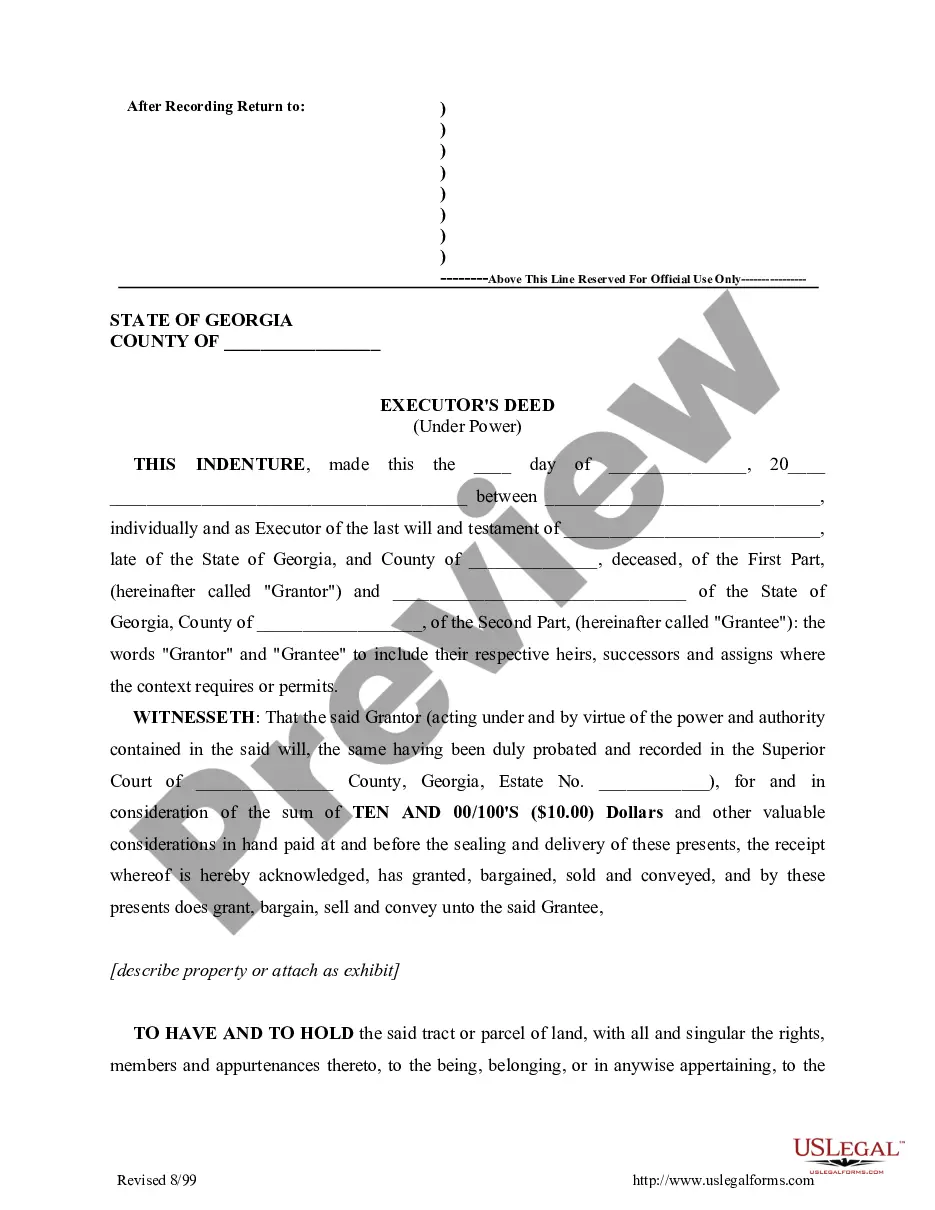
Ga Deed Georgia For Death
Description

Get your form ready online
Our built-in tools help you complete, sign, share, and store your documents in one place.
Make edits, fill in missing information, and update formatting in US Legal Forms—just like you would in MS Word.
Download a copy, print it, send it by email, or mail it via USPS—whatever works best for your next step.
Sign and collect signatures with our SignNow integration. Send to multiple recipients, set reminders, and more. Go Premium to unlock E-Sign.
If this form requires notarization, complete it online through a secure video call—no need to meet a notary in person or wait for an appointment.
We protect your documents and personal data by following strict security and privacy standards.

Make edits, fill in missing information, and update formatting in US Legal Forms—just like you would in MS Word.

Download a copy, print it, send it by email, or mail it via USPS—whatever works best for your next step.

Sign and collect signatures with our SignNow integration. Send to multiple recipients, set reminders, and more. Go Premium to unlock E-Sign.

If this form requires notarization, complete it online through a secure video call—no need to meet a notary in person or wait for an appointment.

We protect your documents and personal data by following strict security and privacy standards.
Looking for another form?






How to fill out Georgia Executor's Deed?
Whether for corporate reasons or personal matters, everyone must confront legal circumstances at some point in their lives.
Filling out legal documents necessitates meticulous care, starting from selecting the appropriate form template.
Once it is saved, you can complete the form using editing software or print it out and finish it manually. With a vast US Legal Forms catalog available, you do not need to waste time searching for the correct sample online. Utilize the library’s user-friendly navigation to find the right template for any occasion.
- For instance, if you select an incorrect version of a Ga Deed Georgia For Death, it will be rejected upon submission.
- Thus, it is vital to obtain a trustworthy source of legal documents like US Legal Forms.
- If you wish to acquire a Ga Deed Georgia For Death template, follow these straightforward steps.
- Retrieve the sample you require by using the search bar or catalog browsing.
- Review the form's details to ensure it aligns with your situation, state, and county.
- Click on the form's preview to examine it.
- If it is the wrong document, return to the search feature to find the Ga Deed Georgia For Death template you need.
- Download the template if it satisfies your requirements.
- If you already possess a US Legal Forms account, simply click Log in to access previously saved documents in My documents.
- If you do not yet have an account, you can acquire the form by clicking Buy now.
- Choose the appropriate pricing option.
- Fill out the account registration form.
- Select your payment method: you can opt for a credit card or PayPal account.
- Choose the document format you desire and download the Ga Deed Georgia For Death.
Form popularity
FAQ
Changing property ownership after death involves legally transferring the title to the beneficiaries or heirs. In Georgia, you will need to file a new deed with the local government, which includes a death certificate and the original deed. Utilizing a GA deed for death can simplify this process for you. Platforms like US Legal Forms offer the resources you need to complete this transition smoothly.
To transfer a deed after death in Georgia, you must prepare a new deed that names the new owner. This deed must be filed with the county clerk, along with the death certificate and any other required documents. A GA deed for death is specifically designed for this purpose. You may find it helpful to use US Legal Forms to get the necessary documents and support.
While it is possible to file a transfer on death deed without a lawyer, having legal guidance can be beneficial. A lawyer can help you navigate the intricacies of Georgia laws regarding property transfer. Using a GA deed for death can streamline the process. US Legal Forms provides templates and instructions that simplify this task, making it accessible.
Changing the deed on a house in Georgia after someone dies typically requires filing a new deed with the county clerk. You will need the deceased person's death certificate and the original deed. A GA deed for death can help facilitate this transfer. It's wise to consult resources like US Legal Forms to ensure you complete the process correctly.
To transfer title deeds after death, you generally need to follow the legal process for handling the deceased's estate. This may involve gathering necessary documents, such as the death certificate and the current deed. In Georgia, you can utilize a GA deed for death to simplify the process. Consider using platforms like US Legal Forms to access the appropriate forms and guidance.
To transfer a property deed in Georgia after death, you must first obtain a death certificate and prepare the necessary documentation. If a TOD deed exists, the beneficiary can file it with the county clerk's office to officially transfer ownership. If no deed exists, you may need to go through probate, which could be more complex. Using a platform like US Legal Forms can simplify this process by providing the appropriate forms and guidance for a GA deed Georgia for death.
A Transfer on Death (TOD) deed in Georgia for death may not address all potential issues. One significant disadvantage is that it does not provide protection against creditors, meaning debts may still impact the property after the owner's death. Additionally, if the beneficiary is unable to accept the property for any reason, the deed could lead to complications. It's essential to consider these factors when deciding on a GA deed Georgia for death.
Filling out a transfer on death deed form requires specific steps to ensure it meets Georgia's legal standards. First, you must download the appropriate Ga deed Georgia for death form from a reliable source, such as USLegalForms. Next, enter the names of the property owners and the beneficiaries who will inherit the property upon your death. Finally, make sure to sign the deed in front of a notary public and file it with the county clerk's office to make it legally binding.