Wisconsin Tint Laws
Description
Get your form ready online
Our built-in tools help you complete, sign, share, and store your documents in one place.
Make edits, fill in missing information, and update formatting in US Legal Forms—just like you would in MS Word.
Download a copy, print it, send it by email, or mail it via USPS—whatever works best for your next step.
Sign and collect signatures with our SignNow integration. Send to multiple recipients, set reminders, and more. Go Premium to unlock E-Sign.
If this form requires notarization, complete it online through a secure video call—no need to meet a notary in person or wait for an appointment.
We protect your documents and personal data by following strict security and privacy standards.

Make edits, fill in missing information, and update formatting in US Legal Forms—just like you would in MS Word.

Download a copy, print it, send it by email, or mail it via USPS—whatever works best for your next step.

Sign and collect signatures with our SignNow integration. Send to multiple recipients, set reminders, and more. Go Premium to unlock E-Sign.

If this form requires notarization, complete it online through a secure video call—no need to meet a notary in person or wait for an appointment.

We protect your documents and personal data by following strict security and privacy standards.
Looking for another form?





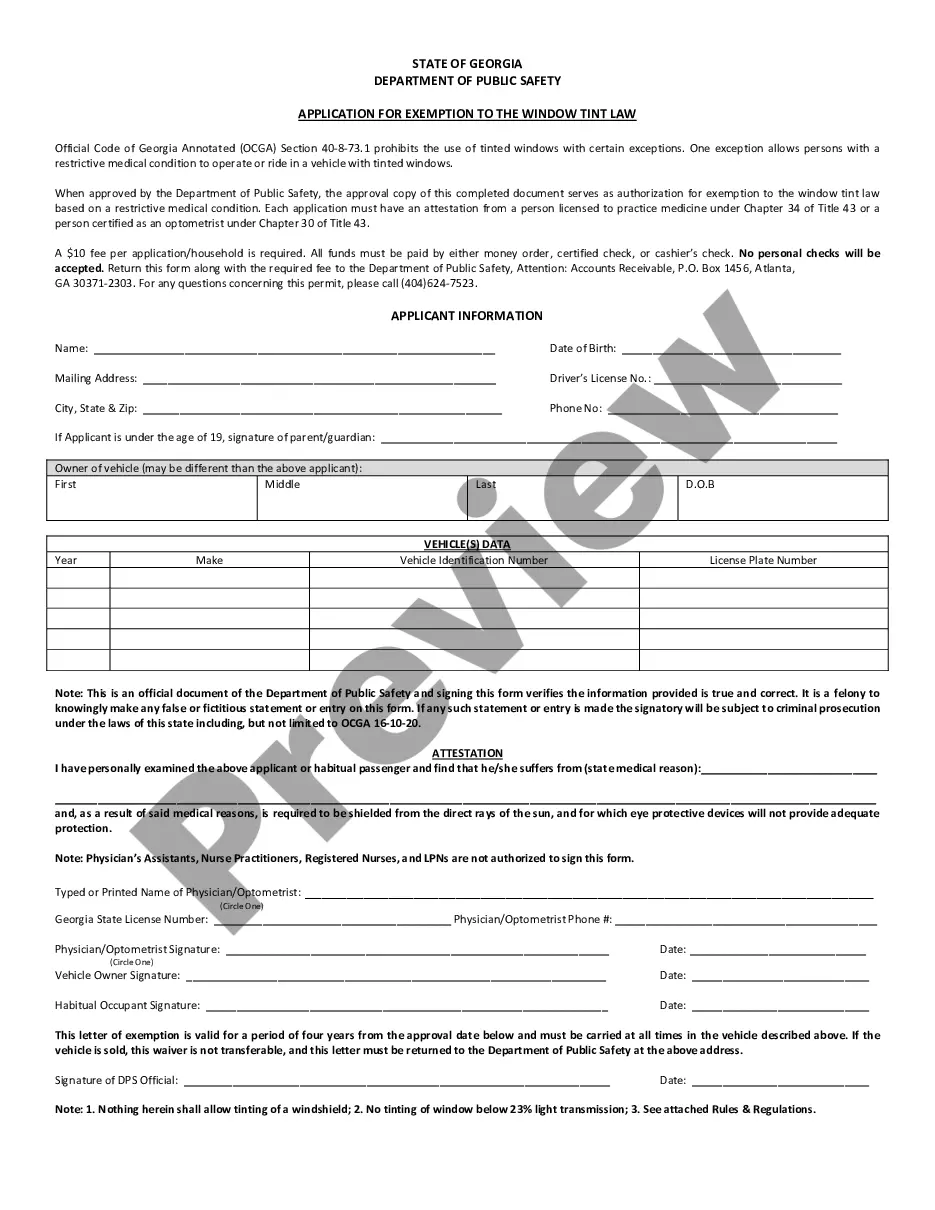
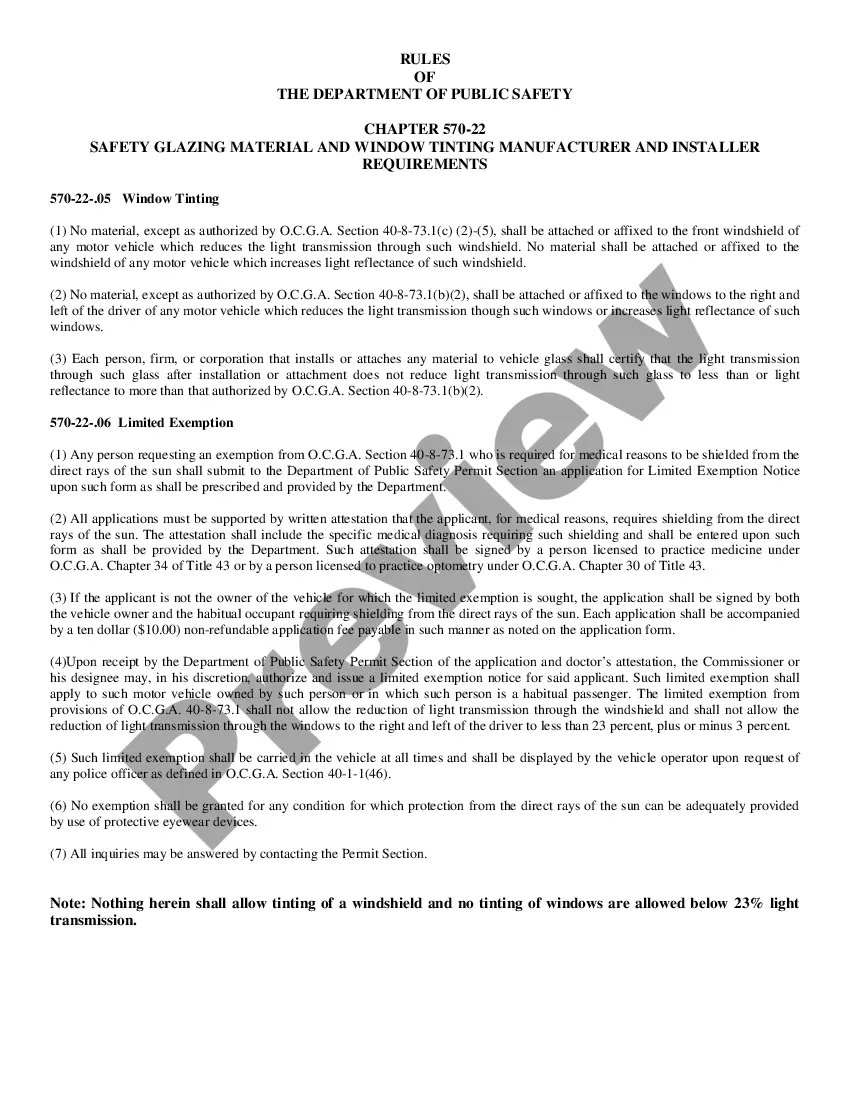
How to fill out Georgia Application For Exemption To The Window Tint Law?
Securing a primary location to obtain the latest and suitable legal templates is a substantial part of navigating bureaucracy. Finding the correct legal documents requires accuracy and meticulousness, which underscores the necessity of sourcing Wisconsin Tint Laws samples from credible providers, such as US Legal Forms. An incorrect template can consume your time and hinder your current situation. With US Legal Forms, you have minimal concerns. You can access and review all the information related to the document’s applicability and significance for your circumstance and in your locality.
Follow the steps below to finalize your Wisconsin Tint Laws.
Eliminate the stress linked to your legal documentation. Explore the vast US Legal Forms library where you can discover legal templates, assess their relevance to your situation, and download them immediately.
- Use the library navigation or search bar to locate your template.
- Examine the form’s description to verify if it meets your state's and region's criteria.
- View the form preview, if available, to confirm that the template is indeed the one you seek.
- Return to the search to find the appropriate template if the Wisconsin Tint Laws does not fulfill your criteria.
- Once you are confident about the form’s applicability, download it.
- If you are a registered user, click Log in to verify your identity and access your chosen forms in My documents.
- If you do not possess an account yet, click Buy now to acquire the form.
- Select the pricing plan that suits your needs.
- Proceed with registration to complete your purchase.
- Finalize your purchase by choosing a payment option (credit card or PayPal).
- Select the file format for downloading Wisconsin Tint Laws.
- Once you have the form on your device, you can modify it with the editor or print it out and fill it out manually.
Form popularity
FAQ
In Wisconsin, the fine for violating tint laws can vary, typically ranging from $175 to $200. It's essential to keep in mind that excessive window tinting could lead to a citation, which may also add points to your driving record. Understanding Wisconsin tint laws is crucial to avoid fines and ensure your vehicle stays compliant. If you need further assistance with legal documentation related to tint regulations, consider using UsLegalForms as a helpful resource.
In Wisconsin, the darkest legal tint allowed on passenger vehicles is a 35% VLT (Visible Light Transmission) for windows. This means that 35% of visible light must be allowed to pass through the tint. Wisconsin tint laws require that the front windshield must have no tint below the AS-1 line, while the driver's and passenger's windows can have tint up to the 35% limit. Always ensure you stay informed about these regulations to avoid possible penalties.
Getting a medical exemption for window tint in Wisconsin involves consulting with a licensed physician who can diagnose and document your condition. After receiving the documentation, use it to apply through Wisconsin's vehicle services. Adhering to Wisconsin tint laws during this process ensures you will maintain legal compliance while protecting your health.
To obtain a tint exemption in Wisconsin, you must first have a certified medical professional document your medical condition. This documentation must clearly state why you need the exemption for window tint. Once you have the necessary documentation, you can apply through the appropriate state department while ensuring compliance with Wisconsin tint laws.
Wisconsin law states that sedans must have at least 35% visible light transmittance on the front windows, meaning 20% tint is illegal for those vehicles. However, if you have a van or SUV, you can use darker tints on the rear windows. Always consult Wisconsin tint laws to ensure compliance and verify if any exceptions apply to your situation.
In Delaware, specific medical conditions that can qualify for window tint exemptions include conditions like severe skin disorders and light sensitivity. These conditions can be documented by a medical professional, providing valid reasons for needing additional window tint. It is important to understand that each state, including Wisconsin, has its laws regarding window tint, so always check the Wisconsin tint laws for requirements in your area.
A 20% tint does provide a level of privacy, as it obscures the view from outside and makes it harder for others to see into your vehicle. However, privacy should always be balanced with the legal limits set by the state. In Wisconsin, understanding the specific tint laws is vital to ensure that any tint installed meets legal requirements while offering the privacy you want.
Some states have quite lenient tint laws, while others impose strict regulations. Generally, states like Michigan have limits that can allow darker tints under specific conditions. It's crucial to verify the properties of your chosen tint against various state laws, especially if you plan on traveling. Keep informed about Wisconsin tint laws to ensure compliance.
A 20% tint is darker than a 35% tint, allowing less light to pass through. This can enhance privacy but may affect visibility. Understanding the difference can help you choose the best option for your vehicle based on Wisconsin tint laws. It's wise to review these laws to avoid potential fines.
Visibility with a 20% tint can be reduced, especially at night or in low-light conditions. While some drivers find this level acceptable, others may face challenges seeing clearly. It’s important to consider your own comfort and safety while driving. Moreover, adherence to Wisconsin tint laws can influence your visibility choices.