Living Trust Forms For Florida
Description





Get your form ready online
Our built-in tools help you complete, sign, share, and store your documents in one place.
Make edits, fill in missing information, and update formatting in US Legal Forms—just like you would in MS Word.
Download a copy, print it, send it by email, or mail it via USPS—whatever works best for your next step.
Sign and collect signatures with our SignNow integration. Send to multiple recipients, set reminders, and more. Go Premium to unlock E-Sign.
If this form requires notarization, complete it online through a secure video call—no need to meet a notary in person or wait for an appointment.
We protect your documents and personal data by following strict security and privacy standards.

Make edits, fill in missing information, and update formatting in US Legal Forms—just like you would in MS Word.

Download a copy, print it, send it by email, or mail it via USPS—whatever works best for your next step.

Sign and collect signatures with our SignNow integration. Send to multiple recipients, set reminders, and more. Go Premium to unlock E-Sign.

If this form requires notarization, complete it online through a secure video call—no need to meet a notary in person or wait for an appointment.

We protect your documents and personal data by following strict security and privacy standards.
Looking for another form?







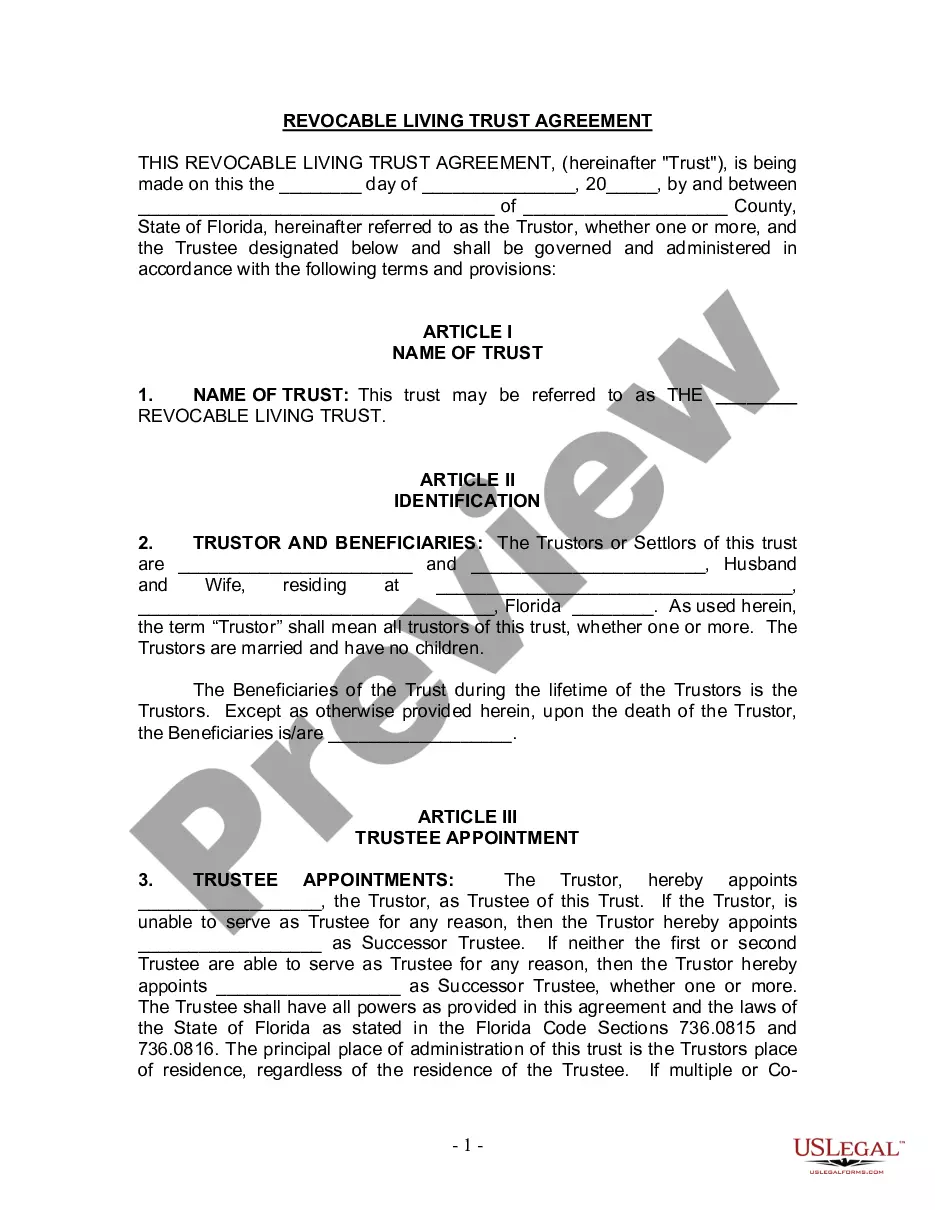
How to fill out Florida Revocable Living Trust For Husband And Wife With No Children?
Locating a reliable source to find the latest and suitable legal documents is a significant part of navigating bureaucracy. Obtaining the correct legal paperwork requires precision and carefulness, which is why it is crucial to acquire Living Trust Forms For Florida solely from trustworthy providers, such as US Legal Forms. Using an incorrect template will squander your time and postpone the matter at hand. With US Legal Forms, you can have minimal concerns. You can access and review all the details regarding the document’s applicability and significance for your situation and in your jurisdiction.
Follow these steps to finalize your Living Trust Forms For Florida.
Eliminate the complications associated with your legal paperwork. Browse the comprehensive US Legal Forms catalog where you can discover legal documents, assess their suitability for your circumstances, and download them instantly.
- Utilize the catalog navigation or search box to locate your template.
- Open the form details to confirm its compliance with your state and locality.
- Access the form preview, if available, to ensure it corresponds to what you need.
- Return to the search and find an alternative template if the Living Trust Forms For Florida does not fulfill your requirements.
- When you are confident about the form’s applicability, download it.
- As a registered user, click Log in to validate and access your chosen templates in My documents.
- If you haven't created an account yet, click Buy now to purchase the form.
- Choose the subscription plan that fits your needs.
- Proceed with registration to finalize your order.
- Complete your transaction by selecting a payment method (credit card or PayPal).
- Choose the document format for downloading Living Trust Forms For Florida.
- Once you have the form on your device, you can edit it with the editor or print it and fill it out manually.
Form popularity
FAQ
A common downfall of a living trust includes the potential for mismanagement due to lack of oversight. If you do not properly fund the trust with your assets, it will not provide the benefits you expect. Furthermore, living trusts do not protect from creditor claims or lawsuits, so understanding their limitations is crucial. Using reliable living trust forms for Florida ensures that you create a solid foundation for your estate plan.
Putting your house in a trust in Florida can have drawbacks, such as possible tax implications. While your home is in a trust, it may still be subject to property taxes, and changes in ownership interest can complicate matters. Additionally, if the trust is not properly managed, it could lead to increased administrative burdens or even legal challenges. It’s important to consult with professionals when using living trust forms for Florida to make informed decisions.
To fill out living trust forms for Florida, start by selecting your beneficiaries and identifying the assets you want to include in the trust. Complete the forms with your information and ensure the trust is signed in front of a notary. Afterward, you must actively transfer title of the assets to the trust, which might require additional documents for real estate or other financial accounts. Reviewing your trust periodically will help reflect any life changes or new assets.
Suze Orman emphasizes the importance of having a living trust, stating that it can help in avoiding lengthy probate processes. She advocates for using living trust forms for Florida, as they allow for a smoother transition of assets to beneficiaries. According to her, a living trust provides greater control over your estate and helps minimize potential family disputes after passing. Proper planning with a living trust is key to maintaining peace and order.
Filing a living trust is not necessary in Florida, as it does not require court approval. Instead, focus on creating your living trust forms for Florida accurately and ensuring all assets are properly transferred into the trust. If you need help during this process, consider using platforms like US Legal Forms that provide straightforward templates and guidance to simplify your journey.
No, a trust does not have to be filed with the state in Florida. You manage the trust and its assets without notifying state authorities. Using living trust forms for Florida can help you easily organize and specify the terms of the trust, providing peace of mind regarding your estate.
In Florida, a living trust does not need to be recorded. Unlike a will, which requires court validation, you simply create and maintain the trust documentation privately. However, it is essential to keep your living trust forms for Florida organized and updated to ensure they meet your needs and intentions.
You do not necessarily need an attorney to prepare a living trust in Florida, but it is highly beneficial. Using reliable living trust forms for Florida from a trusted platform like USLegalForms allows you to create a comprehensive trust without legal hassles. However, consulting an attorney can provide additional insights tailored to your specific financial situation and goals.
While notarization is not a requirement for trust documents in Florida, it is a highly recommended practice. Notarizing your living trust forms for Florida can enhance their credibility and help protect against future legal challenges. By ensuring that your documents are properly signed and executed, you can establish a stronger legal foundation for your trust.
Yes, a trust can still be valid in Florida even if it is not notarized. However, notarization can provide additional legal strength and help reduce the chances of disputes. It is advisable to use notarized living trust forms for Florida to add more security to your trust. This step can also aid in the smooth administration of the trust in the future.