Tenant Landlord Law Florida
Description


Get your form ready online
Our built-in tools help you complete, sign, share, and store your documents in one place.
Make edits, fill in missing information, and update formatting in US Legal Forms—just like you would in MS Word.
Download a copy, print it, send it by email, or mail it via USPS—whatever works best for your next step.
Sign and collect signatures with our SignNow integration. Send to multiple recipients, set reminders, and more. Go Premium to unlock E-Sign.
If this form requires notarization, complete it online through a secure video call—no need to meet a notary in person or wait for an appointment.
We protect your documents and personal data by following strict security and privacy standards.

Make edits, fill in missing information, and update formatting in US Legal Forms—just like you would in MS Word.

Download a copy, print it, send it by email, or mail it via USPS—whatever works best for your next step.

Sign and collect signatures with our SignNow integration. Send to multiple recipients, set reminders, and more. Go Premium to unlock E-Sign.

If this form requires notarization, complete it online through a secure video call—no need to meet a notary in person or wait for an appointment.

We protect your documents and personal data by following strict security and privacy standards.
Looking for another form?








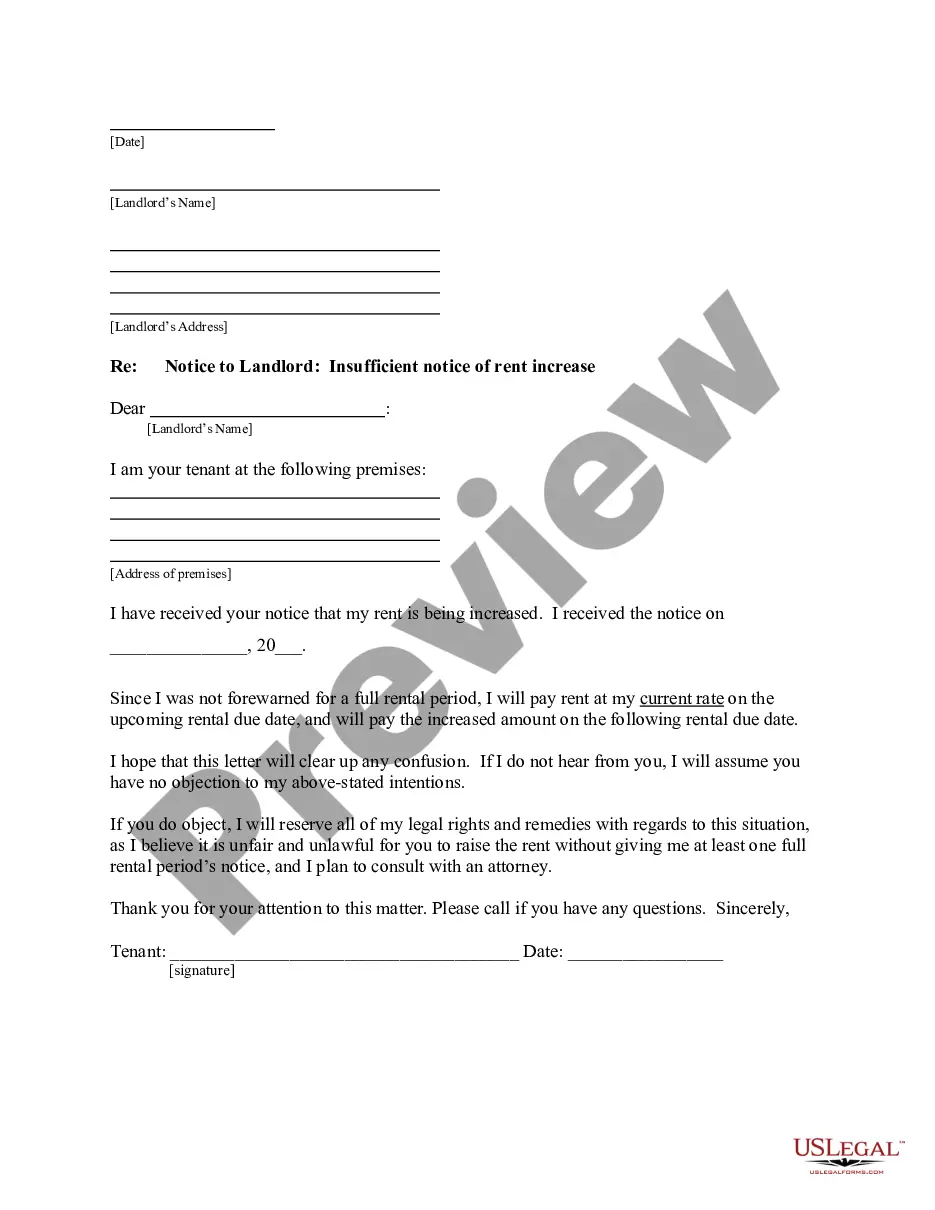
How to fill out Florida Letter From Tenant To Landlord About Insufficient Notice Of Rent Increase?
- If you’re a returning user, log into your account; ensure your subscription is active to download the needed forms.
- If you're new to US Legal Forms, start by exploring the Preview mode to check descriptions and ensure you select the proper form that meets your requirements.
- If you find inconsistencies, utilize the Search tab to locate the correct template for your jurisdiction before proceeding.
- Choose your desired document by clicking the Buy Now button, select a subscription plan, and create an account to access the comprehensive resource library.
- Complete your purchase through credit card or PayPal, confirming your subscription.
- Download the selected document directly to your device for immediate use, and find it later under the My Forms section of your account.
With over 85,000 legal forms and packages, US Legal Forms stands out with a comprehensive collection that simplifies the form-filling process while ensuring legal conformity.
Empower yourself with this efficient resource and take control of your legal documentation. Begin your journey with US Legal Forms today for hassle-free legal solutions.
Form popularity
FAQ
Section 83.60 in Florida details the rules for eviction notices and the legal process for landlords intending to evict a tenant. This section is crucial in tenant landlord law Florida, as it outlines the requirements for proper notification and timing. By familiarizing yourself with this section, you can better understand your legal standing as a tenant. For assistance, uslegalforms offers tools to help navigate these legal complexities.
The 83.60 law in Florida pertains to the rights and responsibilities of landlords and tenants, specifically regarding eviction processes. This part of tenant landlord law Florida outlines various grounds for eviction and the requisite procedures that must be followed. Understanding this law can significantly aid tenants in understanding their rights. For more detailed insights, you might find resources from uslegalforms helpful.
If you experience problems with your landlord in Florida, you can report them to local housing authorities or state agencies. These agencies handle complaints related to tenant landlord law Florida and can provide guidance on how to proceed. Additionally, tenants can seek assistance from local legal aid organizations. Addressing issues early can help you maintain a positive rental experience.
In Florida, the law does not impose a duty on property owners to warn undiscovered trespassers. According to tenant landlord law Florida, landowners are primarily responsible for keeping their premises safe for lawful visitors. Trespassers, however, do not have the same protections. If you have questions, it’s beneficial to consult with a legal expert familiar with tenant landlord law Florida.
When a tenant refuses to leave, the legal approach is to file an eviction complaint in the appropriate local court. This process follows the provisions of tenant landlord law Florida and requires a formal hearing. The court will examine the evidence, and if the decision is in favor of the landlord, they will issue an eviction order. It’s vital to handle this legally to avoid any potential repercussions and ensure a smooth resolution.
If someone is staying in your home without your consent, you should first communicate your desire for them to leave. However, if they refuse, you may need to follow the legal eviction process as outlined under tenant landlord law Florida. Start by providing a written notice, and if they still do not leave, consider filing for eviction in your local court. Using a service like US Legal Forms can provide you with the necessary documents and guidance to navigate this process smoothly.
If a tenant refuses to leave after receiving an eviction notice, the landlord must file a formal eviction lawsuit in court. The court will then assess the situation under tenant landlord law Florida, and if the landlord prevails, they will obtain a judgment for eviction. It’s important for landlords to follow legal procedures to avoid complications. Seeking legal advice may also be beneficial to ensure compliance.
In Florida, landlords must typically provide a written notice to tenants before they can be evicted. For non-payment of rent, landlords usually give a 3-day notice, while for other lease violations, the notice period can vary from 7 to 30 days based on the type of violation. Understanding these timelines is crucial in navigating tenant landlord law Florida effectively. Knowing your rights can help you manage your situation more confidently.
If you face issues with your landlord, you can report them to the Florida Department of Business and Professional Regulation (DBPR). This department oversees landlord-tenant relationships and enforces tenant landlord law Florida. You may also consider contacting local housing authorities or legal aid organizations for assistance. They can help you understand your rights and recommend the best course of action.
Recent changes in tenant landlord law Florida have introduced new requirements regarding security deposit handling and eviction processes. Landlords must now provide more transparent information about security deposits and their rights. Moreover, landlords must adhere to stricter guidelines for legal evictions to protect tenant rights. Keeping abreast of these rules can help you navigate your rental agreements more effectively.