Florida Personal Representative Proof Of Claim
Description

Get your form ready online
Our built-in tools help you complete, sign, share, and store your documents in one place.
Make edits, fill in missing information, and update formatting in US Legal Forms—just like you would in MS Word.
Download a copy, print it, send it by email, or mail it via USPS—whatever works best for your next step.
Sign and collect signatures with our SignNow integration. Send to multiple recipients, set reminders, and more. Go Premium to unlock E-Sign.
If this form requires notarization, complete it online through a secure video call—no need to meet a notary in person or wait for an appointment.
We protect your documents and personal data by following strict security and privacy standards.

Make edits, fill in missing information, and update formatting in US Legal Forms—just like you would in MS Word.

Download a copy, print it, send it by email, or mail it via USPS—whatever works best for your next step.

Sign and collect signatures with our SignNow integration. Send to multiple recipients, set reminders, and more. Go Premium to unlock E-Sign.

If this form requires notarization, complete it online through a secure video call—no need to meet a notary in person or wait for an appointment.

We protect your documents and personal data by following strict security and privacy standards.
Looking for another form?

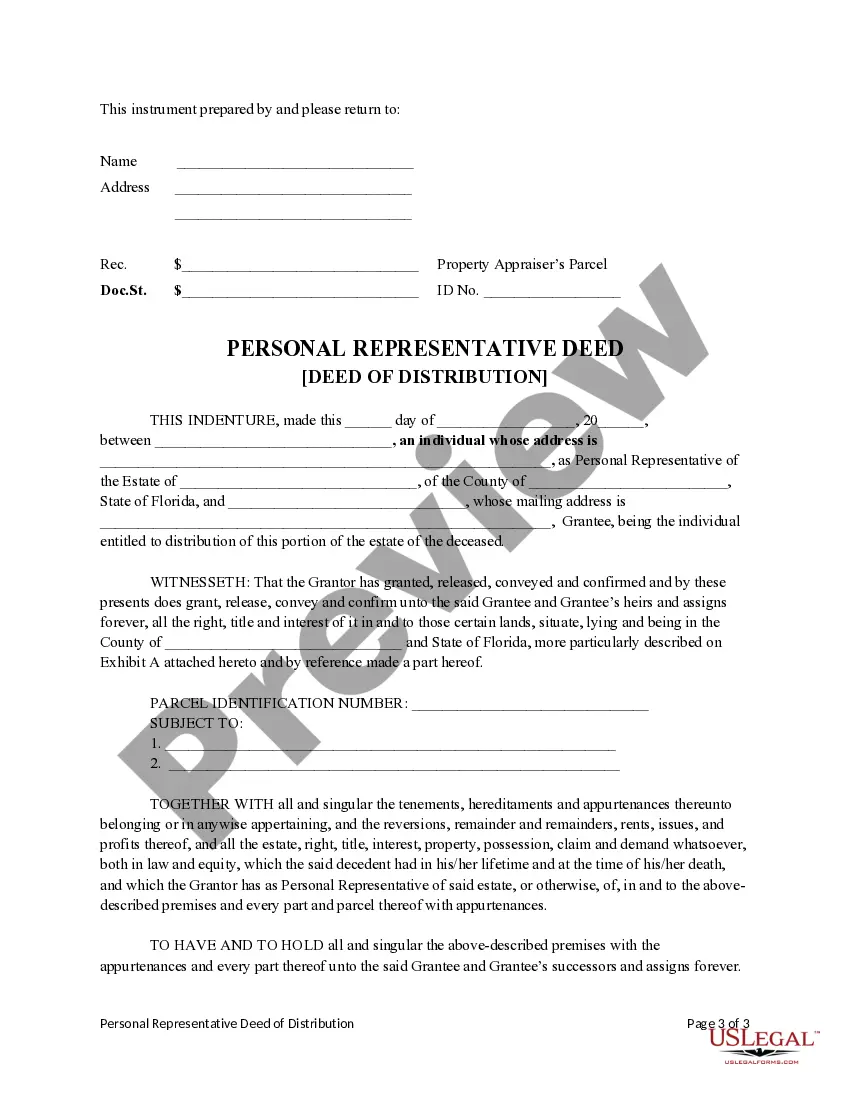
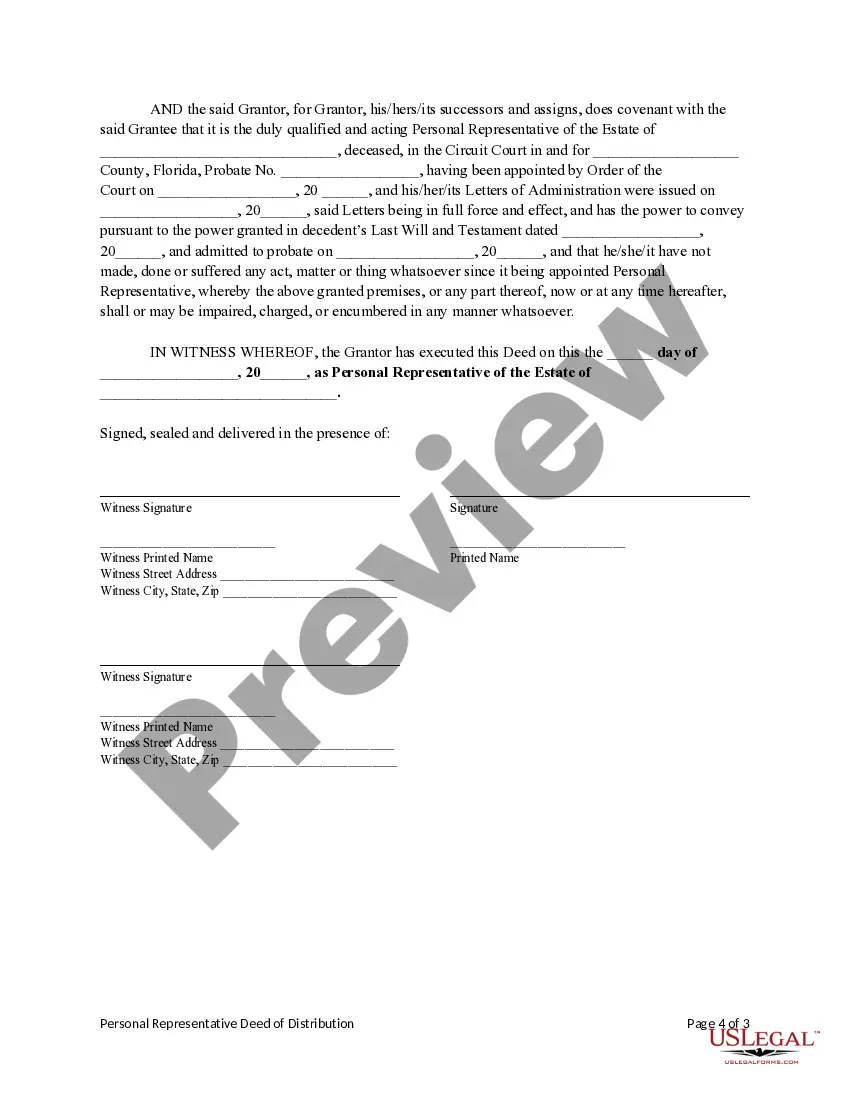
How to fill out Florida Personal Representative's Deed Of Distribution?
Whether for corporate objectives or personal affairs, everyone must handle legal matters at some stage in their life.
Filling out legal paperwork requires meticulous care, starting from choosing the correct form template.
With an extensive US Legal Forms collection available, you do not have to waste time searching for the suitable template online. Utilize the library’s user-friendly navigation to find the right form for any scenario.
- For instance, if you select an incorrect version of a Florida Personal Representative Proof Of Claim, it will be rejected once submitted.
- Thus, it is essential to have a reliable source of legal documents such as US Legal Forms.
- If you need to obtain a Florida Personal Representative Proof Of Claim template, follow these straightforward steps.
- Locate the template you require using the search bar or catalog browsing.
- Review the form’s details to ensure it fits your situation, state, and locality.
- Click on the form’s preview to examine it.
- If it is the wrong document, return to the search feature to find the Florida Personal Representative Proof Of Claim sample you need.
- Download the template if it meets your criteria.
- If you already possess a US Legal Forms account, simply click Log in to access previously stored templates in My documents.
- In case you do not have an account yet, you can acquire the form by clicking Buy now.
- Select the correct pricing option.
- Fill out the account registration form.
- Choose your payment method: utilize a credit card or PayPal account.
- Select the document format you prefer and download the Florida Personal Representative Proof Of Claim.
- Once it is saved, you can complete the form using editing software or print it and finish it by hand.
Form popularity
FAQ
To file a statement of claim in Florida, you must first prepare the claim in writing, ensuring it includes all relevant details such as the amount owed and the basis for the claim. After preparing your statement, submit it to the personal representative of the estate within the required timeframe. Keeping copies of your documents is essential for your records. The US Legal Forms platform offers templates and guidance to assist you in filing your statement of claim correctly.
The 90.408 rule in Florida pertains to the requirements for a claimant to present a proof of claim against an estate. This rule mandates that claims must be filed in writing and must specify the nature of the claim, as well as its amount. By adhering to this rule, you can ensure your claim is properly considered by the Florida personal representative. The US Legal Forms platform can help you create compliant documents to meet these legal requirements.
To file a claim against a deceased person's estate in Florida, you need to submit a written claim to the personal representative of the estate. Ensure your claim includes all necessary details, such as the amount owed and any supporting documentation. It’s important to file your claim within the specified time frame, typically within three months of the personal representative's notice. Using the US Legal Forms platform can simplify this process, providing you with the necessary forms and guidance.
A copy of the appointment of a personal representative is a legal document that officially designates an individual to manage the estate of a deceased person. This document outlines the authority granted to the personal representative to handle estate matters, including settling debts and distributing assets. Understanding this document is crucial for anyone involved in the estate process, as it relates closely to the Florida personal representative proof of claim, ensuring that all claims are handled correctly and efficiently.
A creditor claim in Florida probate is a claim filed by a person or entity (a ?creditor?) that the decedent owed money to at the time decedent died. A creditor must file a timely statement of claim in the probate estate in order to pursue satisfaction of their creditor claim.
A creditor's statement of claim shall be verified and filed with the clerk and shall state: (1) the basis for the claim; (2) the amount claimed; (3) the name and address of the creditor; (4) the security for the claim, if any; and (5) whether the claim is currently due or involves an uncertainty and, if not due, then ...
The claim should only contain enough information to identify why you are suing and what compensation you want. It should not contain evidence or tell a story. You will need the correct name and address for the person you are suing. It is helpful if you also have phone numbers and email addresses for the parties.
To file a claim against an estate, you must first confirm that the deceased owes the debt and then complete and file a claim form. If your claim is not filed correctly, the court may dismiss it. However, before transferring properties to heirs, the estate must pay off any remaining debts.
If the estate value is $1 million or less, your fee is 3% of the estate assets. If the estate value is between $1 million and $5 million, your fee is 2.5% of the estate assets. If the estate value is between $5 million and $10 million, your fee is 2% of the estate assets.