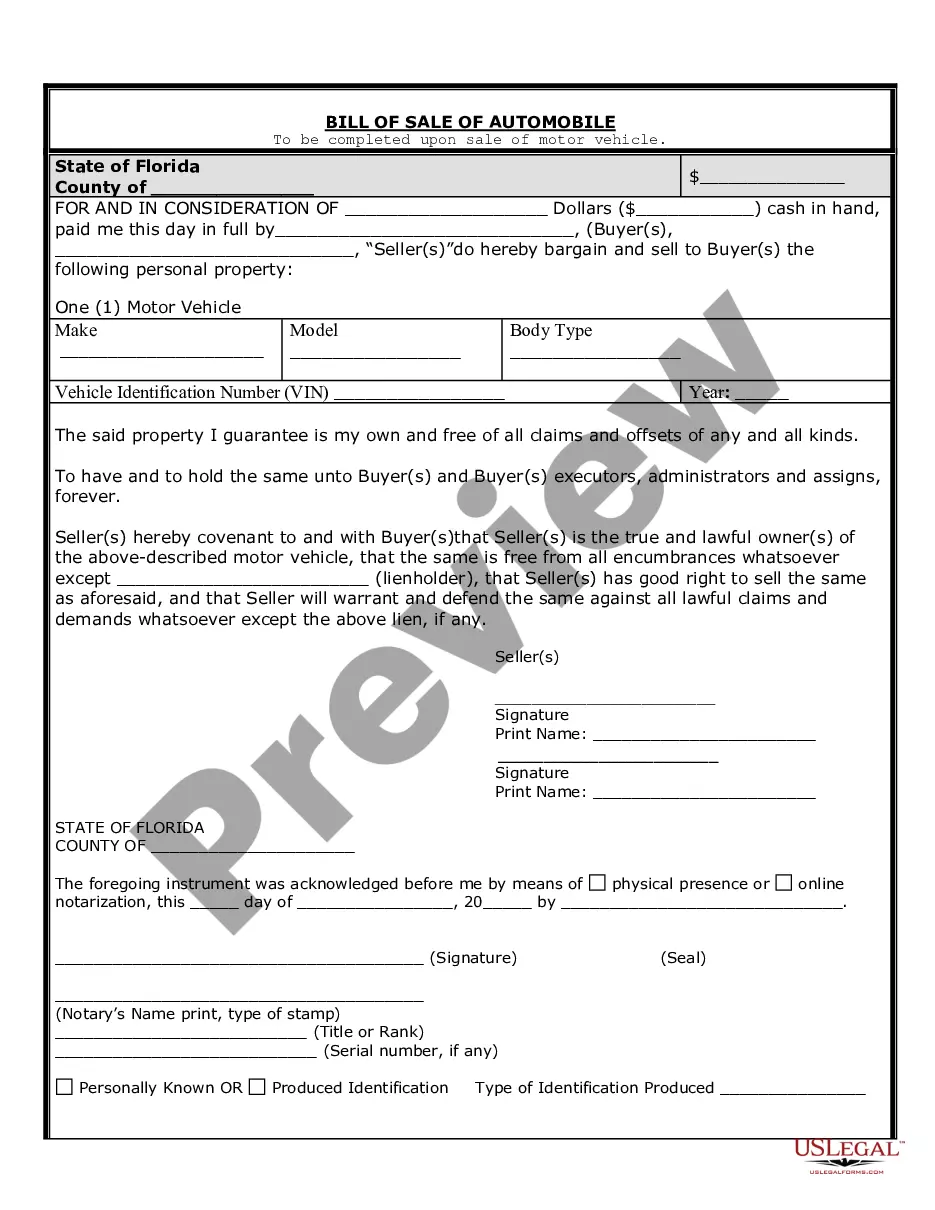
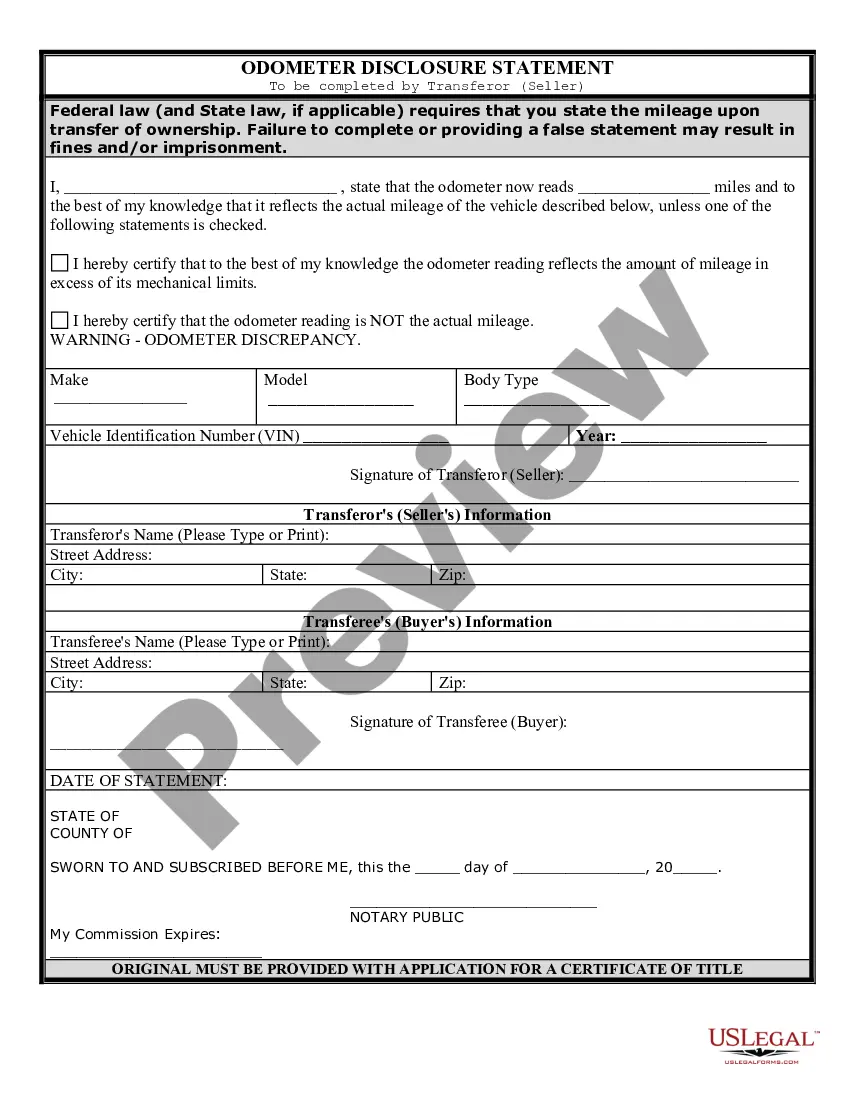
Florida Bill Automobile With An Initial Speed
Description
Get your form ready online
Our built-in tools help you complete, sign, share, and store your documents in one place.
Make edits, fill in missing information, and update formatting in US Legal Forms—just like you would in MS Word.
Download a copy, print it, send it by email, or mail it via USPS—whatever works best for your next step.
Sign and collect signatures with our SignNow integration. Send to multiple recipients, set reminders, and more. Go Premium to unlock E-Sign.
If this form requires notarization, complete it online through a secure video call—no need to meet a notary in person or wait for an appointment.
We protect your documents and personal data by following strict security and privacy standards.

Make edits, fill in missing information, and update formatting in US Legal Forms—just like you would in MS Word.

Download a copy, print it, send it by email, or mail it via USPS—whatever works best for your next step.

Sign and collect signatures with our SignNow integration. Send to multiple recipients, set reminders, and more. Go Premium to unlock E-Sign.

If this form requires notarization, complete it online through a secure video call—no need to meet a notary in person or wait for an appointment.

We protect your documents and personal data by following strict security and privacy standards.
Looking for another form?









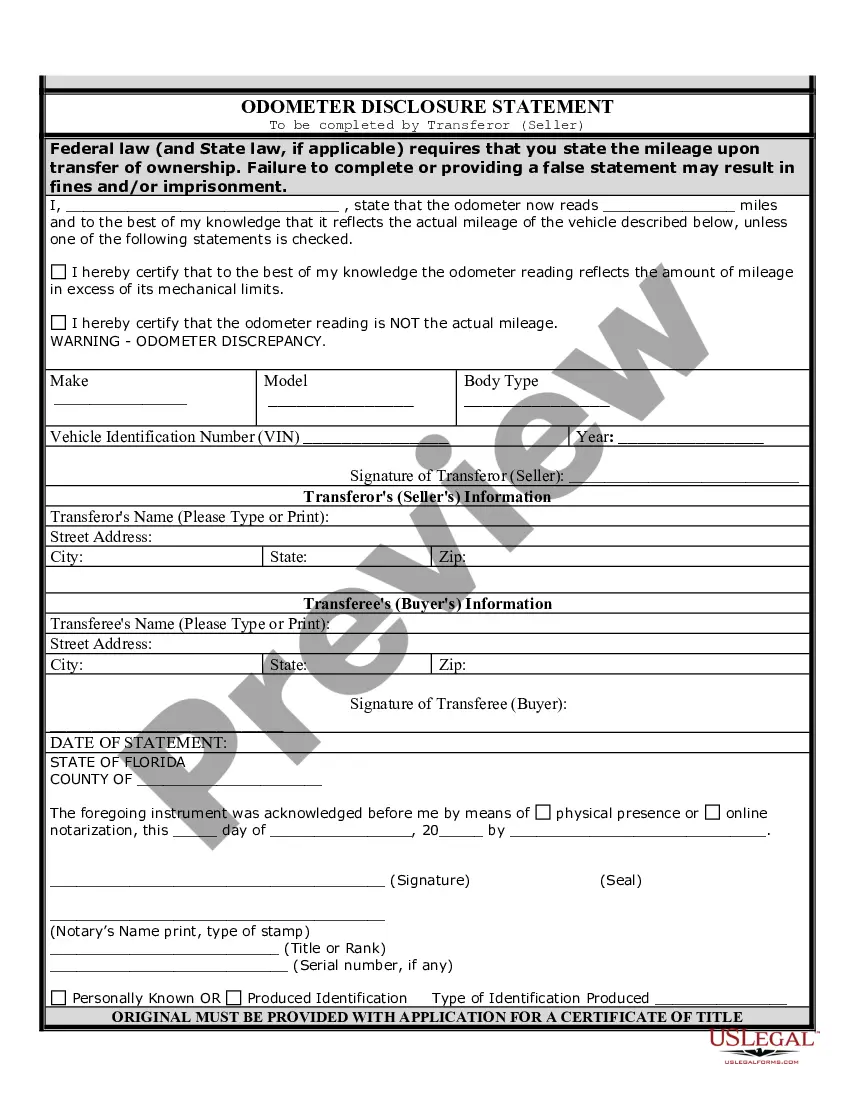
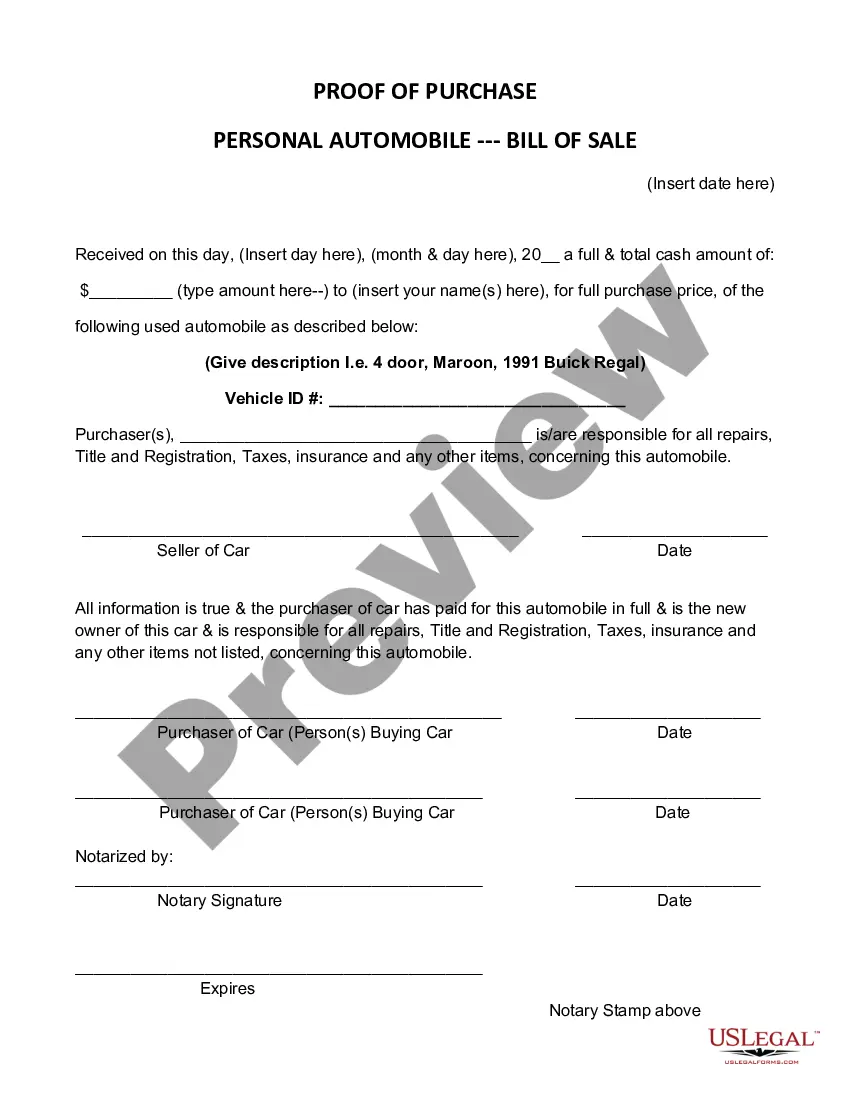
How to fill out Florida Bill Of Sale Of Automobile And Odometer Statement?
Managing legal papers and processes can be a lengthy addition to your day.
Florida Bill Automobile With An Initial Speed and similar documents frequently necessitate that you locate them and comprehend how to fill them out accurately.
Consequently, whether you are dealing with financial, legal, or personal issues, utilizing a comprehensive and convenient online directory of forms at your disposal will be immensely beneficial.
US Legal Forms is the premier online platform for legal templates, offering over 85,000 state-specific documents and various tools that assist you in completing your paperwork effortlessly.
Simply Log In to your account, find Florida Bill Automobile With An Initial Speed and obtain it immediately from the My documents section. You can also retrieve previously saved forms.
- Browse the collection of pertinent documents available to you with just one click.
- US Legal Forms gives you state- and county-specific forms ready for download at any time.
- Protect your document management processes with exceptional support that enables you to create any form in minutes without extra or hidden fees.
Form popularity
FAQ
Understanding Golf Cart Operation on Roads ing to Florida law, golf carts are considered low-speed vehicles (LSVs). LSVs are described as any vehicle with four wheels that travels at speeds just over 20 miles per hour but don't exceed 25 miles per hour.
Gravity's downward force and air resistance act on the arrow, and as a result, the arrow gradually falls to the floor. The arrow starts to move in a straight line but it is pulled downwards gradually due to the gravitational force and finally falls and comes to rest.
Golf carts are not required to be titled or registered and, therefore, are not required to be insured with PIP and PDL insurance coverage. Golf cart operators are not required to have a driver license; however, to operate a golf cart on designated public roadways, a person must be 14 years or older.
Answer and Explanation: When an archer shoots an arrow, the action force is the force by the string on the arrow. From Newton's third law, the reaction force should be the push force of the arrow on the string. This is because action and reaction forces act in a pair and they are equal and opposite.
The archer's paradox is the phenomenon of an arrow traveling in the direction it is pointed at full draw, when it seems that the arrow would have to pass through the starting position it was in before being drawn, where it was pointed to the side of the target. Arrow direction when braced and when at full draw.