Tenant Landlord Shut For Security Deposit
Description


Get your form ready online
Our built-in tools help you complete, sign, share, and store your documents in one place.
Make edits, fill in missing information, and update formatting in US Legal Forms—just like you would in MS Word.
Download a copy, print it, send it by email, or mail it via USPS—whatever works best for your next step.
Sign and collect signatures with our SignNow integration. Send to multiple recipients, set reminders, and more. Go Premium to unlock E-Sign.
If this form requires notarization, complete it online through a secure video call—no need to meet a notary in person or wait for an appointment.
We protect your documents and personal data by following strict security and privacy standards.

Make edits, fill in missing information, and update formatting in US Legal Forms—just like you would in MS Word.

Download a copy, print it, send it by email, or mail it via USPS—whatever works best for your next step.

Sign and collect signatures with our SignNow integration. Send to multiple recipients, set reminders, and more. Go Premium to unlock E-Sign.

If this form requires notarization, complete it online through a secure video call—no need to meet a notary in person or wait for an appointment.

We protect your documents and personal data by following strict security and privacy standards.
Looking for another form?






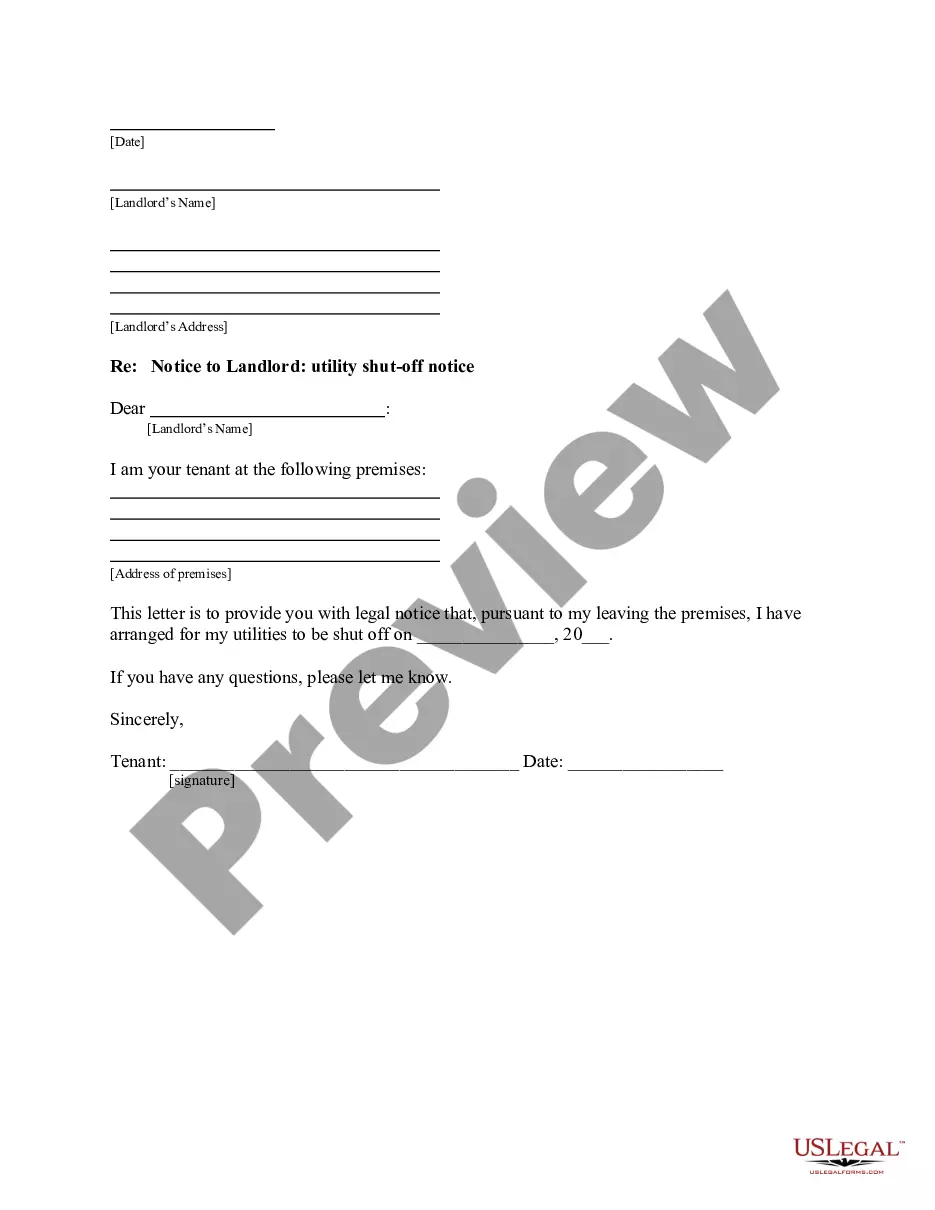
How to fill out Connecticut Letter From Tenant To Landlord - Utility Shut Off Notice To Landlord Due To Tenant Vacating Premises?
- Log into your US Legal Forms account if you're an existing user. Click on the Download button for the needed form template. Verify that your subscription is active; if not, renew it according to your payment plan.
- If you are a new user, start by reviewing the form descriptions and preview mode to select the correct template that fits your needs and complies with your local jurisdiction.
- Should you need additional templates, utilize the Search tab to identify the appropriate forms. Confirm that they are suitable before proceeding.
- To purchase the document, click on the Buy Now button and select your desired subscription plan. Create an account to access the extensive library of resources.
- Complete your transaction by entering your credit card information or using your PayPal account to finalize the subscription.
- Download the form to your device. You can access it later in the 'My Forms' section of your profile whenever needed.
By using US Legal Forms, you can streamline your legal form acquisition process and ensure you have access to a robust library of templates tailored for diverse legal needs. Their extensive collection allows for easy customization, enabling you to create legal documents quickly and effectively.
Don't hesitate; start simplifying your legal process today by exploring the vast resources offered by US Legal Forms!
Form popularity
FAQ
In Missouri, landlords must return security deposits within 30 days after the tenant moves out, minus any deductions for damages or unpaid rent. Landlords are required to provide an itemized list of any deductions made from the deposit. If a landlord does not comply with these laws, tenants have the right to take legal action. It's beneficial to consult the US Legal Forms platform to understand your rights and responsibilities concerning tenant landlord shut for security deposit in Missouri.
To win a court case against a landlord, ensure you have documented evidence of your claims, such as communication records and photos. Clearly outline how your landlord violated the rental agreement or local laws regarding tenant rights, including security deposit issues. Present your case clearly and confidently in court, focusing on the facts. Using resources from US Legal Forms can help you prepare the necessary documentation and understand the legal process better.
In California, you can report your landlord to the California Department of Consumer Affairs, which oversees landlord-tenant disputes. Additionally, local housing authorities can provide assistance and may have specific regulations regarding security deposits. If your landlord's actions are particularly egregious, you may also consider reporting them to your local housing court. Remember, knowing your rights related to tenant landlord shut for security deposit issues will empower you to take action.
To sue your landlord for your deposit, first gather evidence such as your lease agreement, photographs of the rental property, and any communication you've had regarding your security deposit. Then, you can file a claim in small claims court, often without the need for a lawyer. Be prepared to explain why you believe the landlord has not returned your security deposit, as this will help in your case. Utilizing the US Legal Forms platform can provide resources to assist you in the process.
Landlords in Minnesota must adhere to specific legal standards and cannot engage in illegal actions such as retaliating against tenants for asserting their rights, locking tenants out without legal procedure, or discriminating against tenants. Understanding these restrictions is essential for renters to protect themselves. The Tenant landlord shut for security deposit can help clarify these important rights and responsibilities.
Withholding rent in Minnesota typically requires a legitimate basis, such as the landlord's failure to address significant habitability issues. It is crucial for tenants to document problems and provide written notice to the landlord before withholding rent. For assistance and guidance, the Tenant landlord shut for security deposit offers resources to navigate these complex situations effectively.
In Minnesota, a landlord can deduct costs for unpaid rent, repairs for damages beyond normal wear and tear, and cleaning costs if the unit is not left in a clean condition. Each deduction must be itemized and justified. Tenants should be aware of their rights, as outlined in the Tenant landlord shut for security deposit, to ensure that any deductions are fair and lawful.
Deciding whether to sue a landlord for a security deposit often depends on the amount in question and the situation. If the landlord wrongfully withholds the deposit, legal action might be justified. However, before pursuing a lawsuit, consider less confrontational options such as negotiation or mediation. Seeking advice through the Tenant landlord shut for security deposit can provide insight into your next steps.
The security deposit law in Minnesota stipulates how landlords can manage tenant deposits. Landlords must provide a written receipt for the deposit and inform tenants of the conditions under which deductions may occur. Tenants can refer to the Tenant landlord shut for security deposit for clear guidance on enforcement of these laws when disputes arise.
In Minnesota, normal wear and tear refers to the expected deterioration of a rental property due to regular use. It includes minor scuffs on walls, worn carpet, and faded paint. The Tenant landlord shut for security deposit should focus on distinguishing between normal wear and tear and damage caused by the tenant's actions. Understanding this difference can help tenants protect their rights regarding their security deposits.