Hours Employee Overtime For Part Time
Description
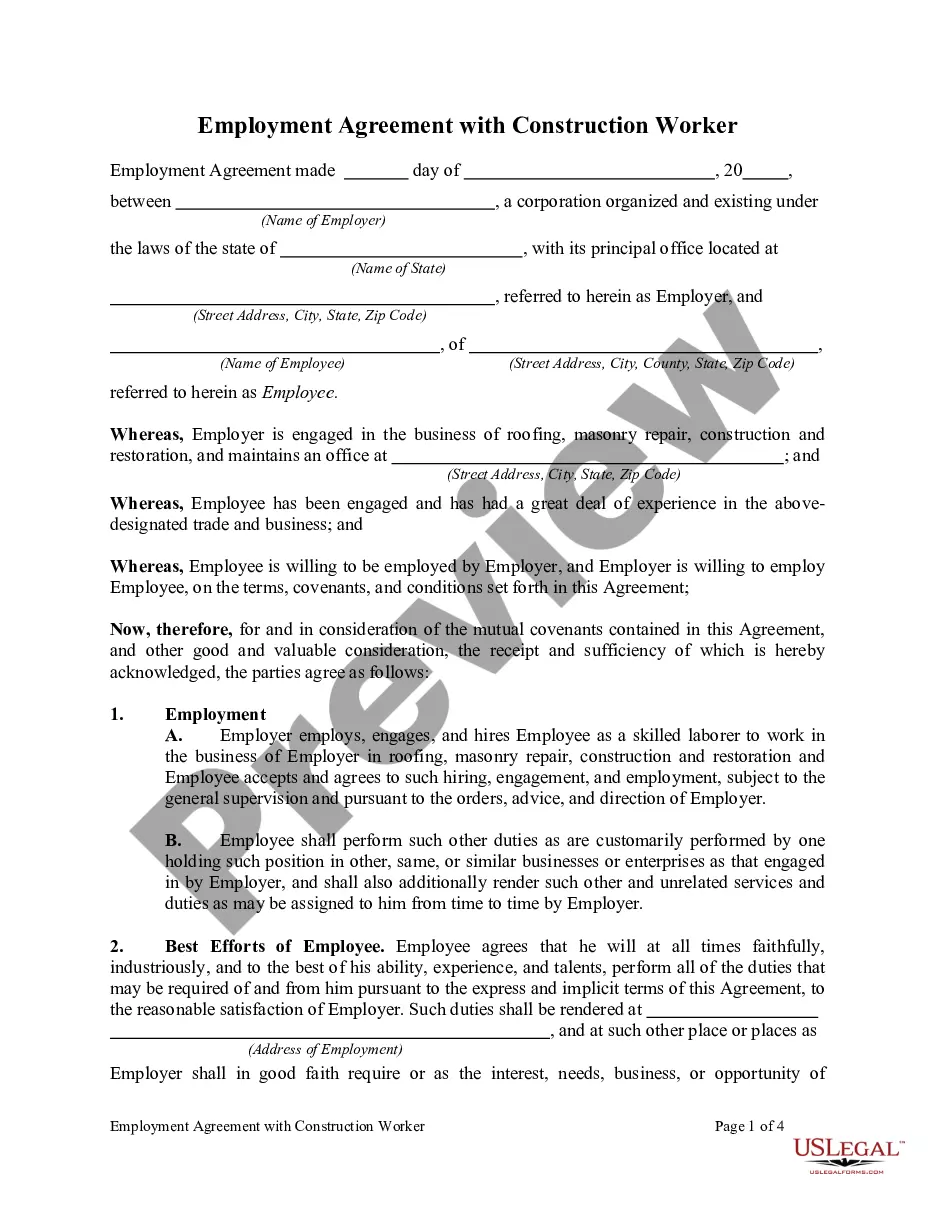
Get your form ready online
Our built-in tools help you complete, sign, share, and store your documents in one place.
Make edits, fill in missing information, and update formatting in US Legal Forms—just like you would in MS Word.
Download a copy, print it, send it by email, or mail it via USPS—whatever works best for your next step.
Sign and collect signatures with our SignNow integration. Send to multiple recipients, set reminders, and more. Go Premium to unlock E-Sign.
If this form requires notarization, complete it online through a secure video call—no need to meet a notary in person or wait for an appointment.
We protect your documents and personal data by following strict security and privacy standards.

Make edits, fill in missing information, and update formatting in US Legal Forms—just like you would in MS Word.

Download a copy, print it, send it by email, or mail it via USPS—whatever works best for your next step.

Sign and collect signatures with our SignNow integration. Send to multiple recipients, set reminders, and more. Go Premium to unlock E-Sign.

If this form requires notarization, complete it online through a secure video call—no need to meet a notary in person or wait for an appointment.

We protect your documents and personal data by following strict security and privacy standards.
Looking for another form?






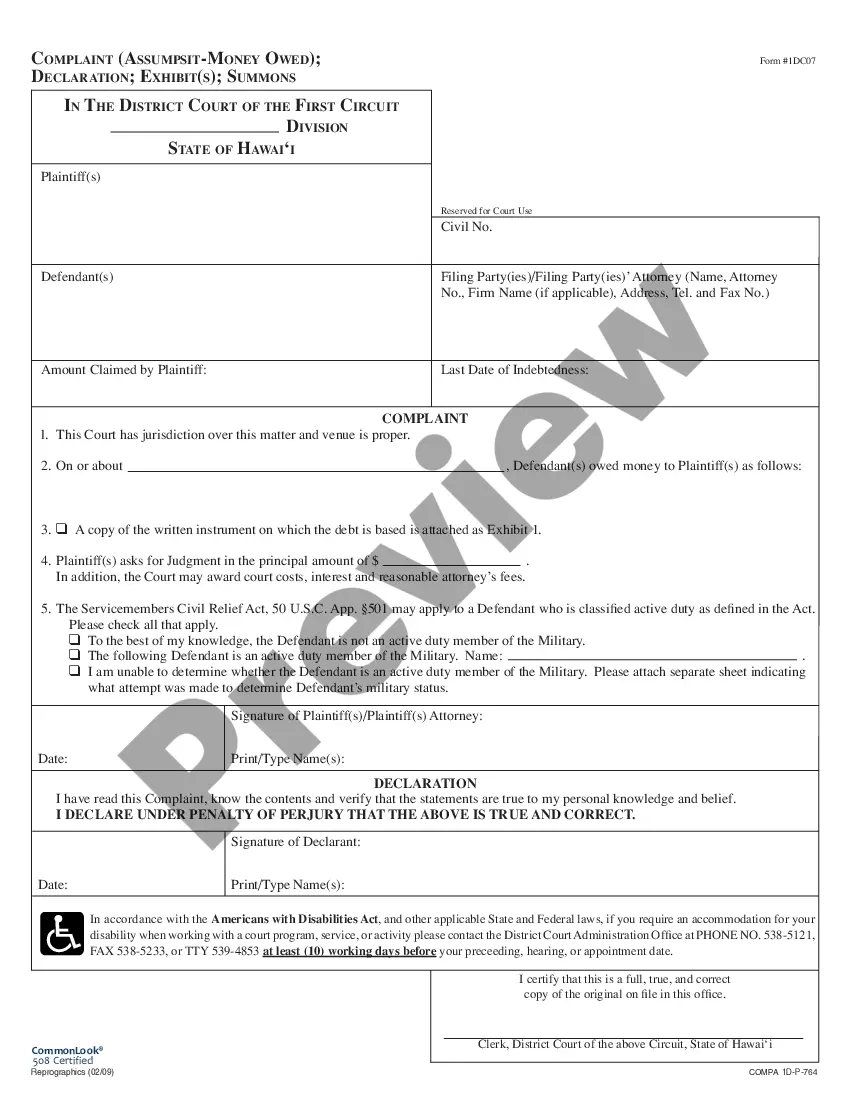


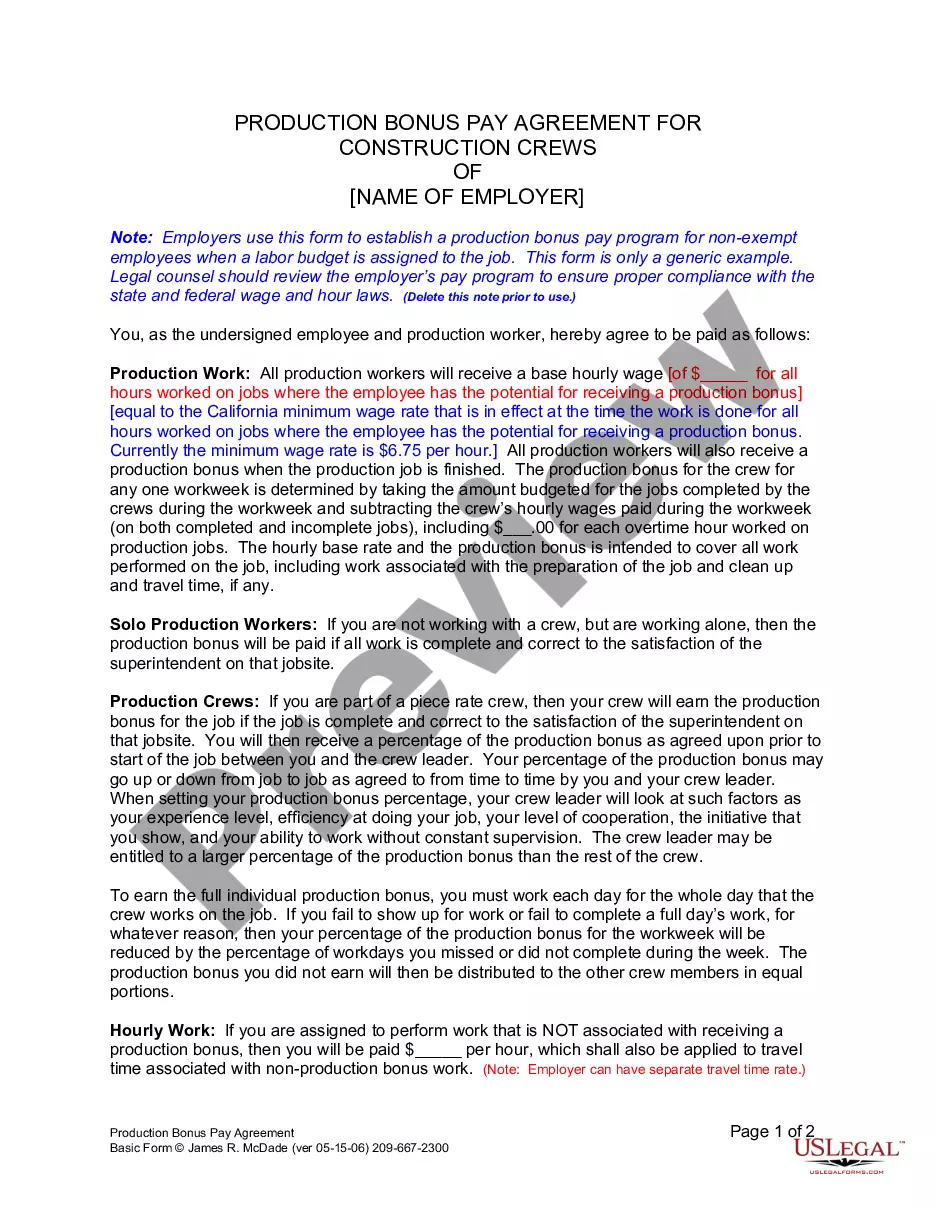
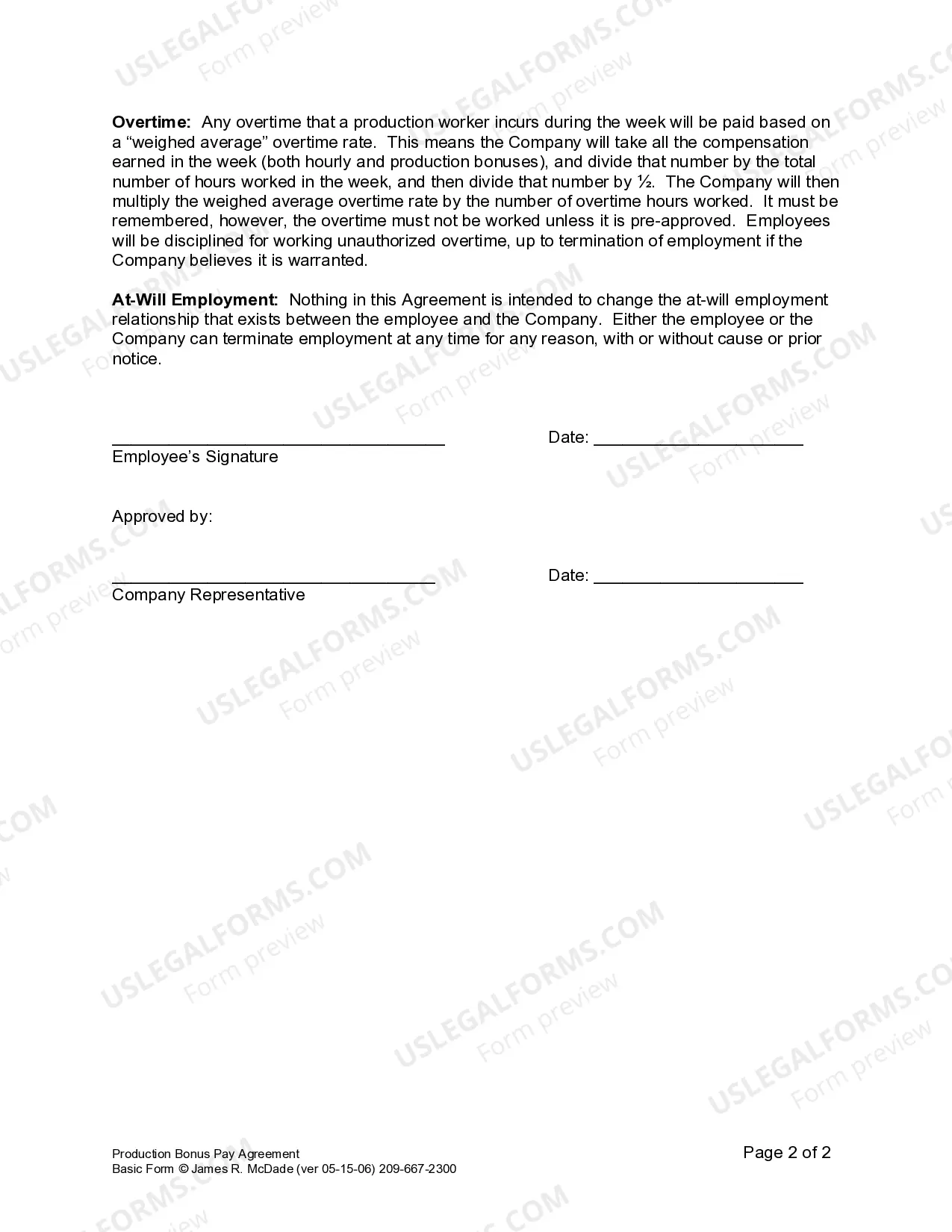
How to fill out California Production Bonus Pay Agreement For Construction?
Dealing with legal paperwork and processes can be a lengthy addition to your routine.
Hours Employee Overtime For Part Time and similar forms typically require you to search for them and figure out how to fill them out correctly.
Thus, whether you are managing financial, legal, or personal issues, utilizing a comprehensive and user-friendly online repository of forms readily available will be beneficial.
US Legal Forms is the premier online source of legal templates, featuring over 85,000 state-specific forms and various resources to assist you in swiftly completing your documents.
Is this your first time using US Legal Forms? Sign up and create an account in a few minutes to gain access to the form library and Hours Employee Overtime For Part Time. Then, follow the steps below to fill out your form: Ensure you have the right form by using the Preview option and reviewing the form details. Select Buy Now when ready, and choose the monthly subscription plan that suits your requirements. Click Download then complete, eSign, and print the form. US Legal Forms has twenty-five years of experience assisting clients with their legal documents. Find the form you need today and streamline any process effortlessly.
- Explore the collection of relevant documents accessible to you with just a single click.
- US Legal Forms provides you with state- and county-specific forms that can be downloaded at any time.
- Safeguard your document handling processes with a high-quality service that allows you to create any form within minutes without extra or concealed fees.
- Simply Log In to your account, find Hours Employee Overtime For Part Time and obtain it instantly from the My documents section.
- You can also access previously saved forms.
Form popularity
FAQ
What is the formula to calculate overtime pay? ing to the FLSA, the formula for calculating overtime pay is the nonexempt employee's regular rate of pay x 1.5 x overtime hours worked. This calculation may differ in states that have requirements, such as double time, which are more favorable to the employee.
IRS definition For the purpose of the Affordable Care Act (ACA), the IRS acknowledges a full-time employee as someone who works an average of at least 30 hours per week, or 130 hours per month. Part-time employees are those who work less than 30 hours per week (on average) or 130 hours per month.
As a general rule, managers usually hold part-time work hours at half of full-time hours (or maybe just a bit more). So, if full-time for your business is 40 hours per week, part-time is anywhere from 20 hours to 28 hours per week.
When an employer has a 40-hour workweek, employees who are scheduled to work 40 hours per week are 1.0 FTEs. Employees scheduled to work 20 hours per week are 0.5 FTEs. An employer with a 35-hour workweek would simply divide the employee's scheduled hours by 35 to determine the FTE.
The calculation of full-time equivalent (FTE) is an employee's scheduled hours divided by the employer's hours for a full-time workweek. When an employer has a 40-hour workweek, employees who are scheduled to work 40 hours per week are 1.0 FTEs. Employees scheduled to work 20 hours per week are 0.5 FTEs.