Agree Period Wage For A Job
Description
Get your form ready online
Our built-in tools help you complete, sign, share, and store your documents in one place.
Make edits, fill in missing information, and update formatting in US Legal Forms—just like you would in MS Word.
Download a copy, print it, send it by email, or mail it via USPS—whatever works best for your next step.
Sign and collect signatures with our SignNow integration. Send to multiple recipients, set reminders, and more. Go Premium to unlock E-Sign.
If this form requires notarization, complete it online through a secure video call—no need to meet a notary in person or wait for an appointment.
We protect your documents and personal data by following strict security and privacy standards.

Make edits, fill in missing information, and update formatting in US Legal Forms—just like you would in MS Word.

Download a copy, print it, send it by email, or mail it via USPS—whatever works best for your next step.

Sign and collect signatures with our SignNow integration. Send to multiple recipients, set reminders, and more. Go Premium to unlock E-Sign.

If this form requires notarization, complete it online through a secure video call—no need to meet a notary in person or wait for an appointment.

We protect your documents and personal data by following strict security and privacy standards.
Looking for another form?






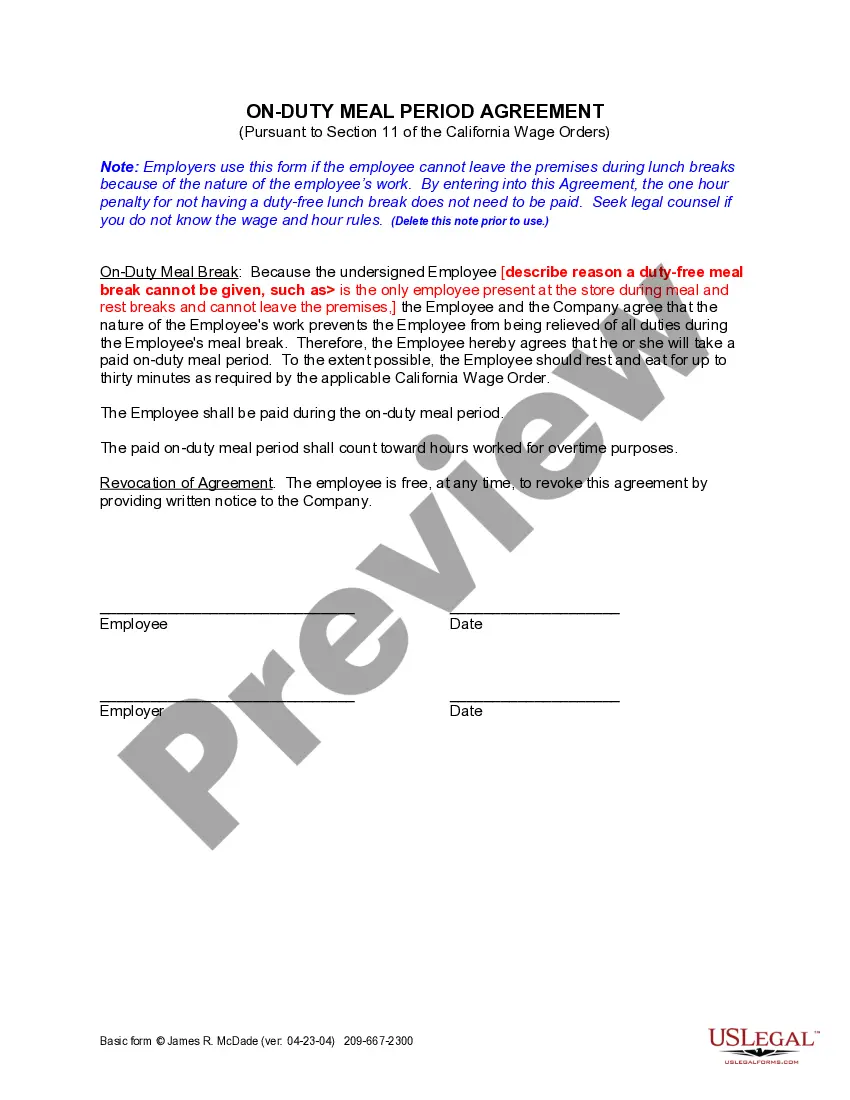
How to fill out California On Duty Meal Period Agreement?
- If you're an existing user, log in to your account and download the necessary form template by clicking the Download button. Ensure your subscription is active, or renew it as necessary.
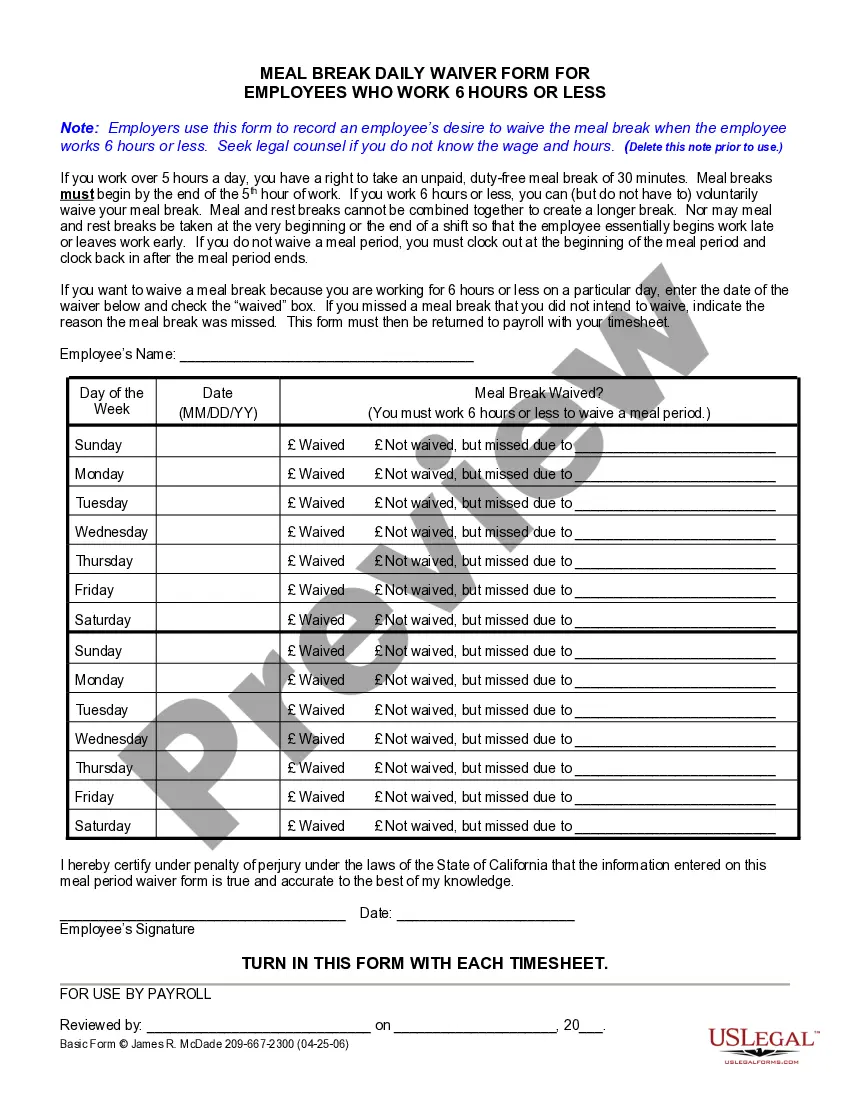
- For first-time users, start by reviewing the Preview mode and the form description to confirm you've selected the correct template that meets your jurisdictional requirements.
- If the template doesn't meet your needs, utilize the Search tab above to explore other options. Once you find a suitable template, you can move on to the next step.
- Purchase the document by clicking the Buy Now button and selecting your preferred subscription plan. Make sure to create an account to unlock the library's extensive resources.
- Complete your payment using credit card details or through your PayPal account. Once payment is confirmed, you can download your form.
- Save the template on your device for completion and access it later through the My Forms section of your profile.
With US Legal Forms, you gain access to over 85,000 editable legal forms, enabling precise and compliant documentation. This robust collection is designed to cater to various legal needs while ensuring ease of use.
Experience the benefits of streamlined legal documentation today. Create your account and start utilizing US Legal Forms to simplify your legal needs!
Form popularity
FAQ
A work week generally consists of seven consecutive days, starting from any day of the week. For most businesses, this period runs from Sunday to Saturday, but it may vary by company policy. When you agree on a period wage for a job, it's crucial to clarify your expected work week, as it influences your overall compensation. Understanding this structure helps you better plan your work-life balance.
The term 'wage period' refers to the specific timeframe during which an employee earns their wages. Typically, this period can be weekly, bi-weekly, or monthly. When you agree on a period wage for a job, you establish how often you will receive your paychecks. Understanding wage periods helps ensure you manage your finances effectively and know what to expect from your employer.
Agreeing to a salary range involves clear communication about your expectations and a willingness to negotiate. When discussing your wage, present research-backed figures that reflect industry standards to navigate the conversation and reach a mutual agreement on a wage for a job that satisfies both you and your employer.
To determine your desired wages per week, divide your annual salary expectations by the number of weeks you plan to work. Ensure this weekly wage reflects your skills and market trends, as it will assist you in agreeing on a wage for a job that is fair and competitive.
The best answer for your desired wage is one that aligns with industry standards and your experience. Clearly state a salary range that you are comfortable with, as this opens up the conversation for negotiation and helps both parties agree on a wage for a job that fits well.
When asked for your desired wage, it’s important to specify a salary range rather than a single number. Research the average salaries for your position and industry to agree on a wage for a job that meets both your expectations and the employer's budget.
Putting 0 as your desired salary can be misleading. It may communicate a lack of understanding about your worth in the job market. Instead, do your research to determine an appropriate salary range to agree on a wage for a job that reflects your skills and experience.
To calculate period wage, you divide your total payment by the number of work periods, such as weeks or months. For instance, if you've agreed period wage for a job at an annual salary, just divide that amount by 12 for a monthly wage or by 52 for a weekly wage. This straightforward calculation helps you understand your earnings and manage your expenses effectively. If you're unsure about the specifics, the US Legal Forms platform can assist you with templates that simplify wage agreements.
The term for such a contract is generally called a fixed-term contract or a temporary employment agreement. In this arrangement, you agree period wage for a job for a specified length of time, which provides clarity for both you and your employer. This type of contract can help ensure that both parties understand their responsibilities and expectations. By defining the duration upfront, it simplifies planning and resource allocation.
To report a company to the labor board anonymously, you can use the online complaint forms provided by many labor boards. While submitting your complaint, ensure you provide as much detail as possible about the violation. You can also reach out to advocacy groups for help. Anonymity helps protect your identity while ensuring you advocate for fair wages and conditions in your workplace.