Break Employees With No Work
Description
Get your form ready online
Our built-in tools help you complete, sign, share, and store your documents in one place.
Make edits, fill in missing information, and update formatting in US Legal Forms—just like you would in MS Word.
Download a copy, print it, send it by email, or mail it via USPS—whatever works best for your next step.
Sign and collect signatures with our SignNow integration. Send to multiple recipients, set reminders, and more. Go Premium to unlock E-Sign.
If this form requires notarization, complete it online through a secure video call—no need to meet a notary in person or wait for an appointment.
We protect your documents and personal data by following strict security and privacy standards.

Make edits, fill in missing information, and update formatting in US Legal Forms—just like you would in MS Word.

Download a copy, print it, send it by email, or mail it via USPS—whatever works best for your next step.

Sign and collect signatures with our SignNow integration. Send to multiple recipients, set reminders, and more. Go Premium to unlock E-Sign.

If this form requires notarization, complete it online through a secure video call—no need to meet a notary in person or wait for an appointment.

We protect your documents and personal data by following strict security and privacy standards.
Looking for another form?

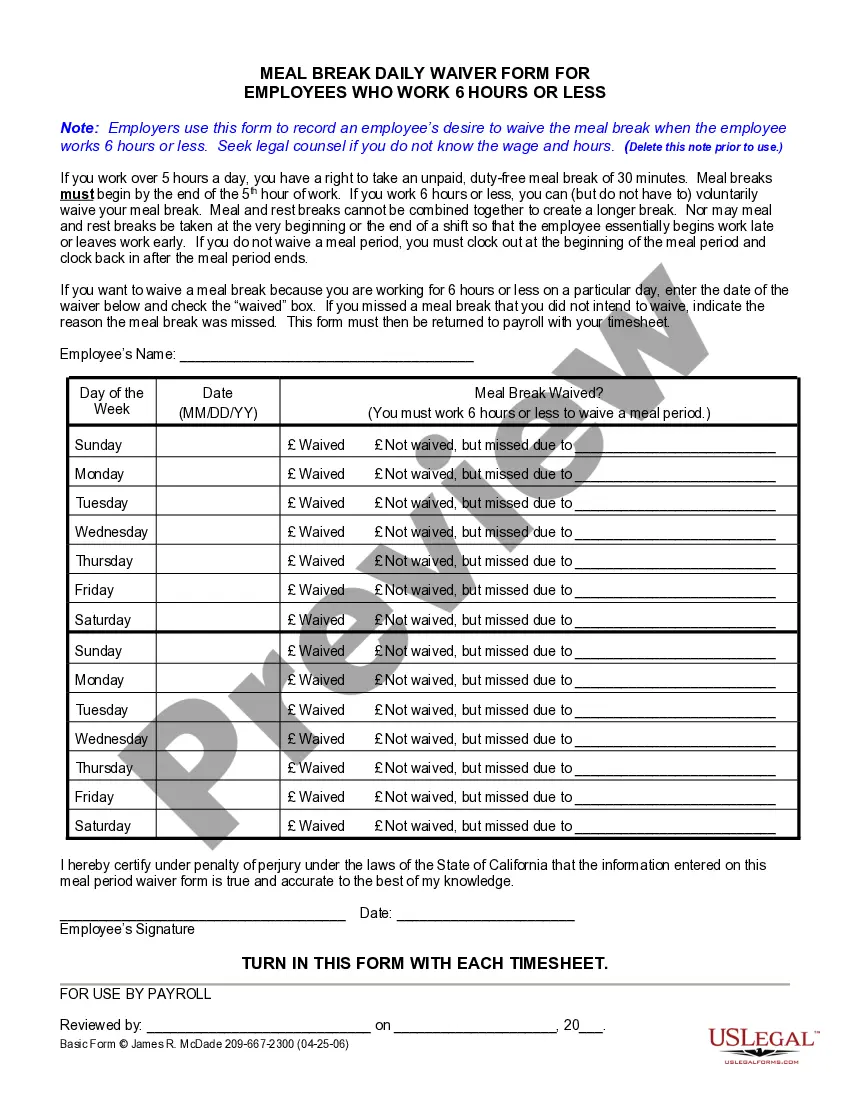
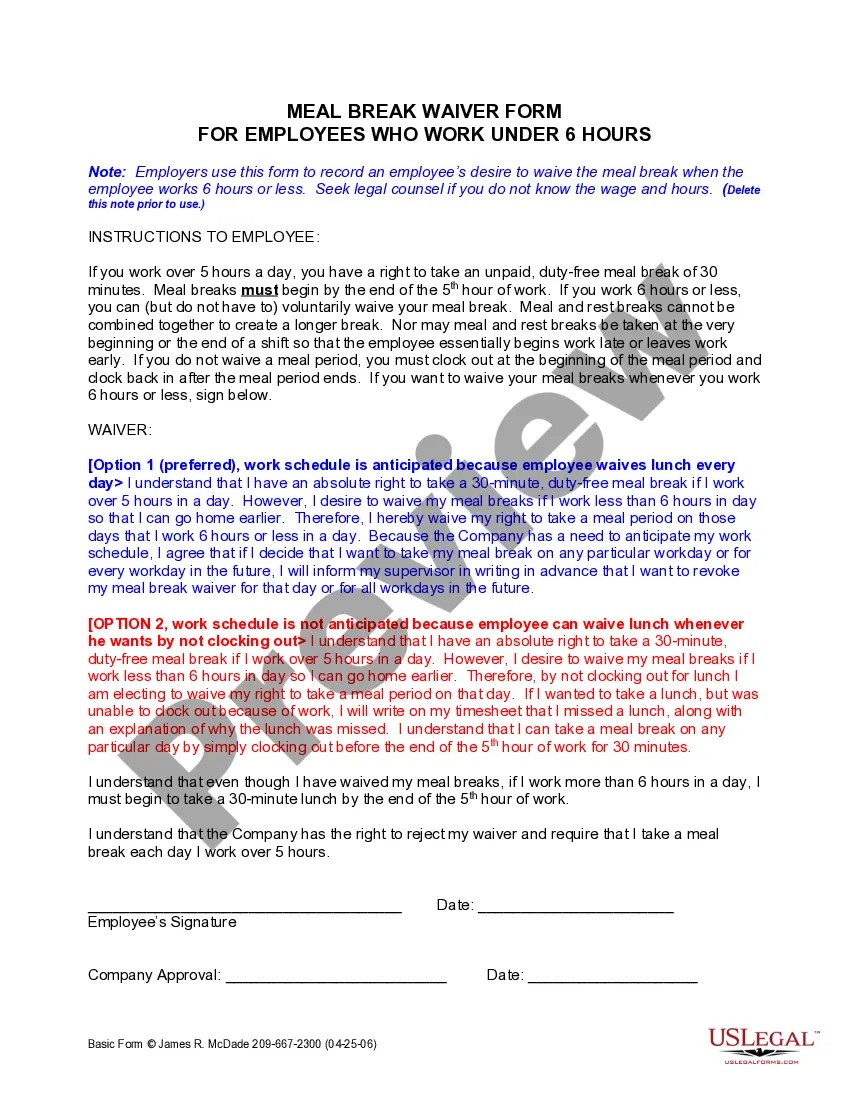
How to fill out California Meal Break Daily Waiver For 6 Hour Employees?
- Log in to your US Legal Forms account if you’re a returning user. Ensure your subscription is active to allow access to all necessary templates.
- If you’re new, start by previewing various form descriptions. Confirm that the document aligns with your requirements and your local jurisdiction's regulations.
- Utilize the Search bar if you need a different template. Find any inconsistencies easily and select the accurate form for your needs.
- Purchase the required document by clicking the Buy Now button. Choose your preferred subscription plan and register an account to access the complete library.
- Complete your purchase by entering your payment details, whether by credit card or PayPal.
- Once your transaction is confirmed, download the form. Save it to your device for immediate use, and remember you can find it anytime in the My Forms section of your profile.
With US Legal Forms, accessing vital legal documents has never been more straightforward, ensuring that both individuals and attorneys can be efficient in their legal paperwork.
Ready to streamline your legal documentation? Visit US Legal Forms today and take advantage of the vast resources available!
Form popularity
FAQ
Yes, an employer may refuse to provide breaks unless mandated by state law or company policy. However, not allowing breaks can lead to employee dissatisfaction and decreased productivity. It is essential to communicate with your employer about the importance of breaks for employees with no work. Consider utilizing resources like UsLegalForms to understand your rights and be well-informed about workplace regulations.
Indiana does not have a specific law concerning work breaks for employees. Employers generally decide their break policies, often allowing breaks for employees with no work to prevent fatigue. It is advisable to speak with your employer to clarify their specific regulations regarding breaks. Every employee deserves to know their rights and access the rest they need during shifts.
In Maryland, there are no state-mandated laws specifically requiring employers to provide breaks. However, if employees work more than 4 consecutive hours, employers are encouraged to offer breaks. This approach supports breaks for employees with no work, thus enhancing workplace morale. Be proactive and inquire about your employer's break policy to ensure you get the necessary rest during your shifts.
The maximum time an employee can work without a break often varies by state and company policy. In most cases, after 4 hours of work, it's beneficial for employees to have a break. This practice is designed to help combat fatigue for workers with no work, enhancing overall performance and satisfaction. Always verify the specific regulations in your state to understand your rights and obtain the necessary breaks.
Legally, there is no defined longest shift without a break across various states. Many companies aim to offer breaks to support their employees. Workers may find themselves in shifts that require breaks to sustain energy and focus. Always check state laws and consult your employer regarding their policies on breaks for employees with no work, ensuring you stay refreshed and engaged.
In Minnesota, employees working an 8-hour shift are entitled to a 30-minute meal break if their shift exceeds 8 hours. Additionally, employers should allow short breaks as needed. However, this is not legally mandated, so your employer can determine the frequency and duration. Keep in mind that breaks are essential; they help break employees with no work to recharge and maintain productivity.
During breaks, employees generally have the right to relax and use their time as they choose. However, employers can set reasonable guidelines so that workplace conduct remains professional. If your employer restricts your activities during breaks excessively, it may be worth discussing the boundaries of your rights with them. Breaking employees with no work means allowing personal time, promoting a healthier workplace.
OSHA has no explicit rules that require employers to provide breaks, but it does recognize the value of breaks for maintaining health and safety. Employers are encouraged to develop policies that promote adequate rest periods. Ensuring breaks helps break employees with no work effectively, leading to a more positive work environment. It's beneficial for both employer and employee to prioritize these practices.
If your employer fails to provide breaks, it is essential to address the issue openly. Start by having a conversation with your supervisor about your need for breaks, as it could be a misunderstanding. If the situation doesn't change, consider reaching out to HR or consulting with labor organizations for guidance. Ultimately, knowing your rights can help protect you from being break employees with no work.
OSHA does not specify the number of breaks during an 8-hour work shift. Instead, it advises that employees should have periods of rest to prevent fatigue. Many employers choose to incorporate breaks into their schedules, helping to break employees with no work. This approach not only benefits employee health but also improves job performance.