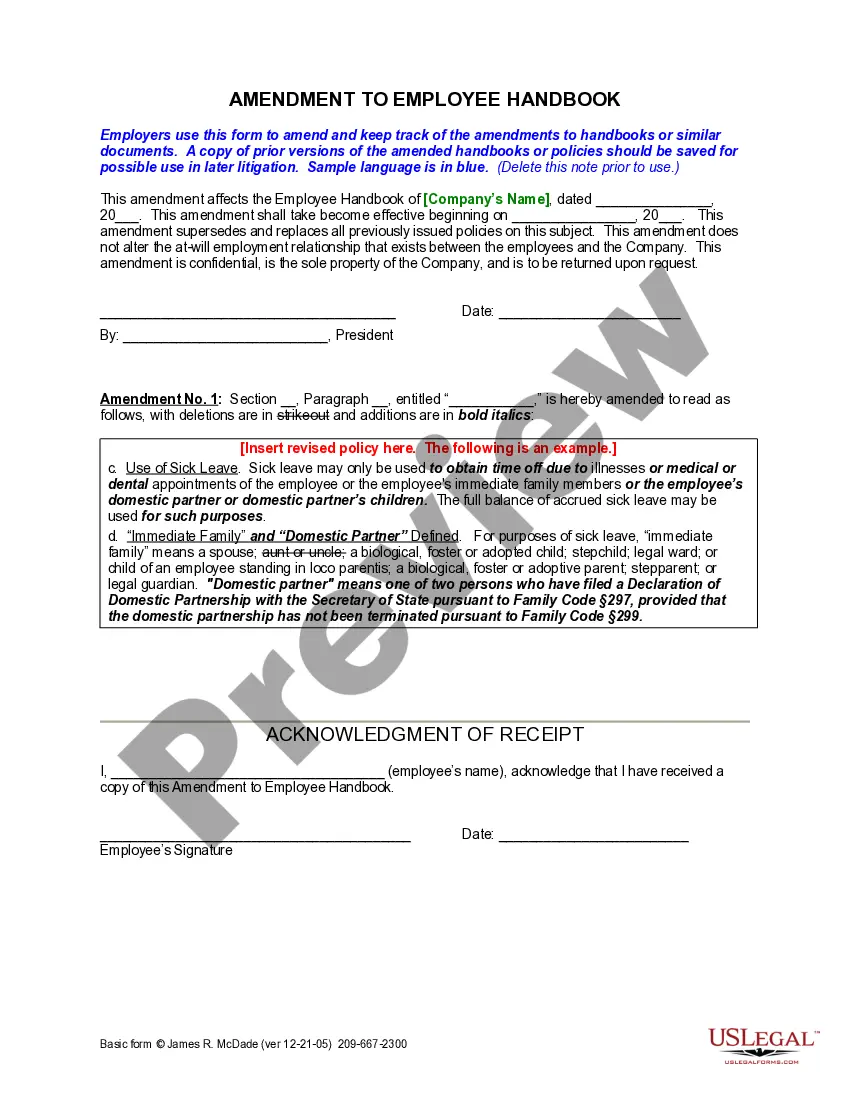
Employee Handbook Amendment Sample With Time
Description

Get your form ready online
Our built-in tools help you complete, sign, share, and store your documents in one place.
Make edits, fill in missing information, and update formatting in US Legal Forms—just like you would in MS Word.
Download a copy, print it, send it by email, or mail it via USPS—whatever works best for your next step.
Sign and collect signatures with our SignNow integration. Send to multiple recipients, set reminders, and more. Go Premium to unlock E-Sign.
If this form requires notarization, complete it online through a secure video call—no need to meet a notary in person or wait for an appointment.
We protect your documents and personal data by following strict security and privacy standards.

Make edits, fill in missing information, and update formatting in US Legal Forms—just like you would in MS Word.

Download a copy, print it, send it by email, or mail it via USPS—whatever works best for your next step.

Sign and collect signatures with our SignNow integration. Send to multiple recipients, set reminders, and more. Go Premium to unlock E-Sign.

If this form requires notarization, complete it online through a secure video call—no need to meet a notary in person or wait for an appointment.

We protect your documents and personal data by following strict security and privacy standards.
Looking for another form?


How to fill out California Amendment To Employee Handbook?
Whether for business purposes or for individual matters, everyone has to manage legal situations at some point in their life. Completing legal documents needs careful attention, starting with picking the right form template. For example, when you select a wrong edition of the Employee Handbook Amendment Sample With Time, it will be rejected when you send it. It is therefore important to have a dependable source of legal documents like US Legal Forms.
If you have to get a Employee Handbook Amendment Sample With Time template, follow these easy steps:
- Get the sample you need by using the search field or catalog navigation.
- Look through the form’s information to make sure it fits your case, state, and county.
- Click on the form’s preview to examine it.
- If it is the incorrect form, get back to the search function to find the Employee Handbook Amendment Sample With Time sample you need.
- Get the template when it matches your requirements.
- If you have a US Legal Forms profile, simply click Log in to access previously saved files in My Forms.
- In the event you don’t have an account yet, you can download the form by clicking Buy now.
- Pick the correct pricing option.
- Complete the profile registration form.
- Select your transaction method: use a bank card or PayPal account.
- Pick the file format you want and download the Employee Handbook Amendment Sample With Time.
- After it is saved, you can complete the form by using editing applications or print it and finish it manually.
With a vast US Legal Forms catalog at hand, you never have to spend time seeking for the appropriate sample across the internet. Utilize the library’s simple navigation to find the correct form for any occasion.
Form popularity
FAQ
How to Amend an Employee Handbook Step 1: Review Current Handbook to Identify Inaccuracies and Inconsistencies. ... Step 2: Assemble All Materials Reflecting Changes in Policies or Procedures. ... Step 3: Assemble All Materials Reflecting No Policies or Procedures. ... Step 4: Conduct Research to Identify Current and Emerging Trends.
Consider the impact on morale and on employees' finances, benefits, work/life balance and job expectations when determining the amount of notice and the method of communicating the change.
Nine Tips for Writing an Employee Handbook Keep It Simple & Engaging. Use Your Handbook As A Communication Tool. Pay Attention to Format and Visuals. Clearly Mention Work Hours, Compensations, and Benefits. Mention Your Company Culture & How Employees Can Maintain The Same. Mention Legal Issues. Mention Employee Appreciation.
Therefore, each time you update the handbook, date it ? or give it a version number ? and distribute it electronically to your entire employee population. Highlight the changes, and ask them to re-read the document, and sign and date an acknowledgement form.
Get to the point immediately by stating the new or changed policy. Explain the reasons for the policy and its benefits for both employees and the company. Employees will respond more positively when they understand the reasons for the policy and if they believe that it protects everyone's best interests.