Rent Increase Notification Letter With Tenants
Description

Get your form ready online
Our built-in tools help you complete, sign, share, and store your documents in one place.
Make edits, fill in missing information, and update formatting in US Legal Forms—just like you would in MS Word.
Download a copy, print it, send it by email, or mail it via USPS—whatever works best for your next step.
Sign and collect signatures with our SignNow integration. Send to multiple recipients, set reminders, and more. Go Premium to unlock E-Sign.
If this form requires notarization, complete it online through a secure video call—no need to meet a notary in person or wait for an appointment.
We protect your documents and personal data by following strict security and privacy standards.

Make edits, fill in missing information, and update formatting in US Legal Forms—just like you would in MS Word.

Download a copy, print it, send it by email, or mail it via USPS—whatever works best for your next step.

Sign and collect signatures with our SignNow integration. Send to multiple recipients, set reminders, and more. Go Premium to unlock E-Sign.

If this form requires notarization, complete it online through a secure video call—no need to meet a notary in person or wait for an appointment.

We protect your documents and personal data by following strict security and privacy standards.
Looking for another form?









How to fill out California Letter From Landlord To Tenant About Intent To Increase Rent And Effective Date Of Rental Increase?
Whether for corporate reasons or personal issues, everyone must manage legal circumstances at some stage in their lifetime.
Completing legal documents requires meticulous focus, starting from selecting the correct form template.
With an extensive US Legal Forms catalog available, you will never need to waste time searching for the correct sample online. Utilize the library’s user-friendly navigation to find the right template for any circumstance.
- For instance, if you choose an incorrect version of a Rent Increase Notification Letter With Tenants, it will be rejected upon submission.
- Thus, it is vital to have a reliable source of legal documents like US Legal Forms.
- If you need to obtain a Rent Increase Notification Letter With Tenants template, follow these simple steps.
- Acquire the sample you require by using the search field or browsing through the catalog.
- Review the form’s description to confirm it aligns with your situation, state, and county.
- Click on the form’s preview to inspect it.
- If it is the incorrect form, return to the search function to locate the Rent Increase Notification Letter With Tenants sample you need.
- Obtain the template if it fulfills your criteria.
- If you have a US Legal Forms account, just click Log in to access previously saved files in My documents.
- If you do not have an account yet, you may download the form by clicking Buy now.
- Select the appropriate pricing option.
- Complete the account registration form.
- Choose your payment method: you can use a credit card or PayPal account.
- Select the file format you prefer and download the Rent Increase Notification Letter With Tenants.
- Once it is downloaded, you can fill out the form using editing software or print it and complete it manually.
Form popularity
FAQ
In California, landlords can raise rent, but they must comply with state laws regarding the amount and notice period. For example, if you have a month-to-month lease, the landlord typically cannot raise the rent by more than a certain percentage without proper notification. It’s advisable to review your lease agreement and consult local regulations to understand your rights.
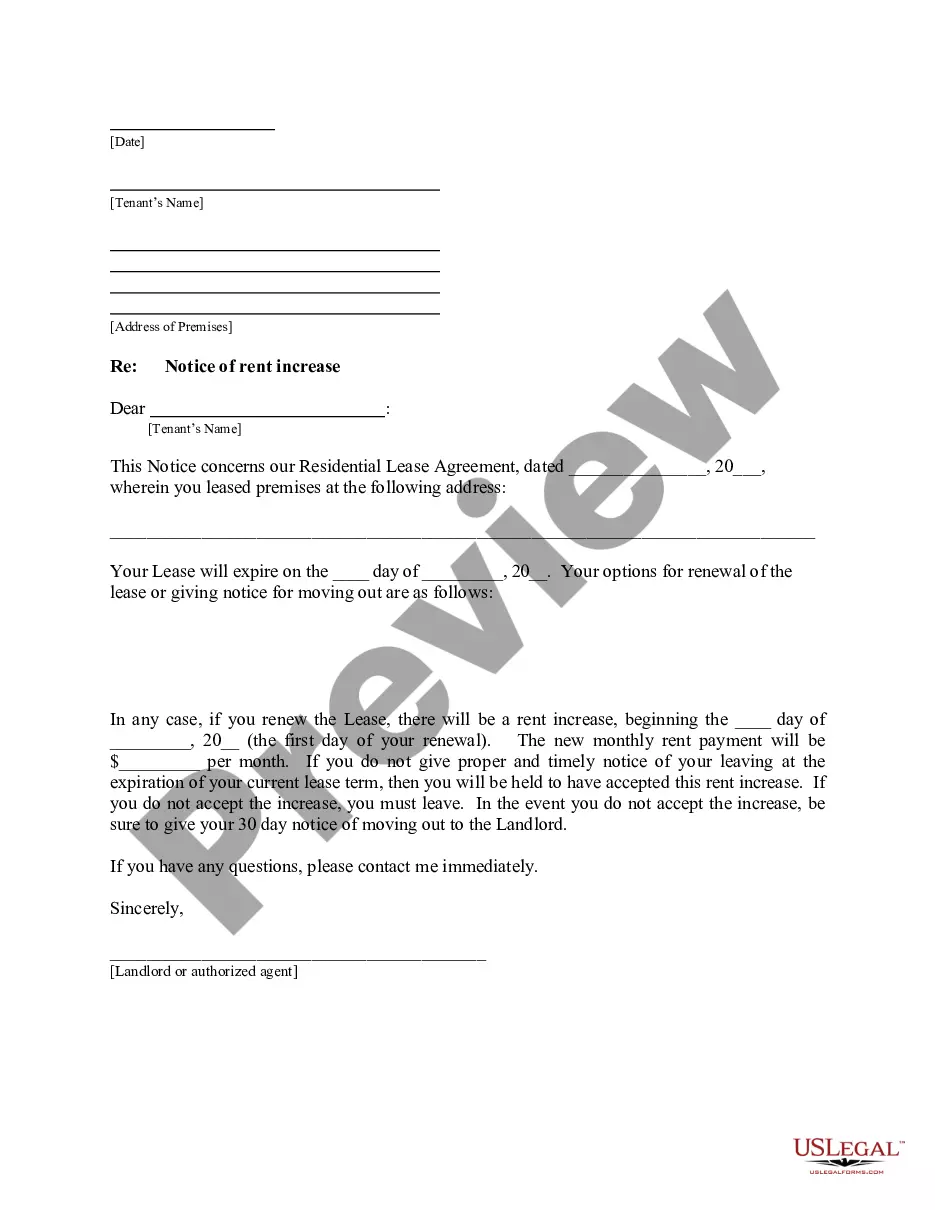
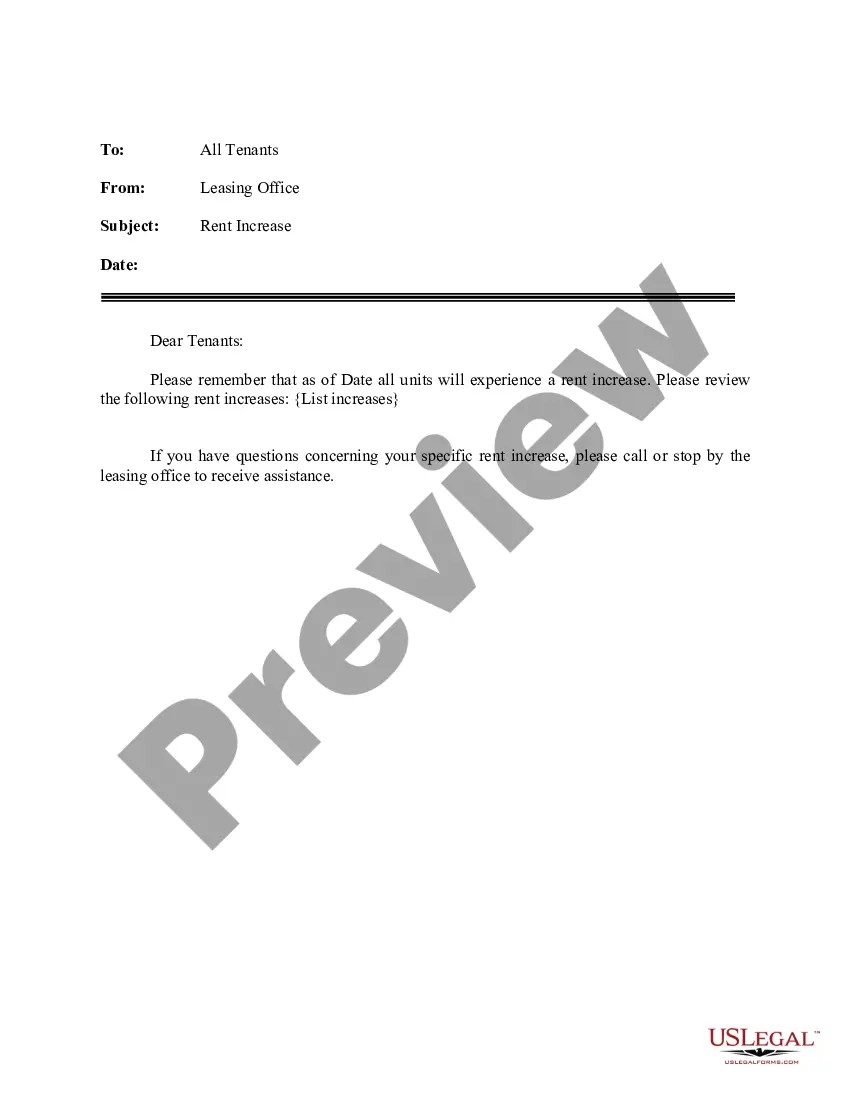
Writing a rent increase notification letter with tenants involves several key elements. Start with a clear subject line, include the date, and address the tenant formally. Clearly state the current rent, the new rent amount, the effective date, and any necessary details to ensure transparency and maintain a good relationship.
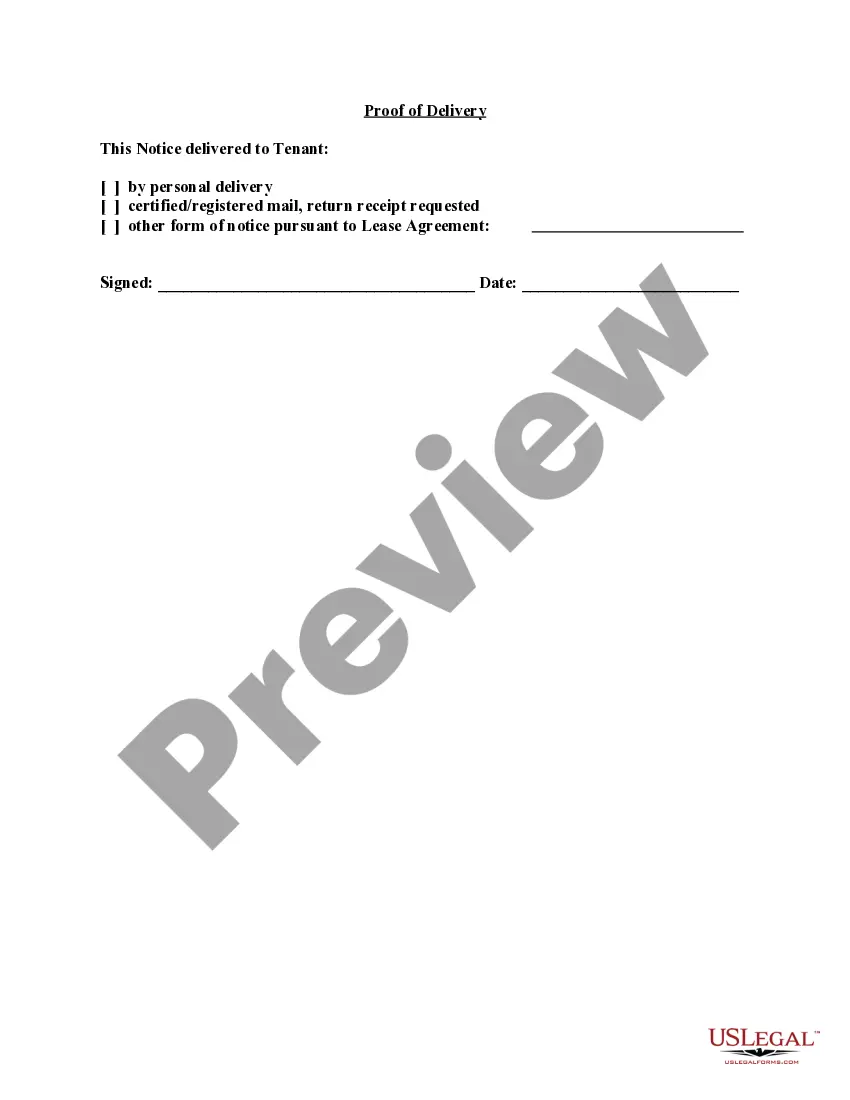
You must generally give tenants at least 30 days' notice before a rent increase takes effect. This can be done through a rent increase notification letter with tenants that clearly outlines the new rent and the effective date. It is crucial to follow your state's specific regulations to avoid potential disputes.
The notice period for a rent increase varies by state, but typically, landlords must provide at least 30 days' notice. This can be communicated through a rent increase notification letter with tenants. Always check local laws to ensure you comply with the required notice period, as some areas may have different regulations.
When explaining a rent increase to a tenant, you can use a sample rent increase notification letter with tenants as a guide. Begin by addressing the tenant, then clearly state the old rent amount, the new rent amount, and the reason for the increase, if applicable. Including a polite closing can help maintain a positive landlord-tenant relationship.
Informing a tenant about an increase in rent involves creating a formal rent increase notification letter with tenants. This letter should include both the new rent and the date when the increase takes effect. It’s important to follow state regulations regarding notice periods, ensuring the tenant understands the changes ahead of time.
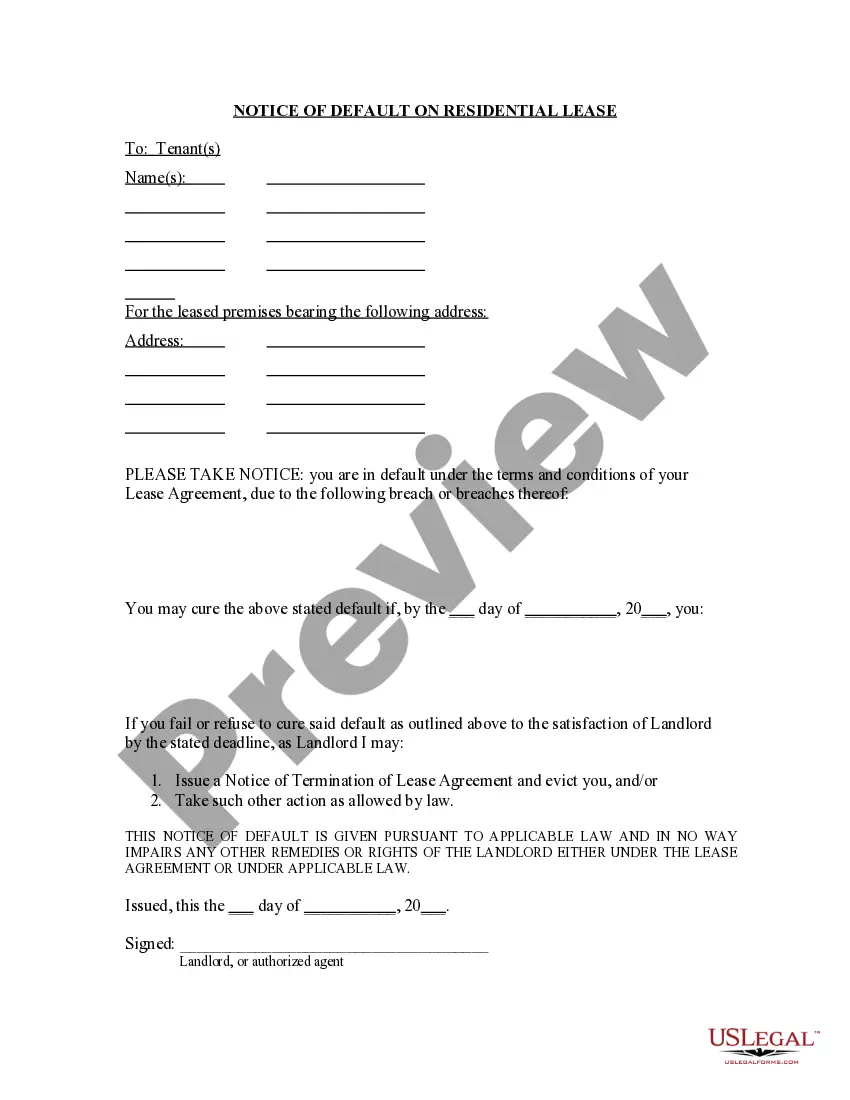
To inform a tenant about a rent increase, you should draft a clear rent increase notification letter with tenants. This letter should state the new rent amount, the effective date of the increase, and any reason for the change if required by local laws. Ensure you deliver this letter in a timely manner, allowing the tenant sufficient notice to prepare for the change.