California Letter Increase Rental Formula
Description

Get your form ready online
Our built-in tools help you complete, sign, share, and store your documents in one place.
Make edits, fill in missing information, and update formatting in US Legal Forms—just like you would in MS Word.
Download a copy, print it, send it by email, or mail it via USPS—whatever works best for your next step.
Sign and collect signatures with our SignNow integration. Send to multiple recipients, set reminders, and more. Go Premium to unlock E-Sign.
If this form requires notarization, complete it online through a secure video call—no need to meet a notary in person or wait for an appointment.
We protect your documents and personal data by following strict security and privacy standards.

Make edits, fill in missing information, and update formatting in US Legal Forms—just like you would in MS Word.

Download a copy, print it, send it by email, or mail it via USPS—whatever works best for your next step.

Sign and collect signatures with our SignNow integration. Send to multiple recipients, set reminders, and more. Go Premium to unlock E-Sign.

If this form requires notarization, complete it online through a secure video call—no need to meet a notary in person or wait for an appointment.

We protect your documents and personal data by following strict security and privacy standards.
Looking for another form?









How to fill out California Letter From Landlord To Tenant About Intent To Increase Rent And Effective Date Of Rental Increase?
Finding a reliable source for the most up-to-date and pertinent legal templates is a significant part of navigating bureaucracy.
Identifying the appropriate legal documents requires accuracy and careful consideration, which is why it's essential to obtain the California Letter Increase Rental Formula only from trustworthy providers like US Legal Forms. An incorrect template could squander your time and hinder your current situation.
Eliminate the complications associated with your legal documentation. Explore the extensive US Legal Forms collection to discover legal samples, evaluate their applicability to your case, and download them instantly.
- Use the library navigation or search tool to locate your document.
- Access the form’s details to verify if it meets the requirements for your state and county.
- View the form preview, if available, to ensure the template aligns with your interests.
- Return to the search if the California Letter Increase Rental Formula does not match your needs.
- If you are confident about the form’s relevance, proceed to download it.
- If you have an account, click Log in to verify and access your chosen forms in My documents.
- If you are new to the site, click Buy now to acquire the form.
- Select the payment plan that best fits your requirements.
- Continue to the registration process to complete your purchase.
- Finalize your payment using a bank card or PayPal.
- Select the file format for downloading the California Letter Increase Rental Formula.
- Once you have the document on your device, you may edit it using the editor or print it for manual completion.
Form popularity
FAQ
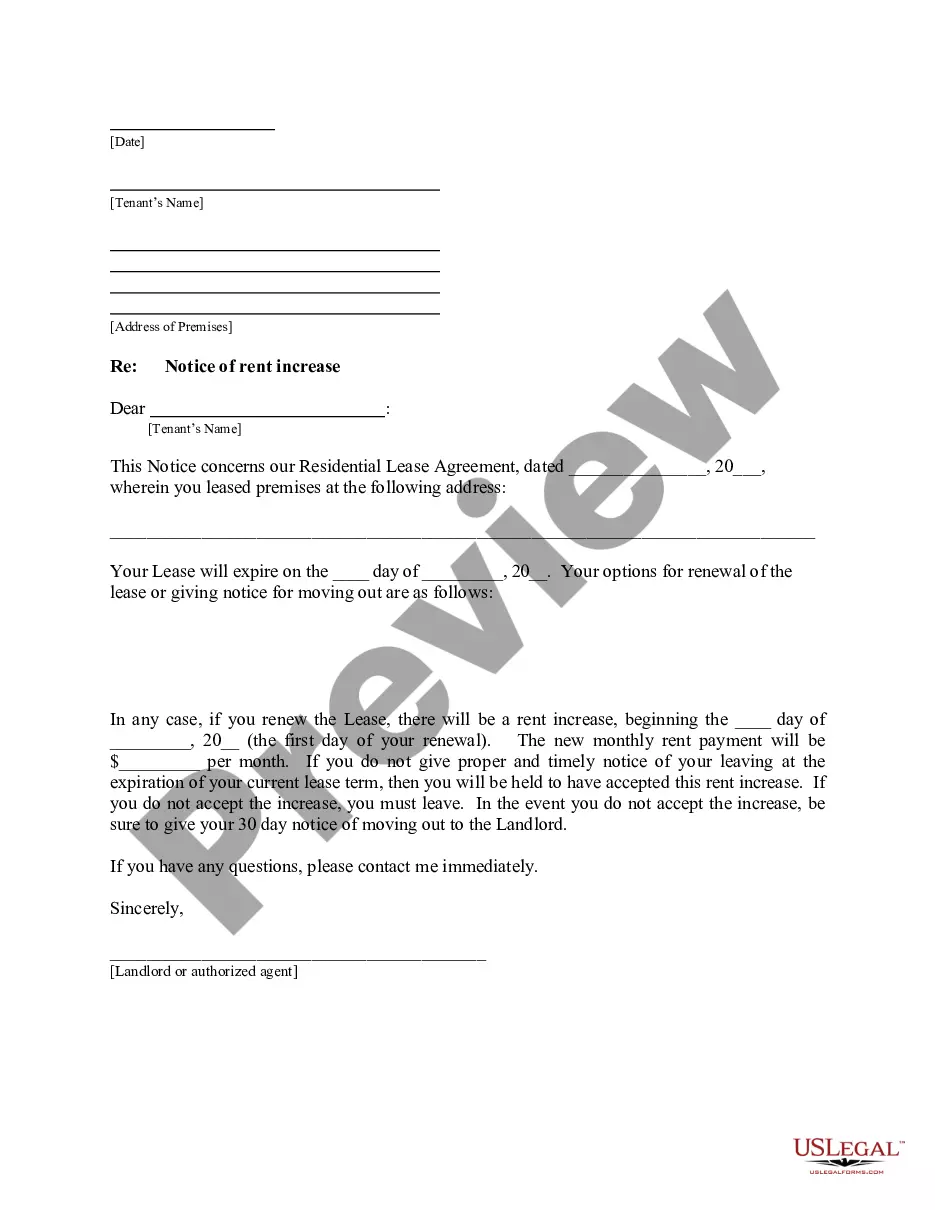
When writing a rent increase letter in California, start by addressing the tenant and clearly stating the purpose of the letter. Include details such as the current rent, the new rent amount, and the effective date of the increase, following the California letter increase rental formula. Be sure to express your appreciation for their tenancy and provide any necessary information regarding the process, such as how to address any questions they may have.
To calculate rent increase in California, first identify the current rent and consult the California letter increase rental formula that applies to your area. This formula often involves a percentage increase based on inflation rates or specific local ordinances. Make sure to factor in any allowable increases and exemptions to ensure compliance with state regulations. For assistance, uslegalforms offers resources and forms that can simplify the calculation process and keep you informed about your legal obligations.
Effective July 1, 2023, the annual rent adjustment maximum rate will be 9.2%. The Tenant Protection Program annual rent adjustment is based on 5% plus the percentage of the annual increase in the California Consumer Price Index (CPI) for All Urban Consumers for all items, if any. 5.156.
This year's CPI for the Los Angeles Area is 3.8%, which makes the maximum allowable annual rent increase under state law equal to 8.8% (5% plus CPI of 3.8%). During the week of , the U.S. Department of Labor and Statistics published the updated Consumer Price Index (CPI) for major urban areas.
What to include in a rent increase letter Date of the rent increase letter. Name and information of the tenant and landlord. Property address and unit number (if applicable). Reference to the expiration date of the existing lease. Current rent amount. Amount of rent increase. Date the rent increase will go into effect.
Limits on Rent Increases The Tenant Protection Act caps rent increases for most tenants in California. Landlords cannot raise rent more than 10% total or 5% plus the percentage change in the cost of living ? whichever is lower ? over a 12-month period.
California's Tenant Protection Act There is a maximum increase of 10% allowed in any given year, thus the Act's provision is often referred to as a ?rent cap.? To calculate the cost of living increase that is applicable to your market, use the Consumer Price Index (CPI) published by the Bureau of Labor Statistics.