California Landlord Increase Rent Without Section 13
Description

Get your form ready online
Our built-in tools help you complete, sign, share, and store your documents in one place.
Make edits, fill in missing information, and update formatting in US Legal Forms—just like you would in MS Word.
Download a copy, print it, send it by email, or mail it via USPS—whatever works best for your next step.
Sign and collect signatures with our SignNow integration. Send to multiple recipients, set reminders, and more. Go Premium to unlock E-Sign.
If this form requires notarization, complete it online through a secure video call—no need to meet a notary in person or wait for an appointment.
We protect your documents and personal data by following strict security and privacy standards.

Make edits, fill in missing information, and update formatting in US Legal Forms—just like you would in MS Word.

Download a copy, print it, send it by email, or mail it via USPS—whatever works best for your next step.

Sign and collect signatures with our SignNow integration. Send to multiple recipients, set reminders, and more. Go Premium to unlock E-Sign.

If this form requires notarization, complete it online through a secure video call—no need to meet a notary in person or wait for an appointment.

We protect your documents and personal data by following strict security and privacy standards.
Looking for another form?









How to fill out California Letter From Landlord To Tenant About Intent To Increase Rent And Effective Date Of Rental Increase?
Locating a reliable source to obtain the latest and pertinent legal templates is half the battle when dealing with bureaucratic processes.
Selecting the appropriate legal documents requires precision and meticulousness, which is why it is crucial to acquire samples of California Landlord Increase Rent Without Section 13 solely from trustworthy providers like US Legal Forms.
Eliminate the stress associated with your legal documents. Explore the extensive US Legal Forms catalog, where you can discover legal templates, assess their relevance to your situation, and download them instantly.
- Utilize the library navigation or search bar to locate your template.
- Examine the form’s details to ensure it aligns with your state and county requirements.
- Review the form preview, if available, to confirm this is the specific form you need.
- Return to the search and look for the correct template if the California Landlord Increase Rent Without Section 13 does not meet your needs.
- Once you are confident about the form’s relevance, download it.
- If you are a registered user, click Log in to verify your identity and access your selected templates in My documents.
- If you do not yet have an account, click Buy now to obtain the form.
- Choose the pricing plan that best suits your needs.
- Continue to the registration process to complete your purchase.
- Conclude your purchase by selecting a payment option (credit card or PayPal).
- Choose the document format for downloading California Landlord Increase Rent Without Section 13.
- Once you have the form on your device, you can modify it using the editor or print it to fill out manually.
Form popularity
FAQ
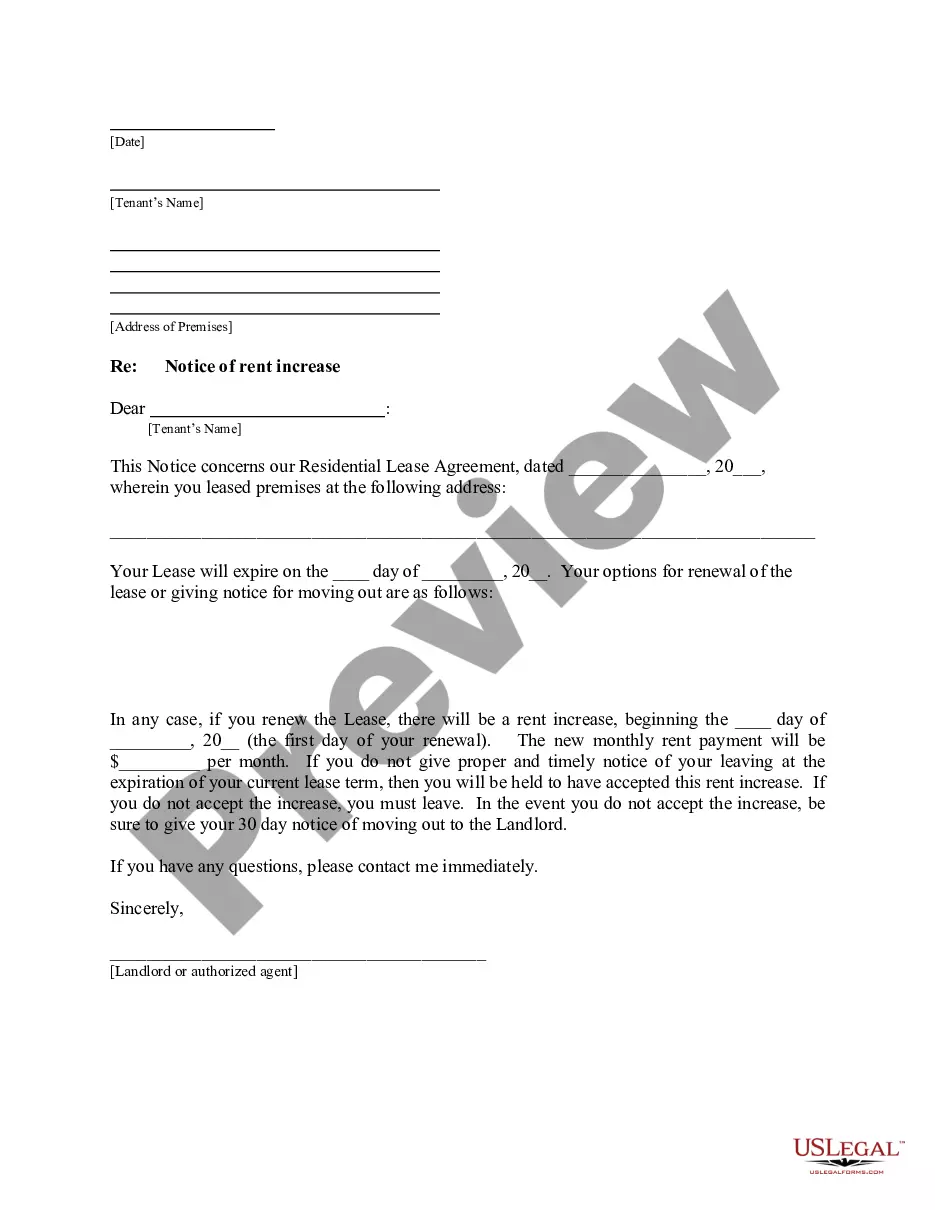
What to include in a rent increase letter Date of the rent increase letter. Name and information of the tenant and landlord. Property address and unit number (if applicable). Reference to the expiration date of the existing lease. Current rent amount. Amount of rent increase. Date the rent increase will go into effect.
Dear [TENANT NAME(S)], As indicated in your lease, your lease at [PROPERTY ADDRESS] will end on [LEASE EXPIRATION DATE ? write in full]. Please note that the monthly rent for the above [PROPERTY ADDRESS] will increase from [OLD RENT AMOUNT] to [NEW RENT AMOUNT] effective [DATE OF NEW LEASE ? write in full].
Exemption Conditions for Single-Family Homes and Condominiums. Single-family homes and condominiums are only exempt from AB 1482 if BOTH of the following conditions apply: The property is not owned by one of the following: a real estate trust, a corporation, or an LLC with at least one corporate member.
Section 13 is a common way to increase the rent when you can't agree with the tenant in writing. This is a formal process and requires a prescribed form (called Form 4) to be completed and served on the tenant. How do I serve a rent increase notice in California?
Keep in mind that certain properties are exempt from California rent control law. These types of properties include: Condos and single family-homes not owned by a real estate investment trust (REIT), corporation, or corporation-owned LLC. Mobile homes.