Tenancy Agreement For Commercial Property Template
Description
Get your form ready online
Our built-in tools help you complete, sign, share, and store your documents in one place.
Make edits, fill in missing information, and update formatting in US Legal Forms—just like you would in MS Word.
Download a copy, print it, send it by email, or mail it via USPS—whatever works best for your next step.
Sign and collect signatures with our SignNow integration. Send to multiple recipients, set reminders, and more. Go Premium to unlock E-Sign.
If this form requires notarization, complete it online through a secure video call—no need to meet a notary in person or wait for an appointment.
We protect your documents and personal data by following strict security and privacy standards.

Make edits, fill in missing information, and update formatting in US Legal Forms—just like you would in MS Word.

Download a copy, print it, send it by email, or mail it via USPS—whatever works best for your next step.

Sign and collect signatures with our SignNow integration. Send to multiple recipients, set reminders, and more. Go Premium to unlock E-Sign.

If this form requires notarization, complete it online through a secure video call—no need to meet a notary in person or wait for an appointment.

We protect your documents and personal data by following strict security and privacy standards.
Looking for another form?






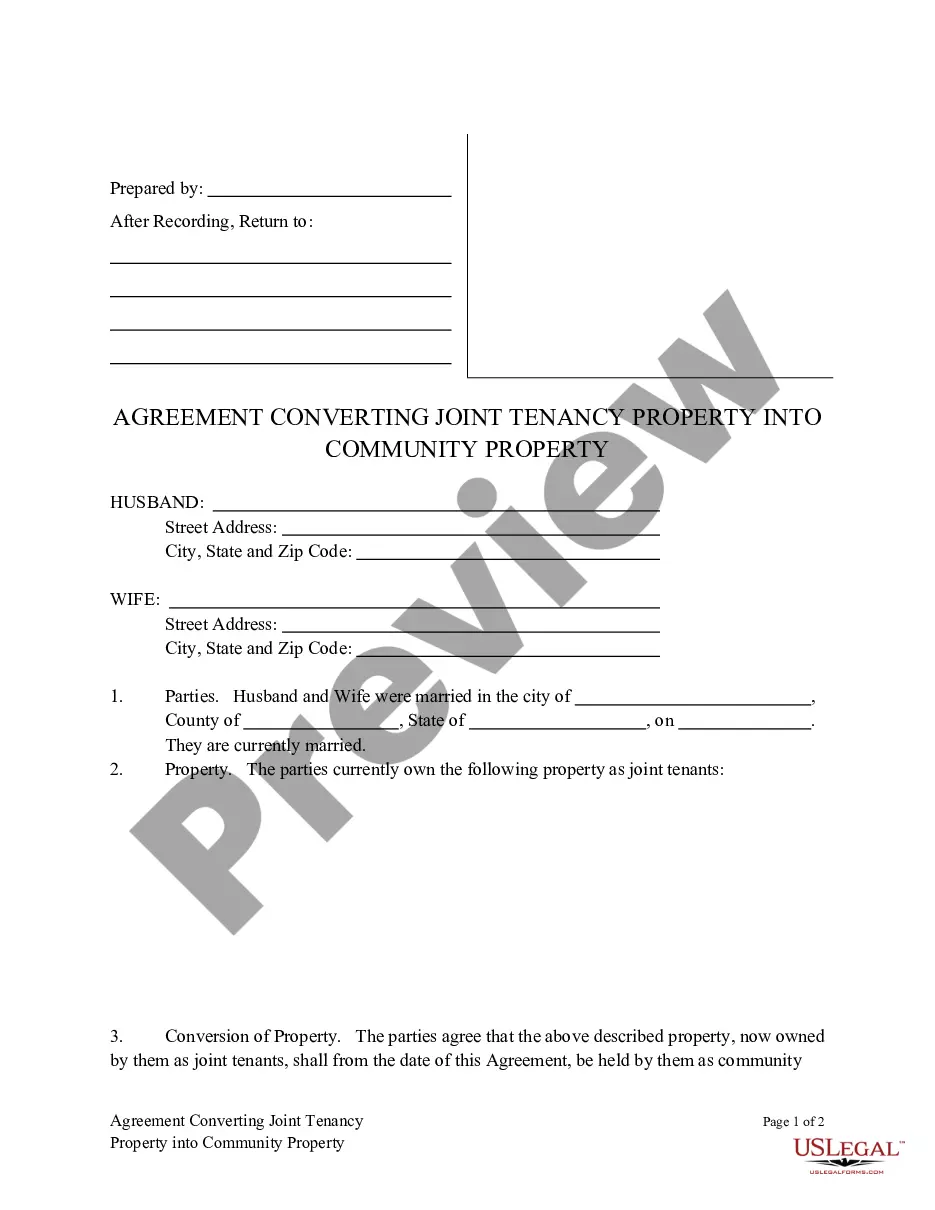
How to fill out Arizona Agreement Converting Joint Tenancy Property Into Community Property - Deed?
- If you're a returning user, log into your account to download the tenancy agreement template directly by clicking the Download button. Ensure your subscription is active.
- For first-time users, start by reviewing the template's preview and description to ensure it meets your needs and complies with local regulations.
- If the template isn't suitable, utilize the Search feature to find a different one that better meets your requirements.
- Once you've selected the appropriate template, click on the Buy Now button and choose your desired subscription plan. You will need to create an account to access the full library.
- Complete your purchase by entering your payment information via credit card or PayPal.
- Finally, download the template to your device and access it in the My Forms section of your profile at any time.
With US Legal Forms, you gain access to a vast collection of over 85,000 editable legal forms, which is more than what competitors offer for a similar cost.
Their service ensures you have the right tools to complete your document accurately, and you can even consult premium experts for assistance. Start your journey today and simplify your legal documentation!
Form popularity
FAQ
To write a handwritten lease agreement, start by including all essential details such as names, property description, rental amount, and lease duration. Make sure to write legibly and organize the information clearly. While a handwritten lease can be effective, consider using a Tenancy agreement for commercial property template to ensure you do not omit any crucial terms.
The most popular lease term in commercial agreements is typically three to five years. This duration provides stability for both landlords and tenants, but longer or shorter terms are also common depending on business needs. It is essential to assess your situation before committing to a term. A Tenancy agreement for commercial property template can help you outline your preferred lease term effectively.
The most common type of commercial lease is the net lease, where tenants take on some or all of the property expenses in addition to rent. Different net leases exist, such as single, double, and triple net leases, each varying in expense responsibility. Choosing a proper lease type is crucial for both landlords and tenants. A Tenancy agreement for commercial property template can guide you in drafting the right lease.
The most common type of lease agreement is the gross lease, where the landlord covers all operating expenses. However, each lease can vary based on location and type of property. Understanding the distinctions helps in selecting the most suitable agreement for your needs. A Tenancy agreement for commercial property template can provide clarity in these distinctions.
To write up a commercial lease, start by clearly stating the names of the parties involved, the property address, and details about the rental amount. Include terms related to duration, maintenance responsibilities, and any operating expenses. Utilizing a Tenancy agreement for commercial property template simplifies this process, ensuring you cover essential details.
A commercial lease agreement typically does not need to be notarized to be legally binding. However, some states may require notarization for certain types of leases. It is wise to check local regulations regarding notarization. Using a Tenancy agreement for commercial property template can help ensure you meet any necessary requirements.
The time it takes to finalize a commercial lease can vary, typically ranging from one to three months. This duration involves negotiation of terms, credit checks, and legal formalities. To streamline this process, you can use a tenancy agreement for commercial property template to ensure all necessary elements are included and that both parties are on the same page.
Attracting a commercial tenant requires you to showcase the advantages of your property. Highlight its features, location, and potential for business growth. Additionally, using a tenancy agreement for commercial property template demonstrates professionalism and helps create trust between you and the tenant.
Typically, landlords prefer tenants with a credit score of 650 or higher for renting commercial properties. A higher credit score indicates financial reliability, making the tenant a safer bet for landlords. Regardless of the score, using a tenancy agreement for commercial property template can help clarify terms and expectations before entering into an agreement.
To attract a commercial tenant, start by advertising your space through various channels like real estate websites, social media, and local classifieds. Consider working with a real estate agent who specializes in commercial properties. When you find potential tenants, use a tenancy agreement for commercial property template to ensure you have the necessary legal safeguards in place.