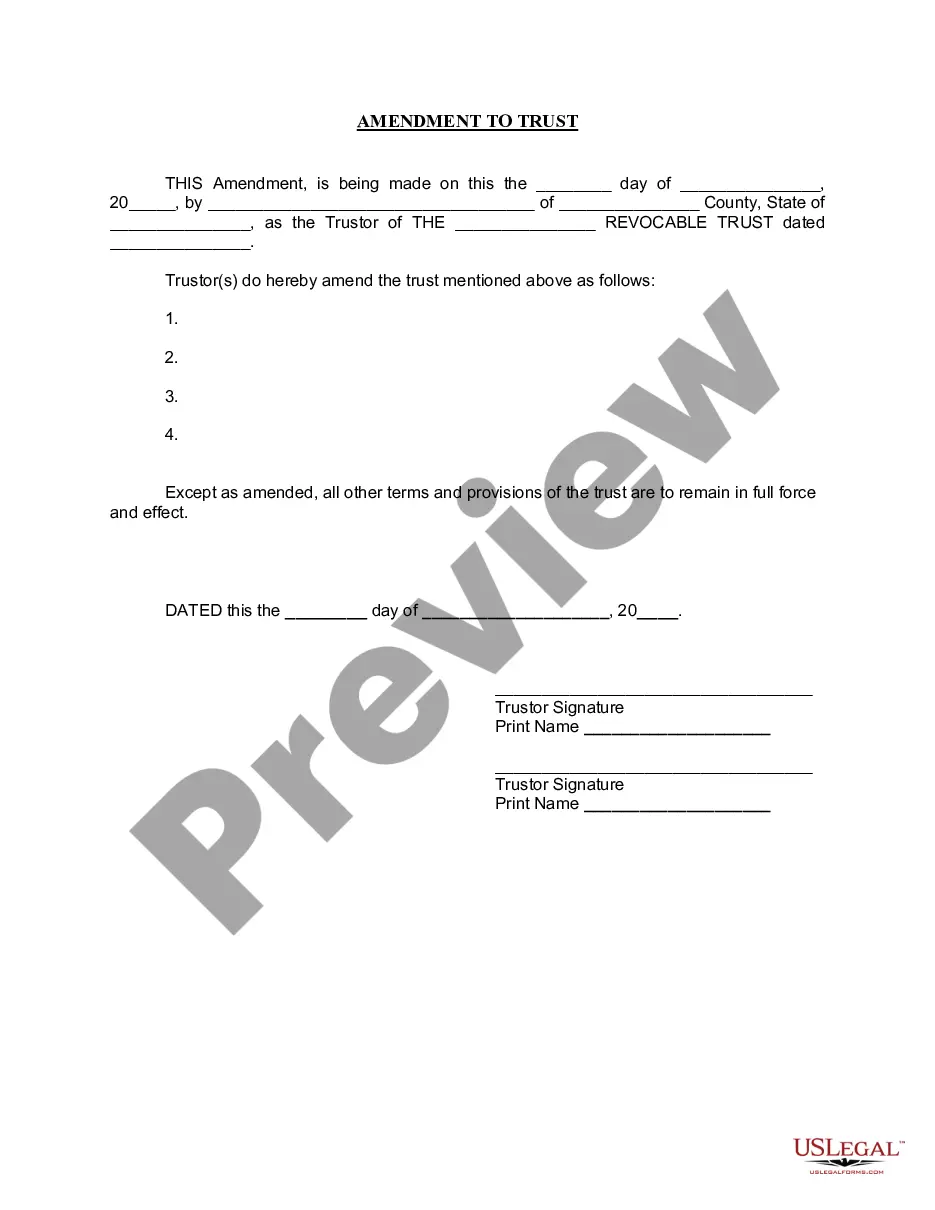
Living Trust Amendment With Two Trustees
Description


Get your form ready online
Our built-in tools help you complete, sign, share, and store your documents in one place.
Make edits, fill in missing information, and update formatting in US Legal Forms—just like you would in MS Word.
Download a copy, print it, send it by email, or mail it via USPS—whatever works best for your next step.
Sign and collect signatures with our SignNow integration. Send to multiple recipients, set reminders, and more. Go Premium to unlock E-Sign.
If this form requires notarization, complete it online through a secure video call—no need to meet a notary in person or wait for an appointment.
We protect your documents and personal data by following strict security and privacy standards.

Make edits, fill in missing information, and update formatting in US Legal Forms—just like you would in MS Word.

Download a copy, print it, send it by email, or mail it via USPS—whatever works best for your next step.

Sign and collect signatures with our SignNow integration. Send to multiple recipients, set reminders, and more. Go Premium to unlock E-Sign.

If this form requires notarization, complete it online through a secure video call—no need to meet a notary in person or wait for an appointment.

We protect your documents and personal data by following strict security and privacy standards.
Looking for another form?


How to fill out Arizona Amendment To Living Trust?
It’s clear that you cannot become a legal authority instantly, nor can you swiftly learn how to draft a Living Trust Amendment With Two Trustees without possessing a specialized background.
Crafting legal documents is a labor-intensive endeavor that demands specific education and abilities.
Thus, why not entrust the creation of the Living Trust Amendment With Two Trustees to the experts.
Preview it (if this option is available) and review the supporting description to determine if Living Trust Amendment With Two Trustees is what you need.
If you require a different template, restart your search.
- With US Legal Forms, one of the most extensive legal document collections, you can discover everything from court documents to templates for internal corporate correspondence.
- We recognize the significance of compliance and adherence to federal and local statutes and regulations.
- For this reason, on our site, all templates are location-specific and current.
- Here’s how you can begin with our platform and obtain the form you need in just minutes.
- Find the form you want by utilizing the search bar at the top of the page.
Form popularity
FAQ
It's important to know what you want to change and where in your trust document this information lives (such as the article number you're amending). Fill out the amendment form. Complete the entire form. It's important to be clear and detailed in describing your changes.
When establishing your trust, you must name at least one successor trustee in the event of your death to administer your assets. This is when you may consider appointing co-trustees, whether you have two or more in mind. A trustee may either be an individual or a financial institution.
Choosing multiple individuals to serve as co-trustees offers the following advantages: Co-trustees can provide checks and balances to guard against potential abuses of authority. Sharing or separating the responsibilities of trust administration among co-trustees can expedite the efficient administration of a trust.
The simple answer is yes, a Trustee can also be a Trust beneficiary. In fact, a majority of Trusts have a Trustee who is also a Trust beneficiary. Being a Trustee and beneficiary can be problematic, however, because the Trustee should still comply with the duties and responsibilities of a Trustee.
The administration burdens of the trust may also be reduced for each trustee serving as they can share the workload. If you name two or more, it is critical that you describe whether they must always act together or whether they can act independently of each other.