Failure Use Heating With The Help
Description



Get your form ready online
Our built-in tools help you complete, sign, share, and store your documents in one place.
Make edits, fill in missing information, and update formatting in US Legal Forms—just like you would in MS Word.
Download a copy, print it, send it by email, or mail it via USPS—whatever works best for your next step.
Sign and collect signatures with our SignNow integration. Send to multiple recipients, set reminders, and more. Go Premium to unlock E-Sign.
If this form requires notarization, complete it online through a secure video call—no need to meet a notary in person or wait for an appointment.
We protect your documents and personal data by following strict security and privacy standards.

Make edits, fill in missing information, and update formatting in US Legal Forms—just like you would in MS Word.

Download a copy, print it, send it by email, or mail it via USPS—whatever works best for your next step.

Sign and collect signatures with our SignNow integration. Send to multiple recipients, set reminders, and more. Go Premium to unlock E-Sign.

If this form requires notarization, complete it online through a secure video call—no need to meet a notary in person or wait for an appointment.

We protect your documents and personal data by following strict security and privacy standards.
Looking for another form?



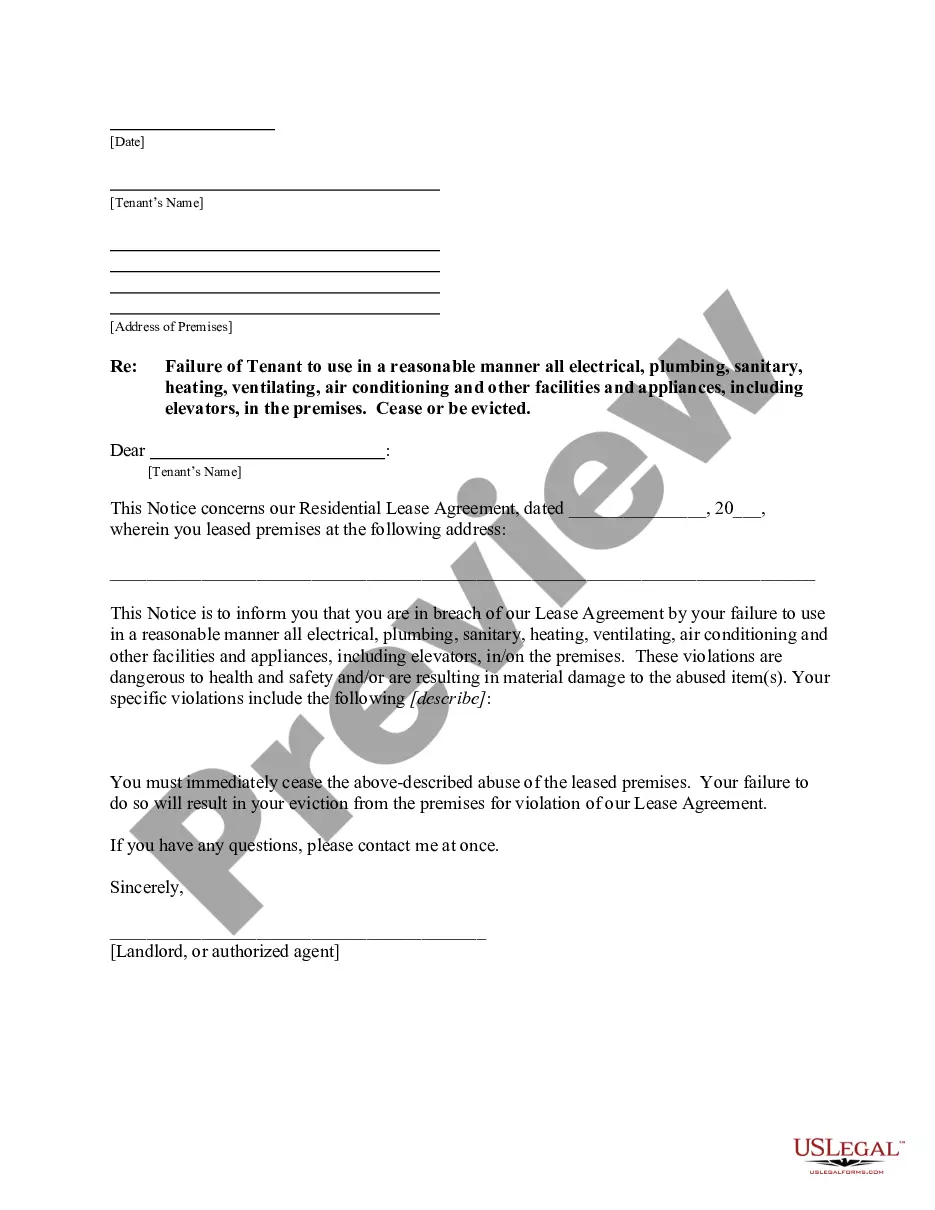
How to fill out Arkansas Letter From Landlord To Tenant For Failure To Use Electrical, Plumbing, Sanitary, Heating, Ventilating, Air Conditioning And Other Facilities In A Reasonable Manner?
- Start by logging into your US Legal Forms account if you're an existing user. Ensure that your subscription is active; renew if necessary.
- For first-time users, visit the website and browse the available legal forms. Use the Preview mode and detailed descriptions to select forms that align with your specific requirements.
- In case you don’t find the right form, utilize the Search function to explore other templates that fit your criteria.
- After locating the correct form, click on the 'Buy Now' button and select your desired subscription plan. New users must create an account to gain access.
- Complete your transaction by providing payment details either through credit card or PayPal.
- Finally, download your form and save it to your device. You can access it anytime in the 'My Forms' section of your account.
US Legal Forms empowers individuals and attorneys, allowing them to execute legal documents efficiently with an extensive library comprising over 85,000 editable forms.
By taking advantage of this comprehensive service, you can ensure your legal documents are precise and compliant. Don't hesitate—start leveraging the power of US Legal Forms today!
Form popularity
FAQ
To activate your emergency heat, locate the thermostat and switch it to the emergency setting, often marked as 'E'. This mode is designed to help your heating system operate independently when primary heating sources fail. Consult your system’s manual for specifics on activating this feature. It’s crucial to understand that failure to use heating with the help of emergency settings when needed may leave you without warmth in critical times.
The amount of water required for your heating system generally depends on the size of the system and its specifications. A pressure reading between 1 and 2 bars, often indicated on the pressure gauge, is typically considered ideal. Always check your manufacturer's guidelines for specific details related to your unique system. Remember, failure to use heating with the help of proper water levels can significantly affect operation.
To eliminate trapped air, locate the radiator valves, typically positioned at the top. Use a radiator key to carefully open the bleed valve on each radiator, allowing the air to escape until water starts to flow. Close the valve immediately to prevent excess water loss. Moreover, knowing how to handle this issue is vital; failure to use heating with the help of these steps can result in cold spots and inefficiencies.
Refilling a heating system can be simple but requires attention to detail. Start by turning off the system and locating the filling loop, usually found near the boiler. Open the valves carefully to allow water into the system, watching the pressure gauge until it reaches the recommended level. Following these guidelines is essential because failure to use heating with the help of proper refilling methods may lead to complications.
Topping up water in a heating system involves locating the filling loop, attaching a hose if necessary, and ensuring your system is powered off. Open the valves slowly and monitor the pressure gauge, filling until it reaches the desired level. After topping up, remember to close the valves and check for leaks. Failure to use heating with the help of proper topping techniques can disrupt system efficiency and heating comfort.
To fill up a heating system, first, turn off the system and make sure the pressure gauge is below the recommended level. Connect a hose to the filling loop, then open the valves gently to allow water to enter until the pressure gauge shows the correct level. Once filled, close the valves and remove the hose safely. It’s crucial to understand that failure to use heating with the help of these steps can lead to inadequate heating and potential damage.
Resetting your heating system can depend on the type of system you have, but usually involves pressing the reset button on your boiler. Check your manufacturer’s instructions for the exact procedure, as some systems may require you to turn off the power first. After resetting, observe if the system returns to normal operation. Remember, failure to use heating with the help of manufacturer guidelines can affect your comfort and efficiency.
To fill a heating system backup, locate the filling loop, usually found near the boiler. Open the valves on the loop to allow water to flow into the system while monitoring the pressure gauge. Once the desired pressure is reached, typically between 1 and 2 bars, close the valves to prevent overfilling. Failure to use heating with the help of proper techniques might lead to further issues, so ensure everything is done correctly.
You can remain in a house without heat for a limited time, generally only a few hours in severe cold. Staying longer may lead to health risks like hypothermia due to extremely low temperatures. In any case of failure to use heating with the help of appropriate solutions, making arrangements to seek warmth can safeguard your well-being.
Pipes can start to freeze within six to eight hours without heat, depending on the temperature outside and insulation quality. Once they freeze, they can rupture and cause costly water damage. To avoid such outcomes, consider legal remedies and guidance from uslegalforms in cases of failure to use heating with the help.