Transfer On Death Deed For Florida
Description

Get your form ready online
Our built-in tools help you complete, sign, share, and store your documents in one place.
Make edits, fill in missing information, and update formatting in US Legal Forms—just like you would in MS Word.
Download a copy, print it, send it by email, or mail it via USPS—whatever works best for your next step.
Sign and collect signatures with our SignNow integration. Send to multiple recipients, set reminders, and more. Go Premium to unlock E-Sign.
If this form requires notarization, complete it online through a secure video call—no need to meet a notary in person or wait for an appointment.
We protect your documents and personal data by following strict security and privacy standards.

Make edits, fill in missing information, and update formatting in US Legal Forms—just like you would in MS Word.

Download a copy, print it, send it by email, or mail it via USPS—whatever works best for your next step.

Sign and collect signatures with our SignNow integration. Send to multiple recipients, set reminders, and more. Go Premium to unlock E-Sign.

If this form requires notarization, complete it online through a secure video call—no need to meet a notary in person or wait for an appointment.

We protect your documents and personal data by following strict security and privacy standards.
Looking for another form?









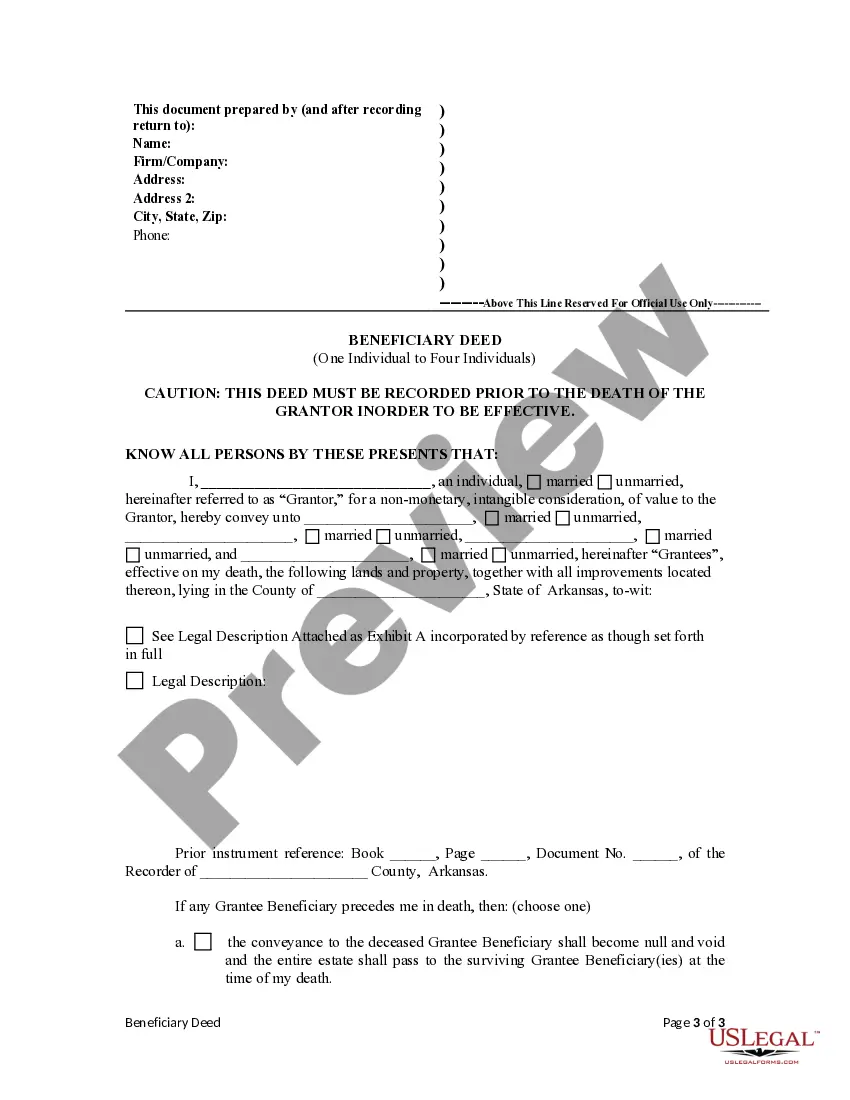
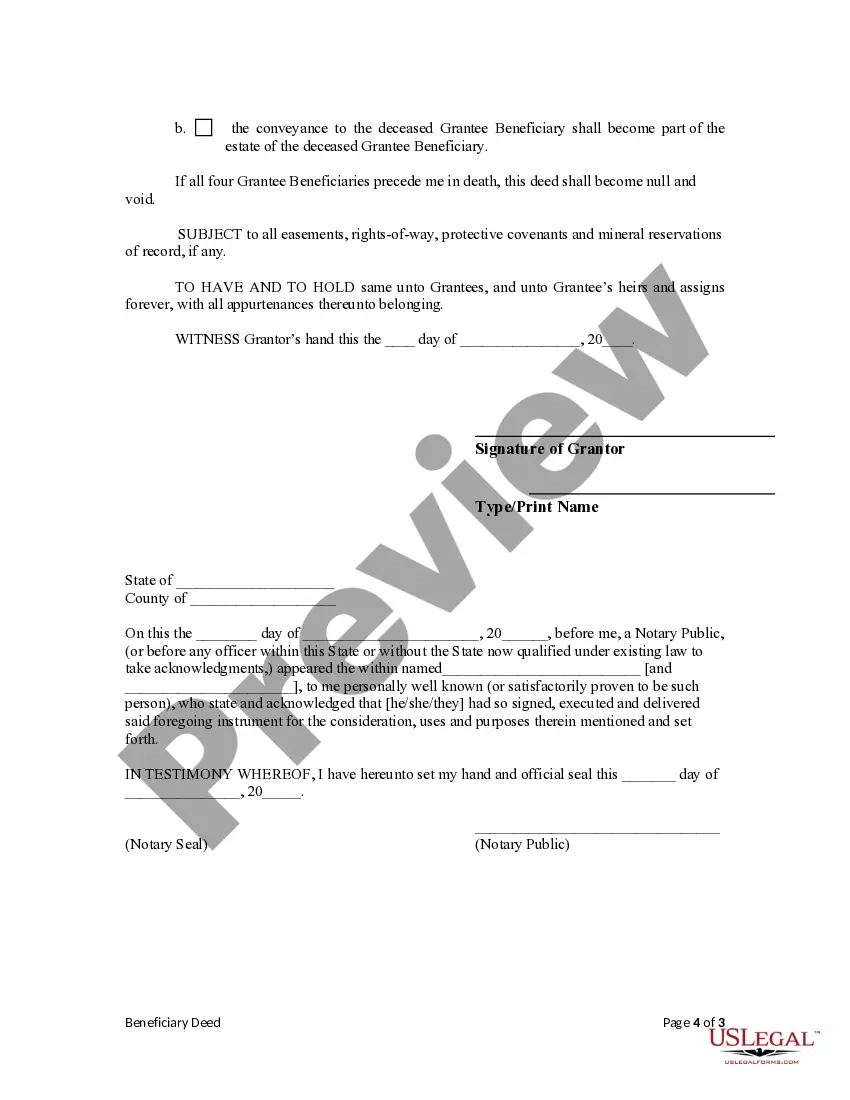
How to fill out Arkansas Transfer On Death Deed Or TOD - Beneficiary Deed For One Individual To Four Individuals?
- Log in to your US Legal Forms account if you’re a returning user, and ensure your subscription is active. If not, renew your plan as necessary.
- If you're a new user, start by checking the preview mode and form description to confirm you've selected the right transfer on death deed that fits your requirements.
- If you need a different template, use the Search tab to find the appropriate document that meets local jurisdiction standards.
- Purchase the document by clicking the Buy Now button and choosing the subscription plan that works best for you. You’ll need to register for an account to access the full library.
- Complete your transaction by entering your payment details or using your PayPal account.
- Download the transfer on death deed to your device, and easily access it later in the My Forms section of your profile.
Utilizing US Legal Forms ensures that your legal documents are comprehensive and tailored to your unique requirements. With an extensive collection of over 85,000 fillable forms, you can confidently create the necessary legal document.
Don’t let the complexities of legal document preparation hold you back. Start your journey with US Legal Forms today and secure your assets with ease!
Form popularity
FAQ
One potential downside of a Transfer on Death deed for Florida is that it only applies to specific properties and does not address personal property or other estate matters. Additionally, if you change your mind about your beneficiary, revoking the deed requires proper documentation. Furthermore, complications may arise if the beneficiary predeceases you. Thus, it is wise to evaluate your options thoroughly and consider how a TOD fits into your overall estate plan.
While the focus here is on Transfer on Death deeds for Florida, you may be curious about their rules in other states like Texas. Each state has distinct regulations governing TOD deeds. Generally, in Texas, a TOD deed must be signed, dated, and recorded to be valid. If you're considering a Transfer on Death deed for Florida, ensure you familiarize yourself with the specific rules applicable to your state.
A Transfer on Death deed for Florida can serve as an effective tool for estate planning, often providing a simpler and quicker alternative to a will. Unlike a will, which goes through probate, a TOD deed allows for direct transfer of property to your designated beneficiary upon your death. However, it is essential to understand that wills may cover more comprehensive issues than a TOD deed. Both documents serve distinct purposes, and choosing between them depends on your individual needs.
You do not necessarily need a lawyer to create a Transfer on Death deed for Florida, but seeking legal advice can be beneficial. A qualified attorney can help you navigate the specific requirements and ensure your deed is completed correctly. As you prepare your Transfer on Death deed for Florida, consider consulting professionals who understand your unique situation. This can help avoid potential pitfalls and ensure your wishes are honored.
Yes, you can establish a transfer on death deed in Florida to easily transfer property to your beneficiaries. This deed allows you to retain full control of the property until your death. Afterward, it automatically transfers to your chosen heirs without the need for probate. If you are considering this option, it may be helpful to consult legal resources from platforms like USLegalForms.
To transfer a title after death in Florida, first, you need to locate the original transfer on death deed for Florida. Then, you must file the deed with the local county clerk’s office, along with the deceased person’s death certificate. Ensuring that all paperwork is completed accurately is crucial to avoid complications. If you face challenges during this process, platforms like USLegalForms can provide guidance.
While a transfer on death deed for Florida simplifies property transfer, it has some disadvantages. For instance, once you create the deed, you cannot change it easily, which may limit your flexibility in estate planning. Additionally, if the property has outstanding debts or other legal issues, those problems may not disappear after death. It is essential to consider these factors when deciding on using this deed.
The rules for a transfer on death deed for Florida are straightforward yet essential. The deed must be in writing, signed, and recorded during your lifetime. You can change or revoke the deed as long as you are alive. It is also essential that the beneficiaries named are legally capable of inheriting. For more detailed instructions on these rules, uslegalforms provides valuable resources.
Changing ownership of property after death in Florida often requires filing a transfer on death deed for Florida, if one was established. If a valid deed exists, you simply need to record it with the county office. In cases without a TOD deed, you may need to go through probate to transfer ownership legally. Platforms like uslegalforms can help you understand and navigate these processes.
To change property ownership after death in Florida, you typically need to file the transfer on death deed for Florida with the county clerk. This deed designates your chosen beneficiaries who will automatically inherit the property. If you did not have a deed set up prior to death, probate may be necessary. For assistance with this process and related documents, consider using uslegalforms.