Support Letter For Court
Description



Get your form ready online
Our built-in tools help you complete, sign, share, and store your documents in one place.
Make edits, fill in missing information, and update formatting in US Legal Forms—just like you would in MS Word.
Download a copy, print it, send it by email, or mail it via USPS—whatever works best for your next step.
Sign and collect signatures with our SignNow integration. Send to multiple recipients, set reminders, and more. Go Premium to unlock E-Sign.
If this form requires notarization, complete it online through a secure video call—no need to meet a notary in person or wait for an appointment.
We protect your documents and personal data by following strict security and privacy standards.

Make edits, fill in missing information, and update formatting in US Legal Forms—just like you would in MS Word.

Download a copy, print it, send it by email, or mail it via USPS—whatever works best for your next step.

Sign and collect signatures with our SignNow integration. Send to multiple recipients, set reminders, and more. Go Premium to unlock E-Sign.

If this form requires notarization, complete it online through a secure video call—no need to meet a notary in person or wait for an appointment.

We protect your documents and personal data by following strict security and privacy standards.
Looking for another form?


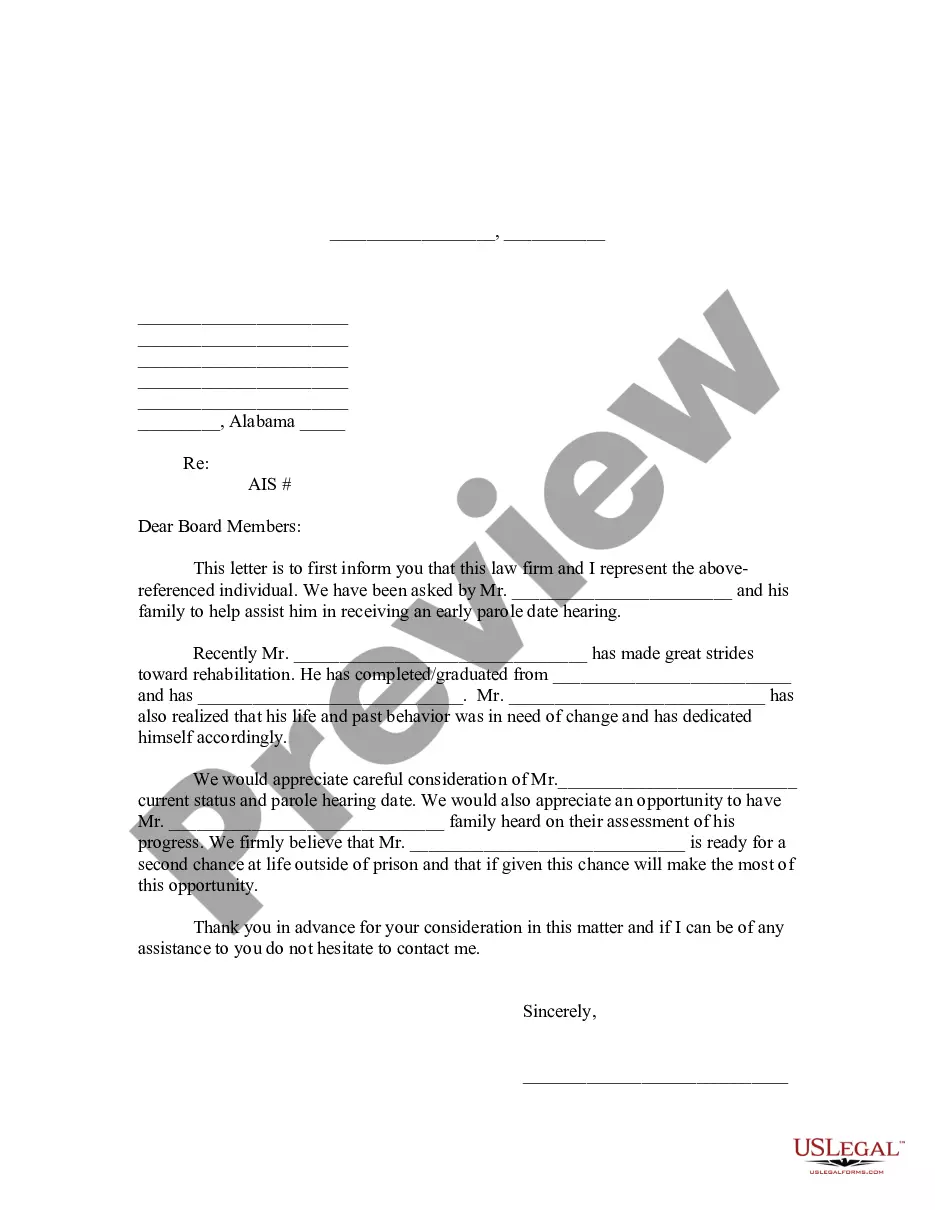
How to fill out Alabama Letter To Parol Board Members By Attorney Requesting Parol Of Inmate For Family?
Legal administration can be overwhelming, even for seasoned professionals.
When you're searching for a Support Letter For Court and lack the time to find the correct and current version, the experience can be stressful.
Access a wealth of articles, guides, and resources related to your situation and requirements.
Save time and effort searching for the needed paperwork, and use US Legal Forms’ sophisticated search and Preview feature to obtain Support Letter For Court quickly.
Enjoy the extensive US Legal Forms online catalog, supported by 25 years of expertise and trustworthiness. Simplify your day-to-day document management into a straightforward and user-friendly process today.
- Confirm this is the appropriate form by previewing it and reviewing its description.
- Ensure that the template is accepted in your jurisdiction.
- Click Buy Now when you're ready.
- Select a monthly membership plan.
- Choose the format you require, and Download, complete, eSign, print, and submit your document.
- Access state- or locality-specific legal and business documents.
- US Legal Forms fulfills all your needs, from personal to business forms, in one location.
- Leverage advanced tools to create and manage your Support Letter For Court.
Form popularity
FAQ
To write a good support letter for court, start with a clear introduction stating your relationship to the person and the purpose of the letter. Then, provide concrete examples that support your claims about their character or situation, ensuring you adhere to the format required by the court. Using the right template from a reliable platform like USLegalForms can help structure your letter effectively and enhance its impact.
In a support letter for court, you should clearly express your relationship to the individual and the context of your support. Focus on specific examples that highlight their character, achievements, or circumstances that warrant the court's consideration. It's important to keep the tone respectful and honest while also emphasizing your belief in their positive qualities.
When writing a supportive letter to a judge, clarity and respect are paramount. Begin with a formal greeting, provide your qualifications for commenting on the individual, and share your specific observations about their character. It’s essential to be genuine and to express how the individual's actions have positively affected others, urging the judge to consider these insights seriously.
To write a good support letter for court, focus on clarity and sincerity. Start by introducing yourself and your relationship to the individual. Then, offer specific examples of their positive traits or actions that are relevant to the case. Make your request clear, and remind the judge of the positive impact the person has on their family or community.
In a court support letter, you should express your belief in the individual and share relevant anecdotes that reflect their good character. Personal stories that illustrate the person's kindness or contributions to the community can be persuasive. Moreover, specify the reason you're writing the letter and request the judge to consider these points in their decision-making.
In a support letter for court, impactful words can enhance your message. Consider using words like trustworthy, dedicated, compassionate, responsible, reliable, commendable, influential, respectful, honest, supportive, and community-focused. These words convey positive characteristics that can significantly affect the judge's perception.
When addressing a support letter for court to a judge, use a formal salutation such as 'Dear Honorable Judge Last Name.' Ensure you include the court's name and case number if applicable. Maintaining a respectful tone throughout the letter reinforces the seriousness of the request and your respect for the judicial process.
To compose a strong support letter for court, you should begin with a clear introduction stating your relationship to the individual in question. Next, provide specific examples of their character and actions that demonstrate their positive attributes. It's essential to conclude with a strong statement urging the court to consider these factors in their judgment.
A support letter for court can provide personal insights into a person's character or circumstances. For instance, it may include testimonials about the individual’s good deeds, community involvement, or family responsibilities. This letter can highlight the positive influences the individual has on others, making a compelling case for leniency or understanding before the court.
Yes, judges often read support letters submitted in court cases, as they provide valuable perspectives on the individual involved. A well-crafted support letter for court can help the judge understand the character and circumstances of the person being judged. Therefore, taking the time to write a thoughtful letter can make a difference in the outcome of the case.