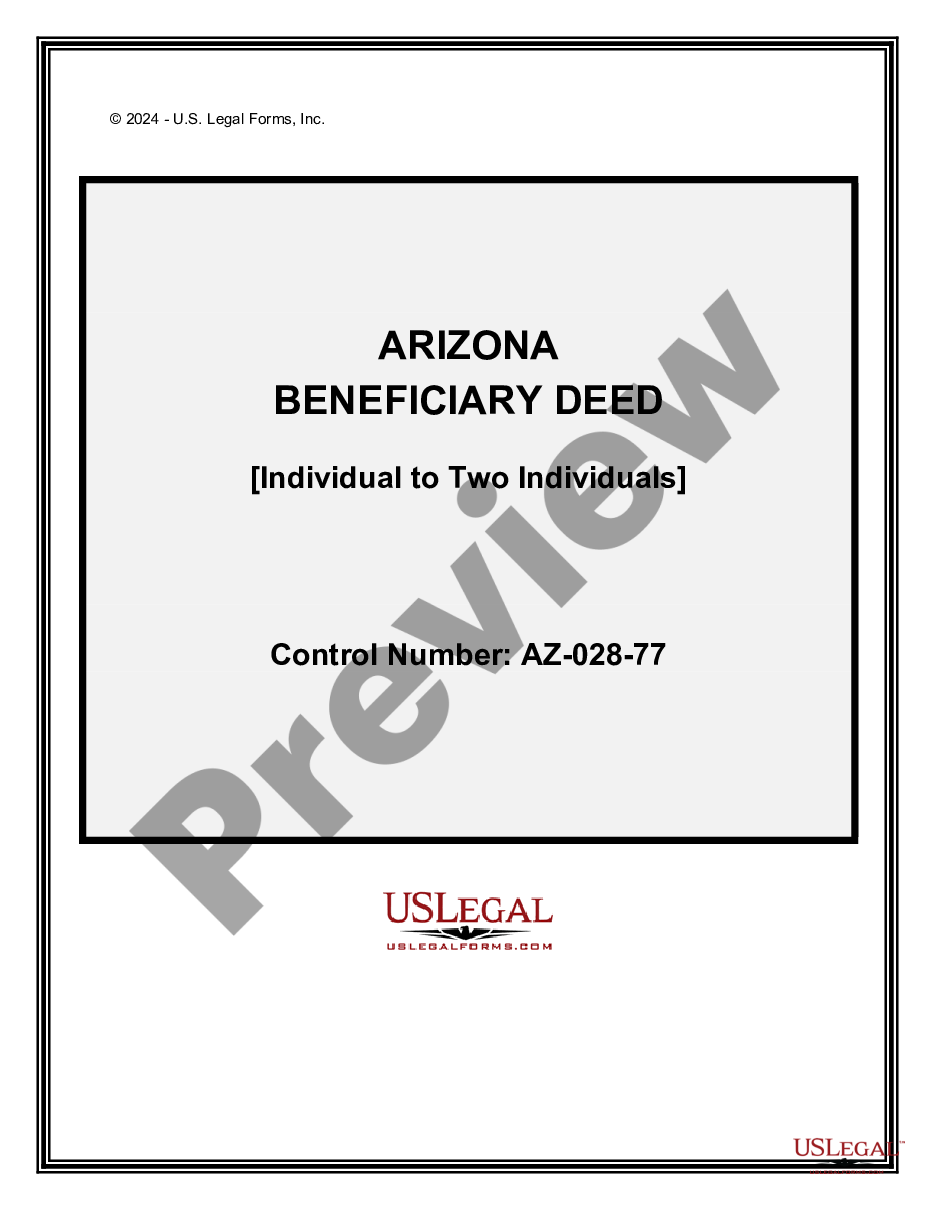
Arizona Transfer on Death Deed or TOD - Beneficiary Deed - Individual to Two Individuals
Understanding this form
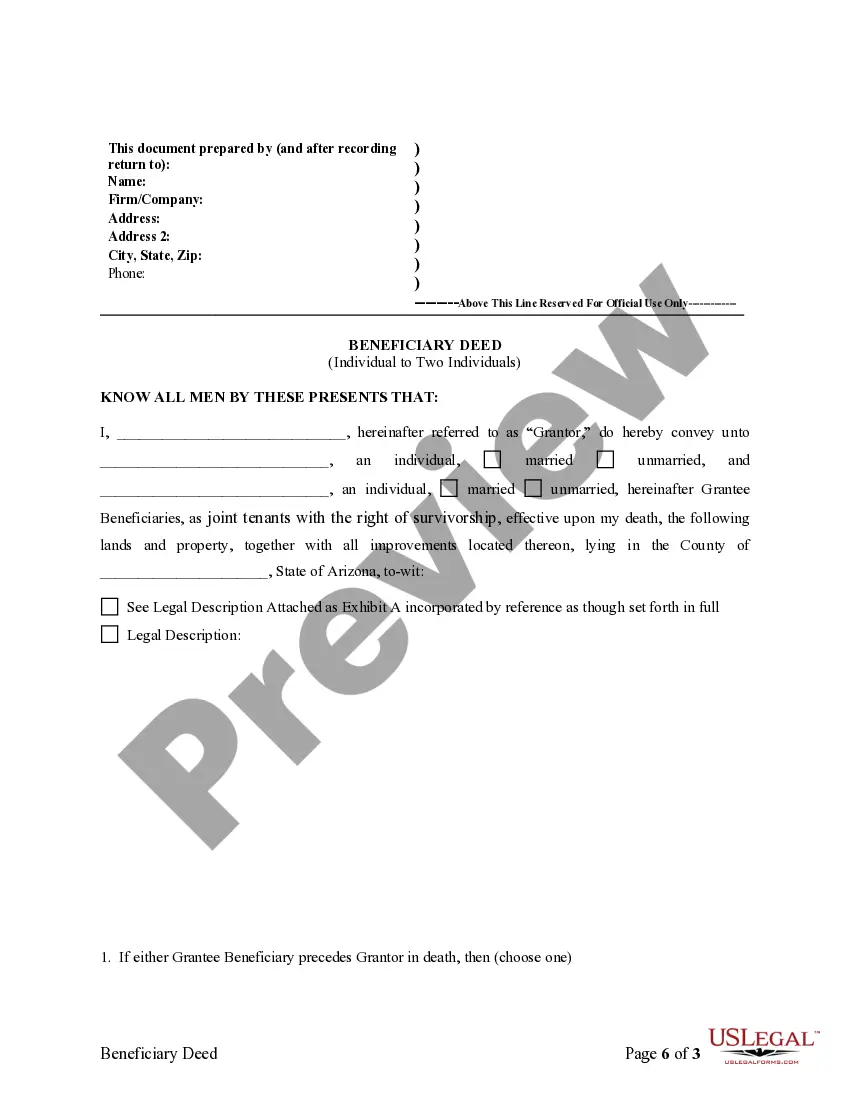
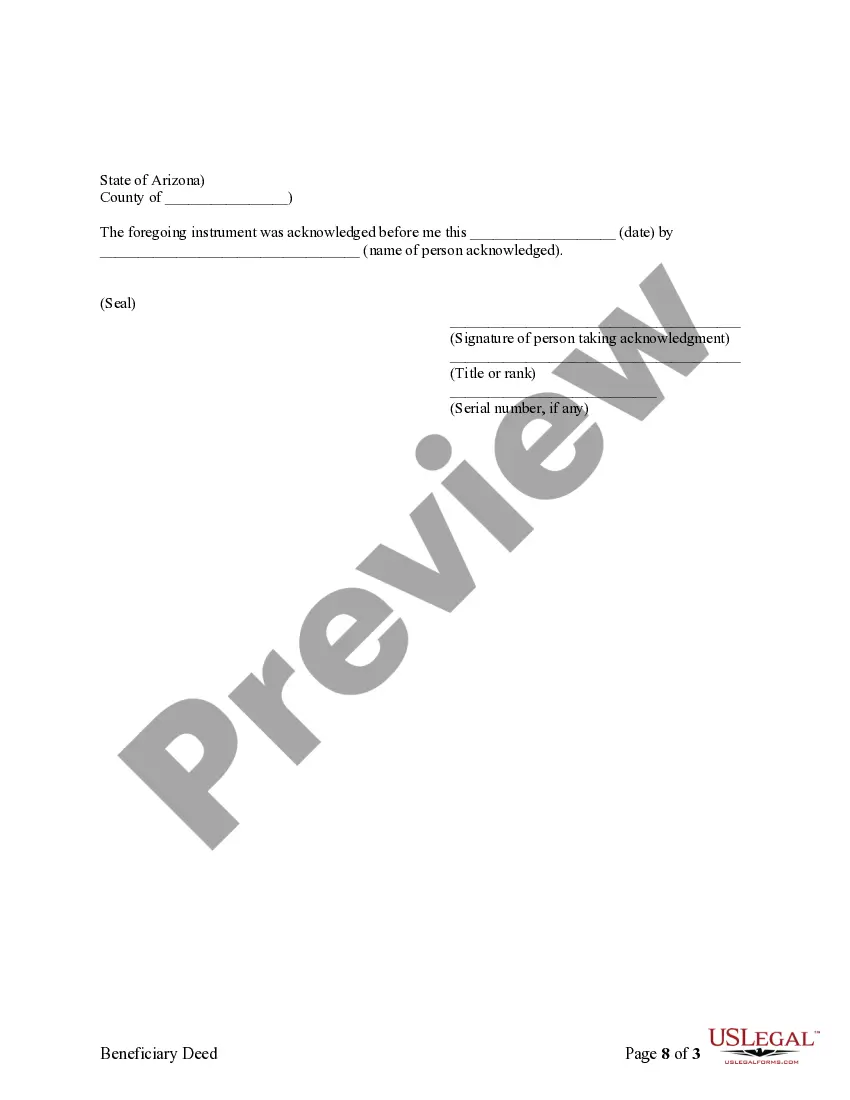
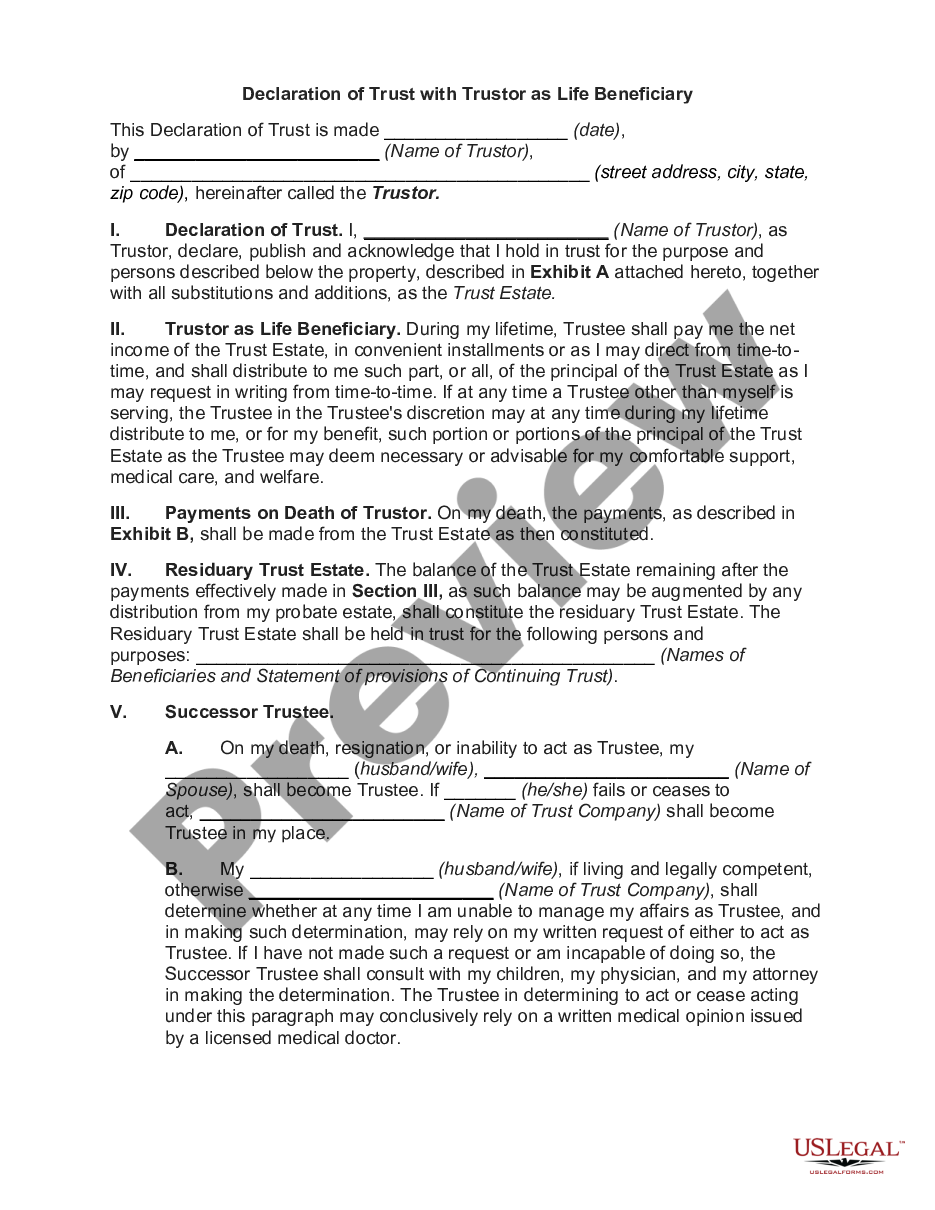
The Transfer on Death Deed (TOD) form allows an individual property owner (the Grantor) to designate two individuals (the Grantee Beneficiaries) to receive property upon the Grantor's death. This deed is revocable during the Grantor's lifetime and becomes effective only after the Grantor passes away. It primarily serves to simplify estate transfer, avoiding probate. Unlike a traditional will, a Transfer on Death Deed allows beneficiaries to claim ownership directly and can convey property as either joint tenants with rights of survivorship or tenants in common.
Main sections of this form
- The names and addresses of the Grantor and Grantee Beneficiaries.
- A description of the property being transferred.
- Instructions for revocation if the Grantor changes their mind.
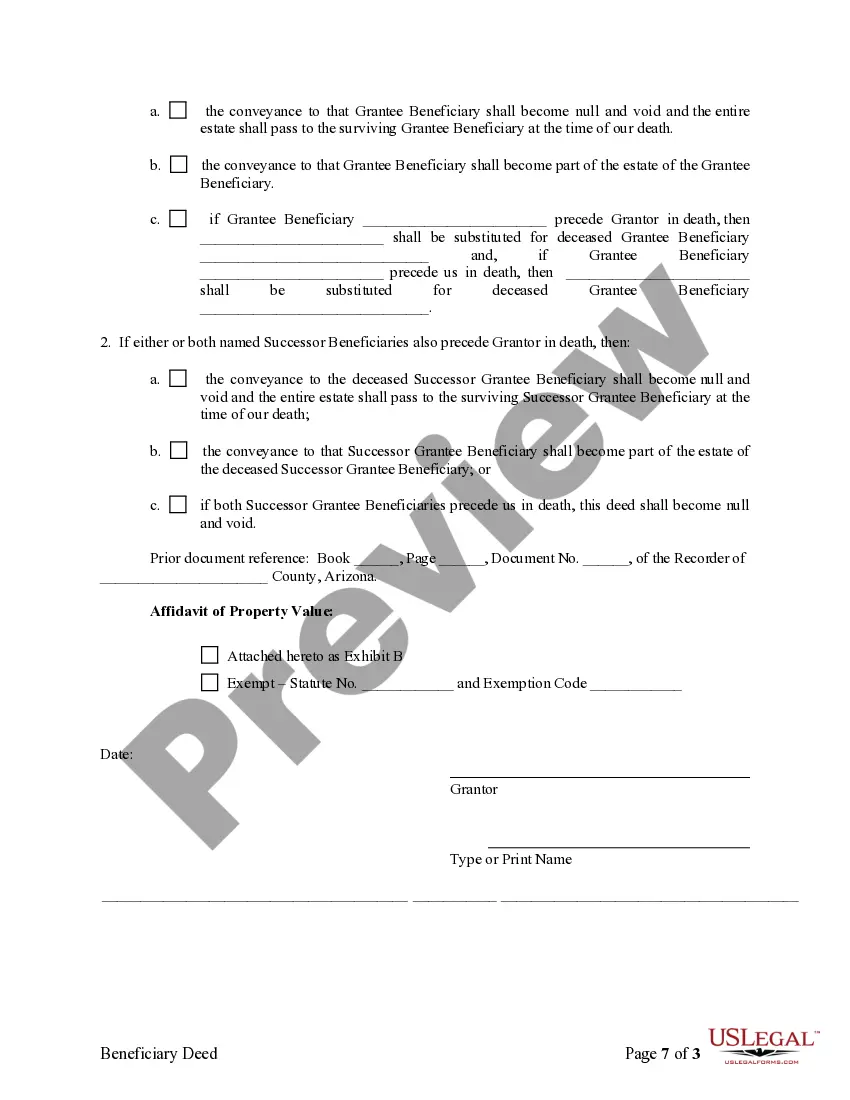
- Provisions regarding the distribution of the property if a Beneficiary predeceases the Grantor.
- Signature field for the Grantor to affirm the deed.
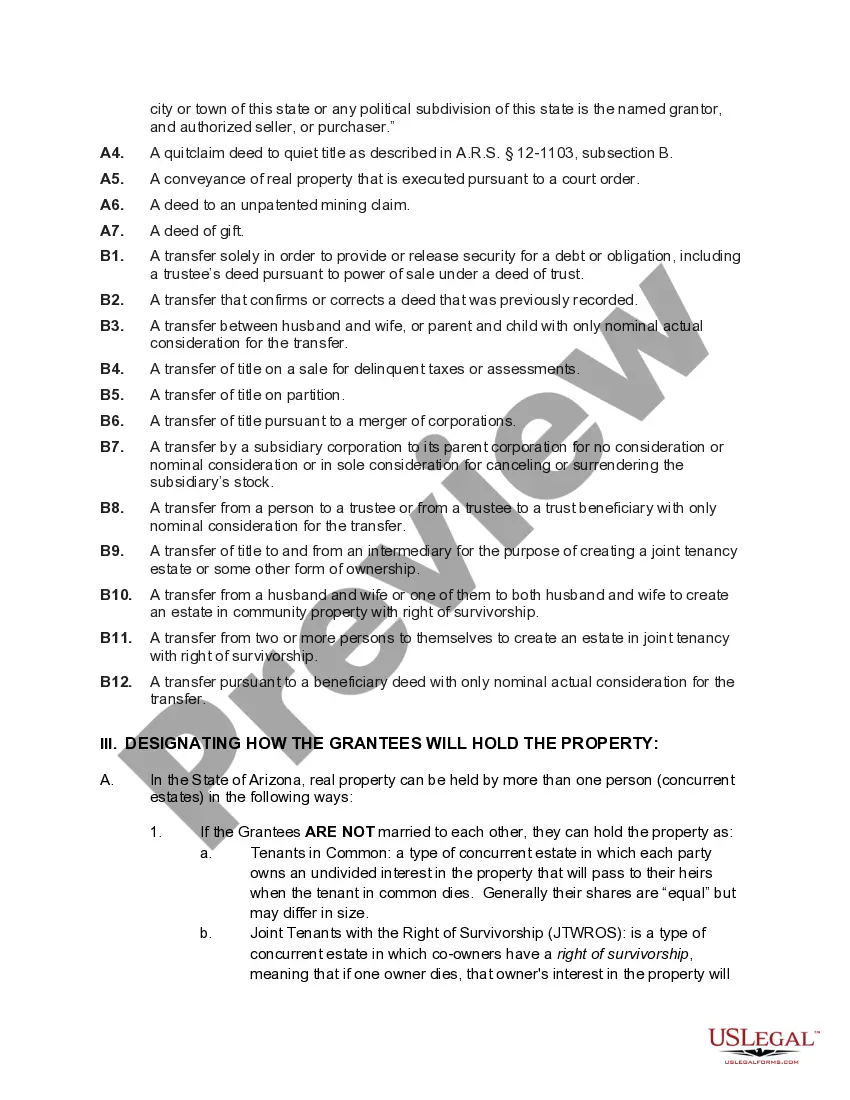
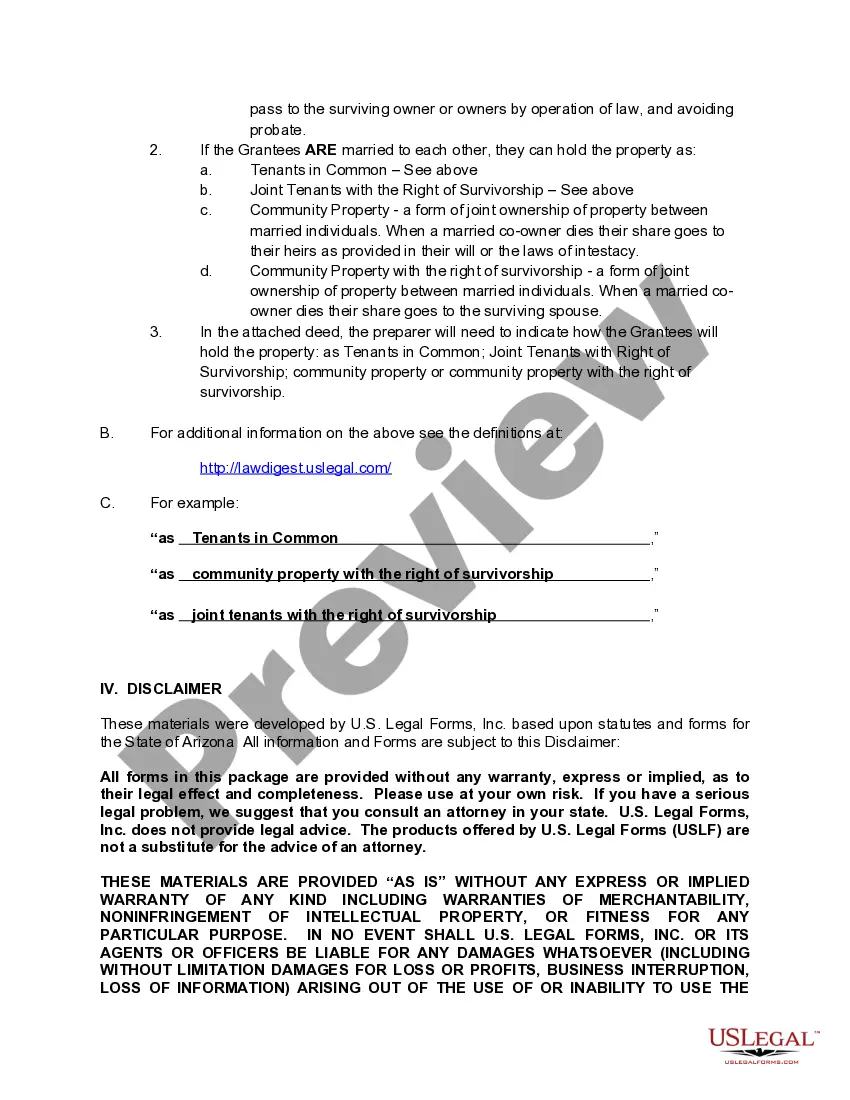





Situations where this form applies
This form should be used when an individual wishes to ensure that their property is transferred to two specific individuals upon their death, without the need for probate. It is particularly useful for those seeking a straightforward way to pass on property to loved ones while maintaining control during their lifetime.
Who needs this form
- Individuals who own real estate and want beneficiaries to inherit it directly upon death.
- Property owners who desire a flexible method to revoke or alter transfer instructions during their lifetime.
- Those looking to avoid probate proceedings for the property in question.
How to prepare this document
- Identify the Grantor and the two Grantee Beneficiaries by entering their full names and addresses.
- Provide a detailed description of the property being transferred.
- Specify any conditions regarding the transfer, such as what happens if one Beneficiary predeceases the Grantor.
- Sign and date the deed in the presence of a notary public, if required.
- Submit the completed form to the appropriate local registry office, if necessary.
Notarization requirements for this form
This form does not typically require notarization unless specified by local law. However, having the deed notarized may provide greater assurance of its validity and acceptance.
Get your form ready online
Our built-in tools help you complete, sign, share, and store your documents in one place.
Make edits, fill in missing information, and update formatting in US Legal Forms—just like you would in MS Word.
Download a copy, print it, send it by email, or mail it via USPS—whatever works best for your next step.
Sign and collect signatures with our SignNow integration. Send to multiple recipients, set reminders, and more. Go Premium to unlock E-Sign.
If this form requires notarization, complete it online through a secure video call—no need to meet a notary in person or wait for an appointment.
We protect your documents and personal data by following strict security and privacy standards.

Make edits, fill in missing information, and update formatting in US Legal Forms—just like you would in MS Word.

Download a copy, print it, send it by email, or mail it via USPS—whatever works best for your next step.

Sign and collect signatures with our SignNow integration. Send to multiple recipients, set reminders, and more. Go Premium to unlock E-Sign.

If this form requires notarization, complete it online through a secure video call—no need to meet a notary in person or wait for an appointment.

We protect your documents and personal data by following strict security and privacy standards.
Mistakes to watch out for
- Failing to provide complete and accurate descriptions of the property.
- Not including all required signatures and dates on the form.
- Overlooking to state what happens if a Beneficiary dies before the Grantor.
- Not revoking or updating the deed if circumstances change, such as the death of a Beneficiary.
Advantages of online completion
- Convenience of completing the form from home without the need for legal assistance.
- Easy access to a legally compliant template prepared by licensed attorneys.
- Editable fields that allow you to tailor the document to your specific situation.
- Immediate download for quick use and filing.
Legal use & context
- Transfer on Death Deeds are a legally recognized tool for estate planning.
- Proper execution of the deed ensures enforceability and avoids disputes.
- Understanding how survivorship rights work can prevent conflict among beneficiaries.
What to keep in mind
- The Transfer on Death Deed allows property to pass directly to beneficiaries without probate.
- It can be revoked or altered by the Grantor during their lifetime.
- It's essential to specify conditions regarding the death of a Beneficiary.
Looking for another form?
Form popularity
FAQ
A beneficiary deed can have multiple beneficiaries named within it, depending on the owner's wishes. In Arizona, there is no strict limit to the number of beneficiaries you can designate in a beneficiary deed. However, clarity in naming beneficiaries is essential for ensuring a smooth transfer. Resources from USLegalForms can help you draft a comprehensive beneficiary deed.
Transfer on Death (TOD) and joint with rights of survivorship are distinct in how ownership and transfer occur. A joint ownership transfers the property immediately upon death, whereas a TOD allows for control and rights of the property until death, when the transfer takes effect. This means you can decide your property’s fate while you are alive. Understanding these structures helps in effective estate planning, and USLegalForms can assist further.
Yes, Arizona allows for the creation of Transfer on Death (TOD) deeds, providing a convenient tool for transferring property without probate. This option simplifies the process for individuals wishing to leave property to beneficiaries. It's essential to adhere to Arizona's laws to ensure the deed's effectiveness. You can find helpful resources on the USLegalForms platform to guide you.
One of the primary disadvantages of a Transfer on Death (TOD) deed is that it does not protect the property from the owner's debts. Creditors may still lay claim to the property within the value of the debts at the time of death. This lack of creditor protection can be a significant concern. Evaluating your needs through platforms like USLegalForms can help in making informed decisions.
A Transfer on Death (TOD) and a beneficiary deed serve similar purposes but are distinct in execution. A TOD deed allows properties to directly transfer to multiple individuals upon the owner's death without probate, whereas a beneficiary deed is often used for a single recipient. Understanding these differences is crucial when choosing the right estate planning tools. Exploring options with USLegalForms can help clarify your choices.
A Transfer on Death (TOD) designation includes beneficiaries who will receive the property upon your death, but it is not the same as a traditional beneficiary designation. A beneficiary may inherit a broader range of assets, while a TOD specifically applies to real property in Arizona. Understanding this distinction can help you plan your estate more effectively. The USLegalForms platform can guide you in setting up a TOD appropriately.
Although a Transfer on Death (TOD) deed provides a quick way to transfer assets, it can have drawbacks. For example, if the property owner incurs debts, creditors may still claim the property despite the TOD. Additionally, if your financial or family situation changes, updating or revoking the TOD may require legal processes. Consulting resources like USLegalForms can clarify these disadvantages.
A Transfer on Death (TOD) account automatically transfers to named beneficiaries upon your passing, so it is not considered inheritance in the traditional sense. Instead of going through probate, assets pass directly to the beneficiaries. This direct transfer can speed up access to funds and simplify estate management. Thus, while it functions similarly to an inheritance, it's distinct in its legal handling.
In Texas, you can contest a transfer on death deed. Grounds for contesting may include a challenge to the validity of the document or claims of undue influence. It's important to familiarize yourself with Texas probate laws, particularly in relation to the Arizona Transfer on Death Deed or TOD - Beneficiary Deed - Individual to Two Individuals. Accessing comprehensive resources through platforms like US Legal Forms can guide you through this process.
In Florida, a transfer on death deed can indeed be contested. The contest may focus on issues like fraud or improper execution. If you are faced with contesting an Arizona Transfer on Death Deed or TOD - Beneficiary Deed - Individual to Two Individuals, consider seeking legal advice. Knowing the rules can significantly impact the outcome of any contest.