Florida Residential or Rental Lease Extension Agreement
Understanding this form
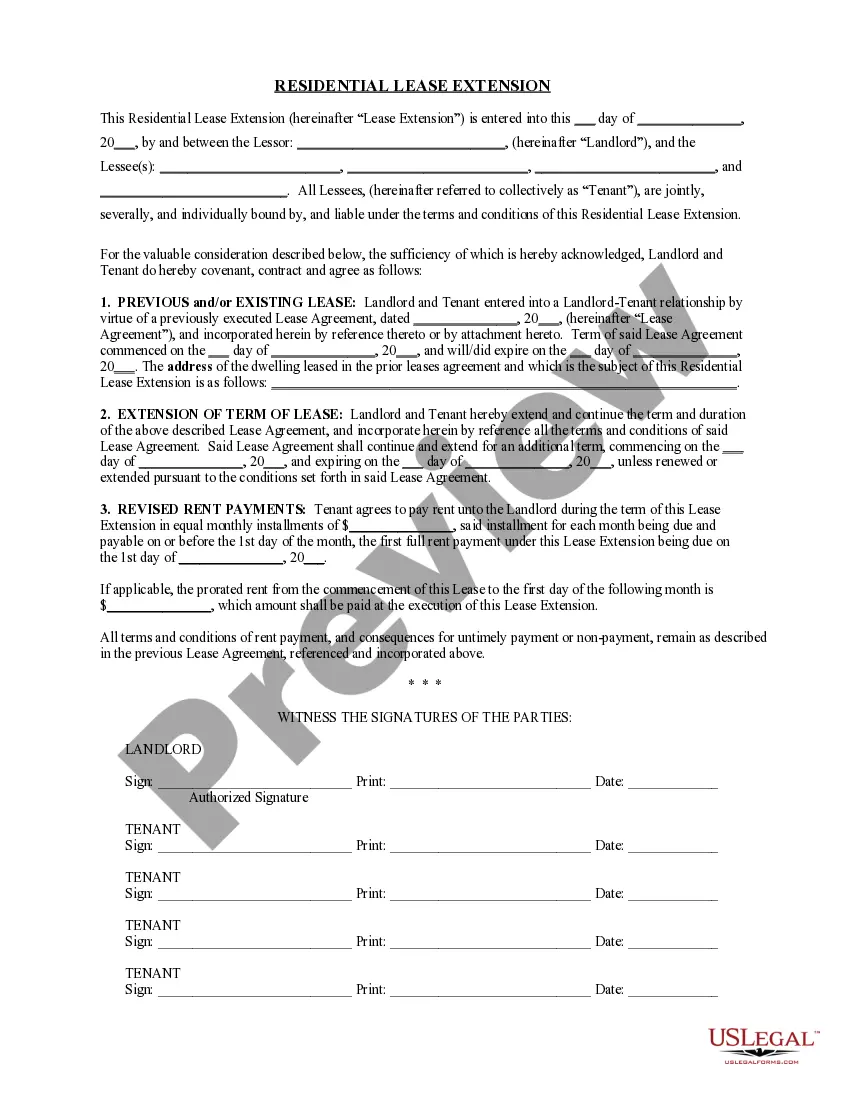
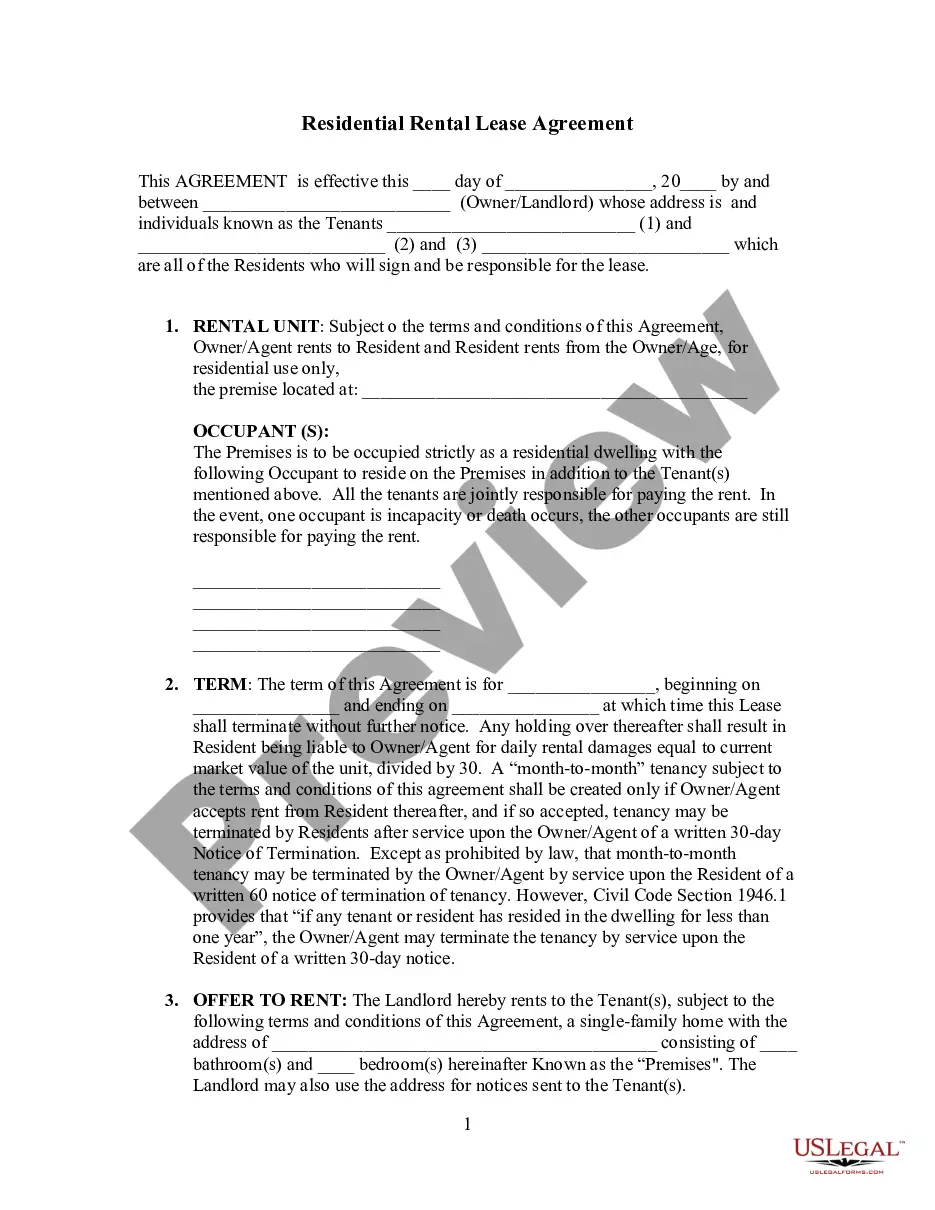
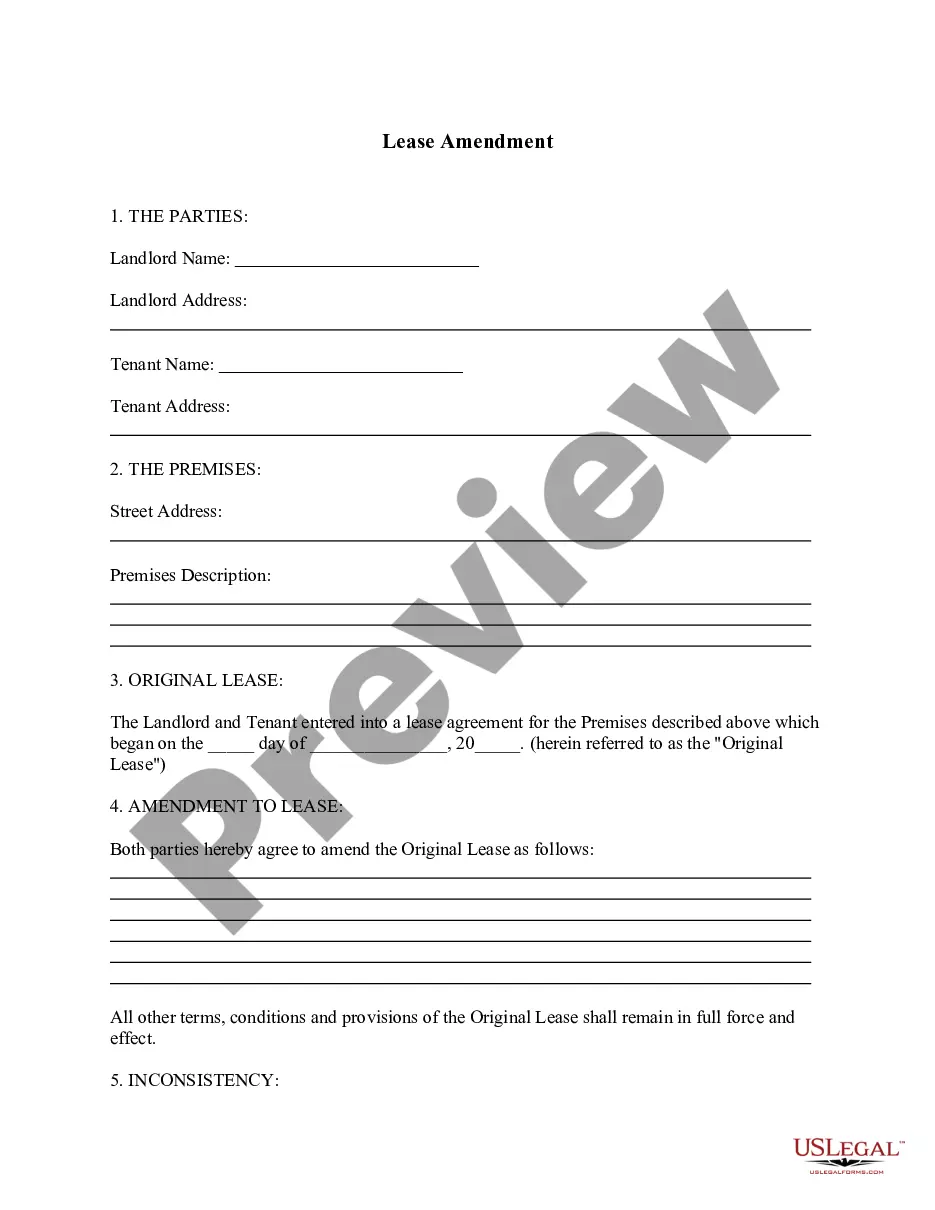
The Residential or Rental Lease Extension Agreement is a legal document that allows landlords and tenants to extend the duration of an existing residential lease without drafting a new lease. This form preserves all terms of the original lease while potentially updating rent amounts and other conditions. It is particularly useful for maintaining continuity in tenancy and avoiding the need for a new rental agreement.
Key components of this form
- Identification of the parties involved: Landlord and Lessee(s).
- Details of the previous lease agreement, including its start and end dates.
- Extension terms specifying the new lease duration.
- Revised rent payment details, including amount and due dates.
- Signature lines for both landlord and tenants to legally affirm the agreement.
When this form is needed
This form is needed when a tenant and landlord wish to extend the term of their existing lease agreement beyond its original expiration date. This situation can arise when both parties agree to continue the leasing arrangement, possibly with updated financial terms or conditions. It is commonly utilized when both the landlord and tenant want to maintain their relationship without the complexities of signing a new lease.
Who needs this form
- Landlords looking to extend an existing lease with their tenants.
- Tenants wishing to continue their residence under the same leasing conditions.
- Both parties who need to modify certain terms of their current lease agreement without starting fresh.
How to prepare this document
- Identify the landlord and all tenants by entering their names in the designated fields.
- Provide the original lease agreement's details, including start and end dates.
- Specify the new lease term dates that the extension will cover.
- Fill out the new rent payment amount and the due date.
- Ensure all parties sign and date the agreement to finalize the extension.
Notarization guidance
This form does not typically require notarization unless specified by local law. However, it is always advisable to check local regulations and practices to ensure compliance.
Get your form ready online
Our built-in tools help you complete, sign, share, and store your documents in one place.
Make edits, fill in missing information, and update formatting in US Legal Forms—just like you would in MS Word.
Download a copy, print it, send it by email, or mail it via USPS—whatever works best for your next step.
Sign and collect signatures with our SignNow integration. Send to multiple recipients, set reminders, and more. Go Premium to unlock E-Sign.
If this form requires notarization, complete it online through a secure video call—no need to meet a notary in person or wait for an appointment.
We protect your documents and personal data by following strict security and privacy standards.

Make edits, fill in missing information, and update formatting in US Legal Forms—just like you would in MS Word.

Download a copy, print it, send it by email, or mail it via USPS—whatever works best for your next step.

Sign and collect signatures with our SignNow integration. Send to multiple recipients, set reminders, and more. Go Premium to unlock E-Sign.

If this form requires notarization, complete it online through a secure video call—no need to meet a notary in person or wait for an appointment.

We protect your documents and personal data by following strict security and privacy standards.
Avoid these common issues
- Failing to include all tenant names, which can lead to enforcement issues.
- Not clearly specifying the new lease term dates.
- Ignoring the original lease terms when modifying payment amounts.
- Omitting signatures from all parties involved.
Benefits of completing this form online
- Convenience of downloading and completing the form at any time.
- Editability allows landlords and tenants to customize the agreement easily.
- Reliability of using a template created by licensed attorneys.
Legal use & context
- The Residential Lease Extension Agreement legally binds parties to continue the lease under previously agreed terms.
- It ensures continuity in the rental relationship without the need for a new lease.
- The extension is subject to state laws governing landlord-tenant relationships, which may vary.
Looking for another form?

Form popularity
FAQ
Renewal and extension are not the same. A lease renewal typically indicates a new agreement with possibly updated terms, while an extension preserves the current contract's stipulations. Utilizing a Florida Residential or Rental Lease Extension Agreement can clarify this distinction and provide an efficient solution for tenants looking to stay in their homes.
Renewing a lease often involves signing a new contract that may have different terms, while extending keeps the existing lease in place. A Florida Residential or Rental Lease Extension Agreement allows for a smooth continuation without alterations. Being aware of these differences helps you make informed decisions about your rental arrangements.
Extending a lease in Florida involves mutual agreement between the landlord and tenant. Start by reaching out to your landlord and express your interest in a Florida Residential or Rental Lease Extension Agreement. Having a written agreement protects both parties and ensures everyone understands their rights and responsibilities during the extension period.
To renew typically implies creating a new agreement with potentially altered terms, whereas extending keeps the original contract in effect. A Florida Residential or Rental Lease Extension Agreement serves as a straightforward solution for those who want to continue under the same conditions. This clarity helps avoid confusion and strengthens communication between landlords and tenants.
To obtain a lease extension agreement, start by discussing it with your landlord or property manager. Documentation, such as a Florida Residential or Rental Lease Extension Agreement, can easily be found online, including on platforms like USLegalForms. Once both parties agree to the terms, ensure they sign the document to formalize the extension.
In Florida, a lease extension continues the existing terms, while a renewal usually involves a new agreement. The Florida Residential or Rental Lease Extension Agreement maintains the original conditions, which can benefit both landlords and tenants seeking stability. Renewal may change rental terms or dates, so understanding this difference is crucial when planning your housing situation.
Extending a lease, like a Florida Residential or Rental Lease Extension Agreement, can lock you into unfavorable terms. If property values or rental rates increase, you might miss opportunities for better options elsewhere. Additionally, staying in a property longer could cause you to feel tied down, limiting your flexibility. Evaluate your circumstances before deciding to extend.
Extending a residential lease agreement generally involves discussing your plans with your landlord before your current lease expires. You may need to negotiate new terms or confirm existing conditions for your Florida Residential or Rental Lease Extension Agreement. It’s essential to document these changes formally to protect both parties. Tools like US Legal Forms offer easy-to-use templates that you can fill out and submit, helping you navigate this process smoothly.
To start an extension on your lease, first check your current lease agreement for any clauses regarding extensions. Typically, you will need to communicate directly with your landlord or property manager about your intention to extend. Ensure you understand the terms of the Florida Residential or Rental Lease Extension Agreement that you might have to sign. Using platforms like US Legal Forms can simplify this process by providing the necessary forms and guidance.
When a tenant remains in the property after the lease expiration in Florida, this situation often leads to a holdover tenancy. The landlord can choose to allow the tenant to stay under the existing terms, hinting at a potential Florida Residential or Rental Lease Extension Agreement. Alternatively, the landlord may initiate eviction proceedings to regain possession of the property. It’s essential to communicate openly about intentions and explore options like a lease extension to ensure a smooth resolution.