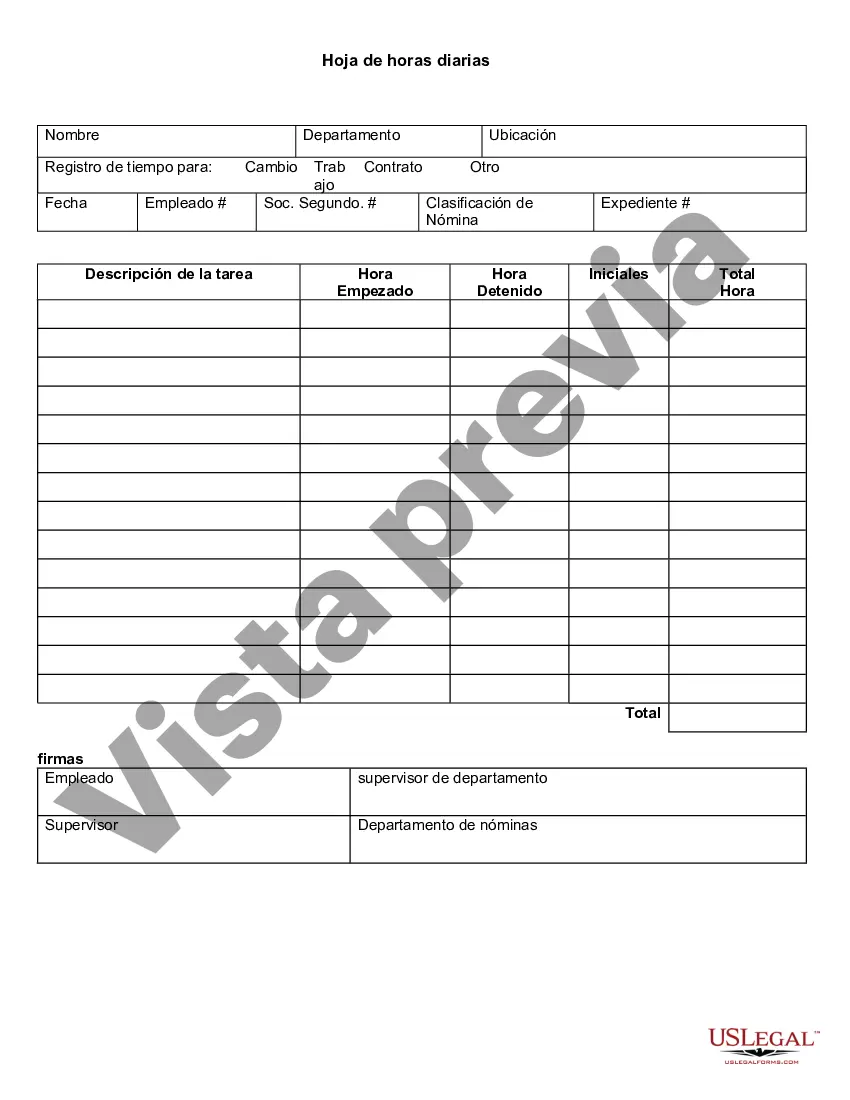
Timesheets were originally developed for an employer to determine payroll. However timesheets are not just for payroll any more. Timesheets may record the start and end time of tasks, or just the duration. It may contain a detailed breakdown of tasks accomplished throughout the project or program. This information may be used for payroll, client billing, and increasingly for project costing, estimation, tracking and management.
Some companies provide web-based timesheet software or services that provide a means to track time for payroll, billing and project management.
Para su conveniencia, debajo del texto en español le brindamos la versión completa de este formulario en inglés.
For your convenience, the complete English version of this form is attached below the Spanish version.
Newark New Jersey Hoja de horas diarias - Daily Time Sheet
Category:
State:
Multi-State
City:
Newark
Control #:
US-02949BG
Format:
Word
Instant download