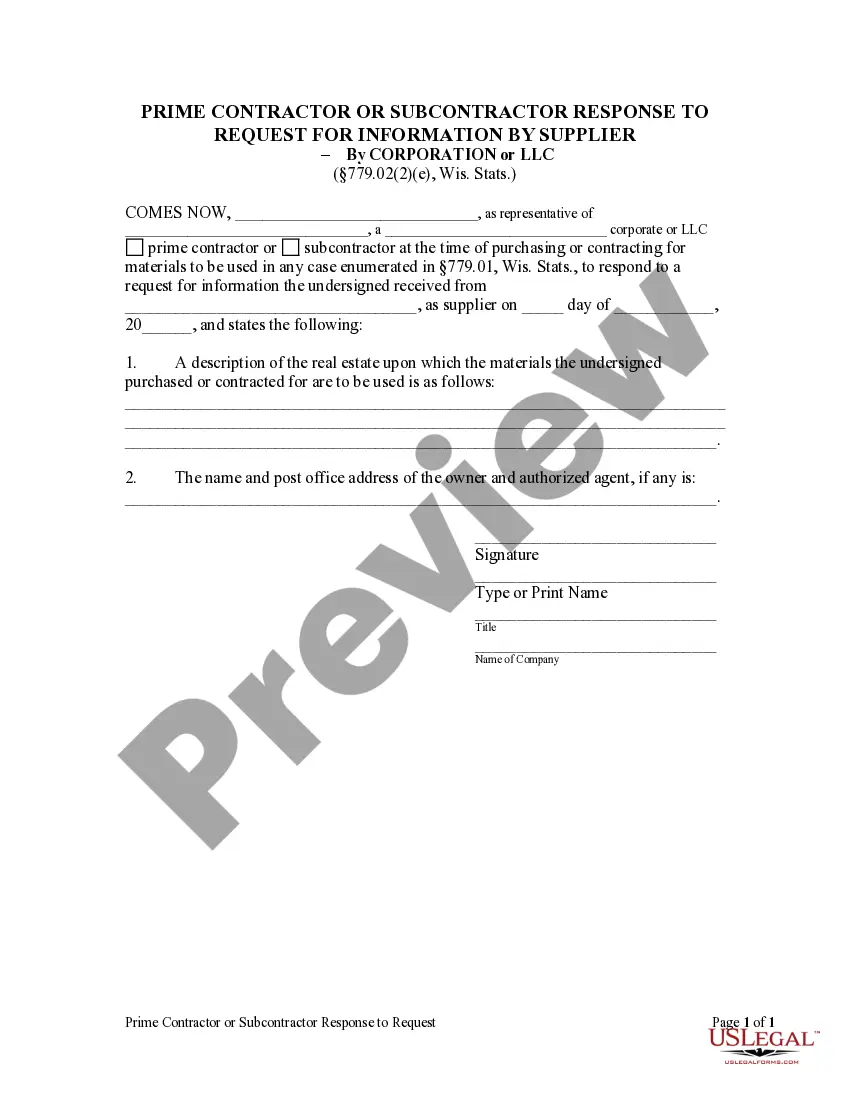
Wisconsin Prime Contractor or Subcontractor Response to Request for Information by Supplier - Corporation
Overview of this form
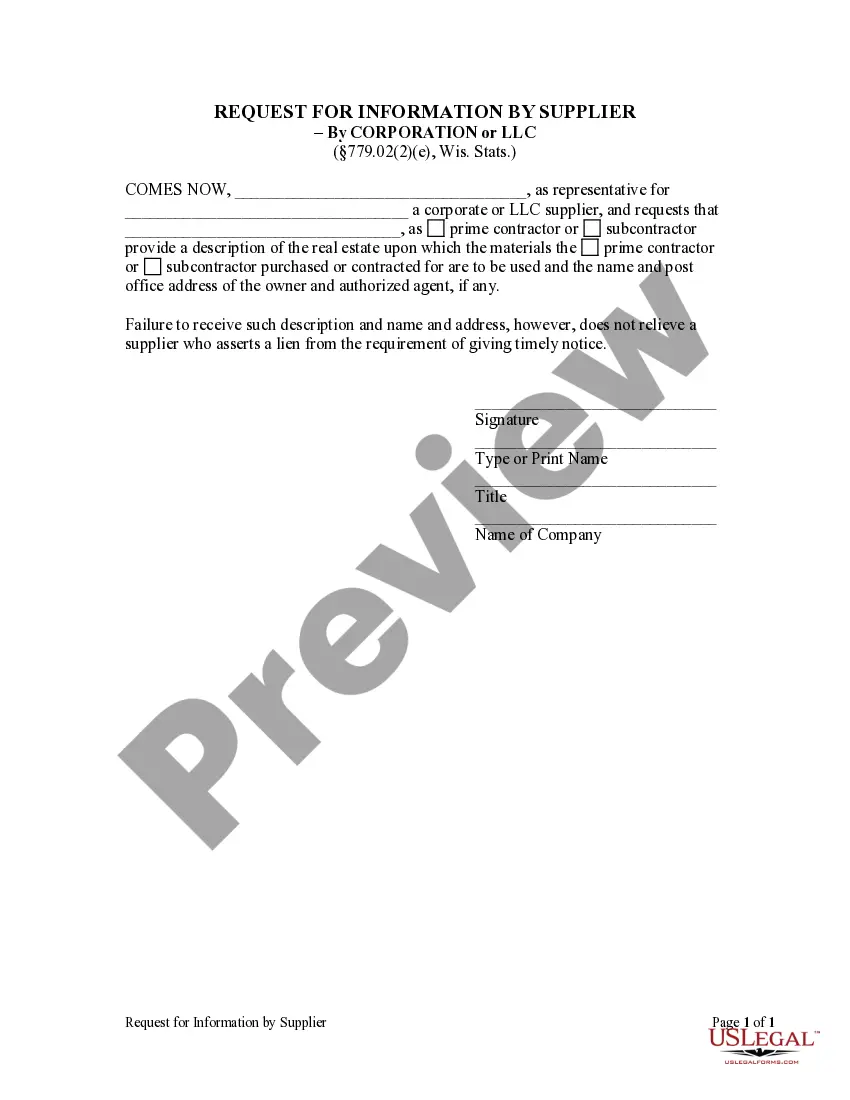
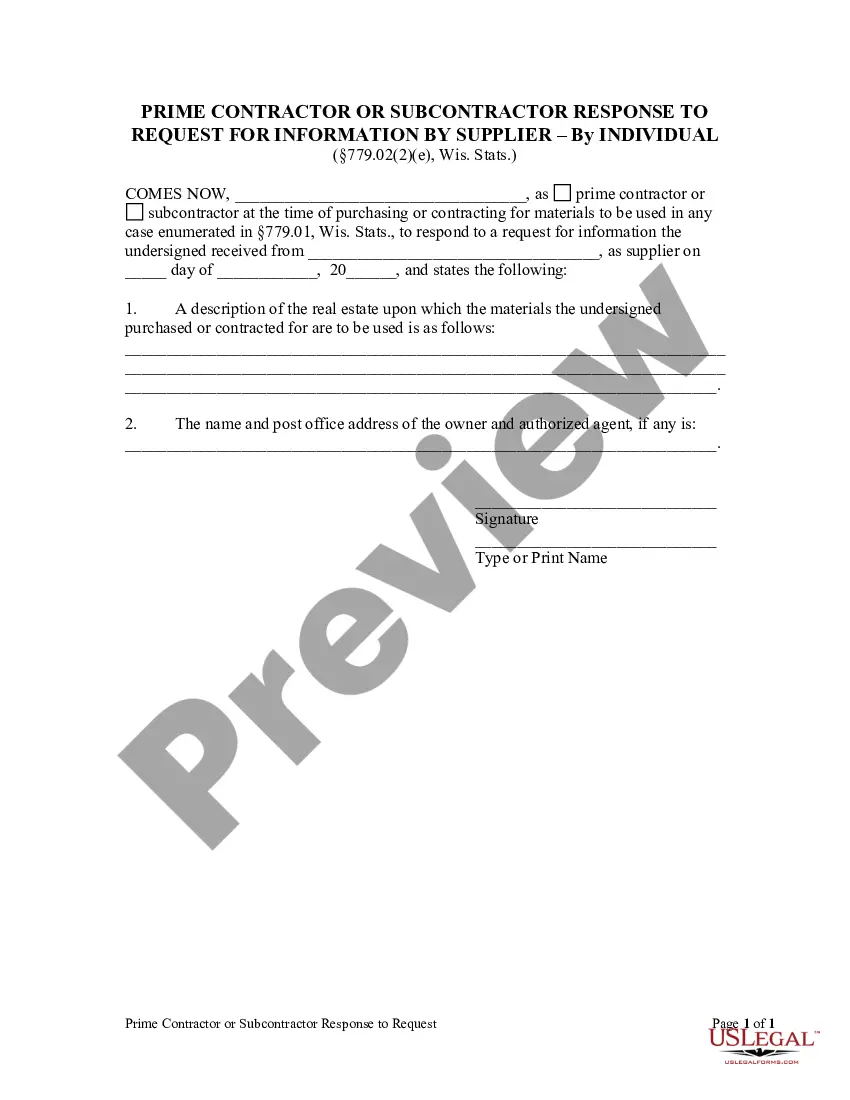
The Prime Contractor or Subcontractor Response to Request for Information by Supplier form is a legal document designed for corporate prime contractors and subcontractors. It is used to respond to inquiries from suppliers regarding the information about real estate where purchased materials will be utilized. This form sets it apart from other contracts as it specifically addresses supplier requests for information crucial in ensuring compliance with Wisconsin law, specifically §779.01 of the Wisconsin Statutes.
What’s included in this form
- Identification of the responding party, including the name and title of the representative.
- A description of the real estate where the materials will be used.
- Details of the owner of the real estate and their authorized agent, if applicable.
- Signature line for the representative of the corporation.
- Date of response, which establishes the timeline of the information exchange.
When to use this document
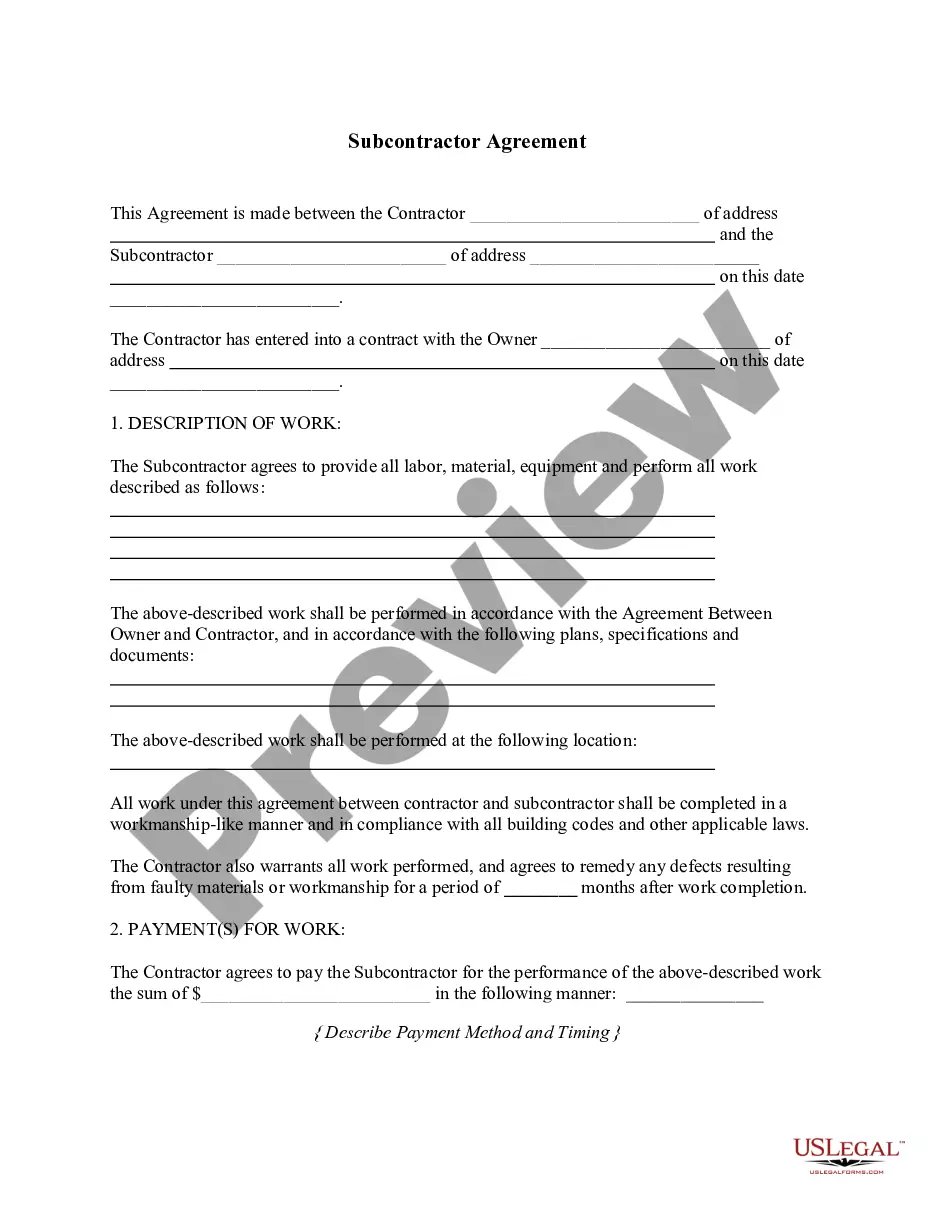
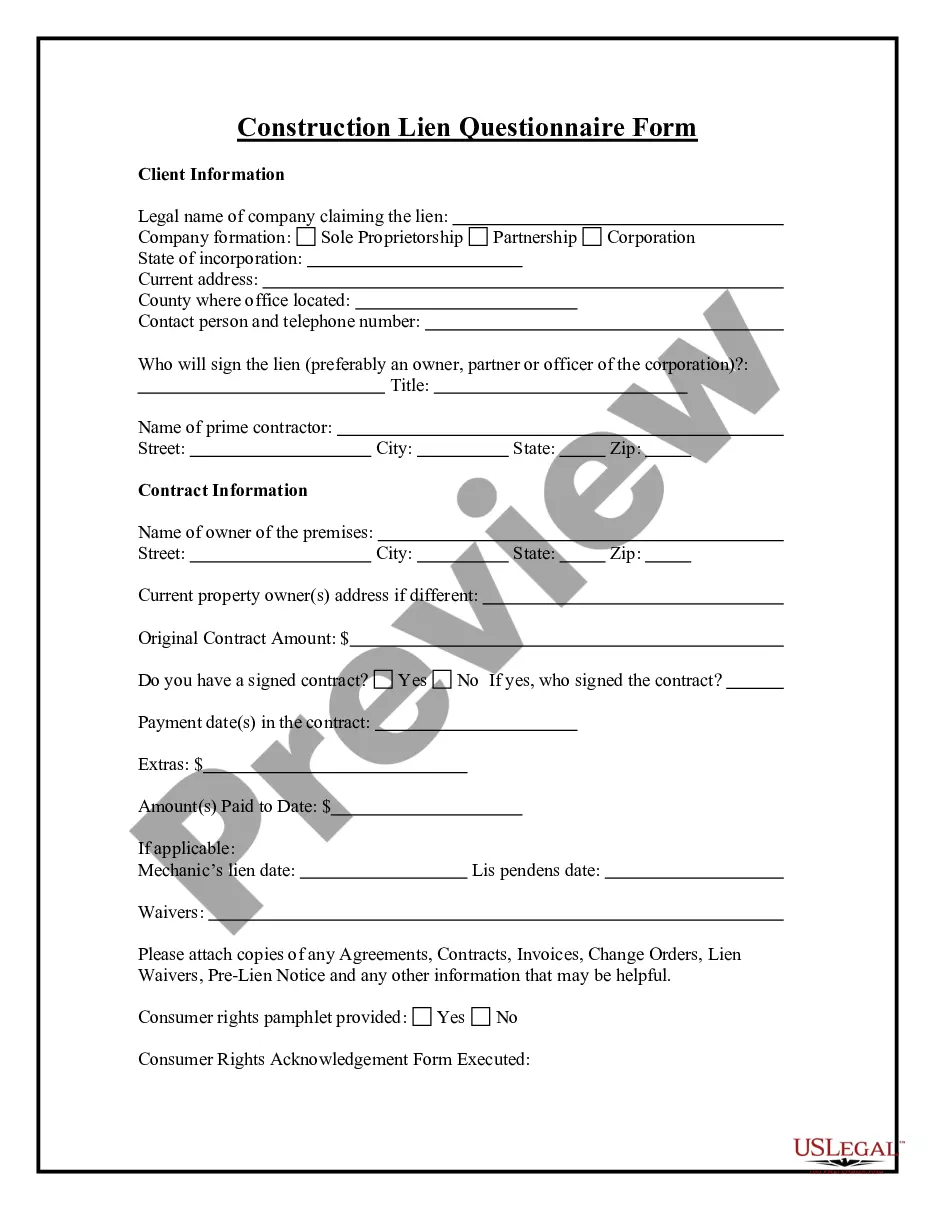
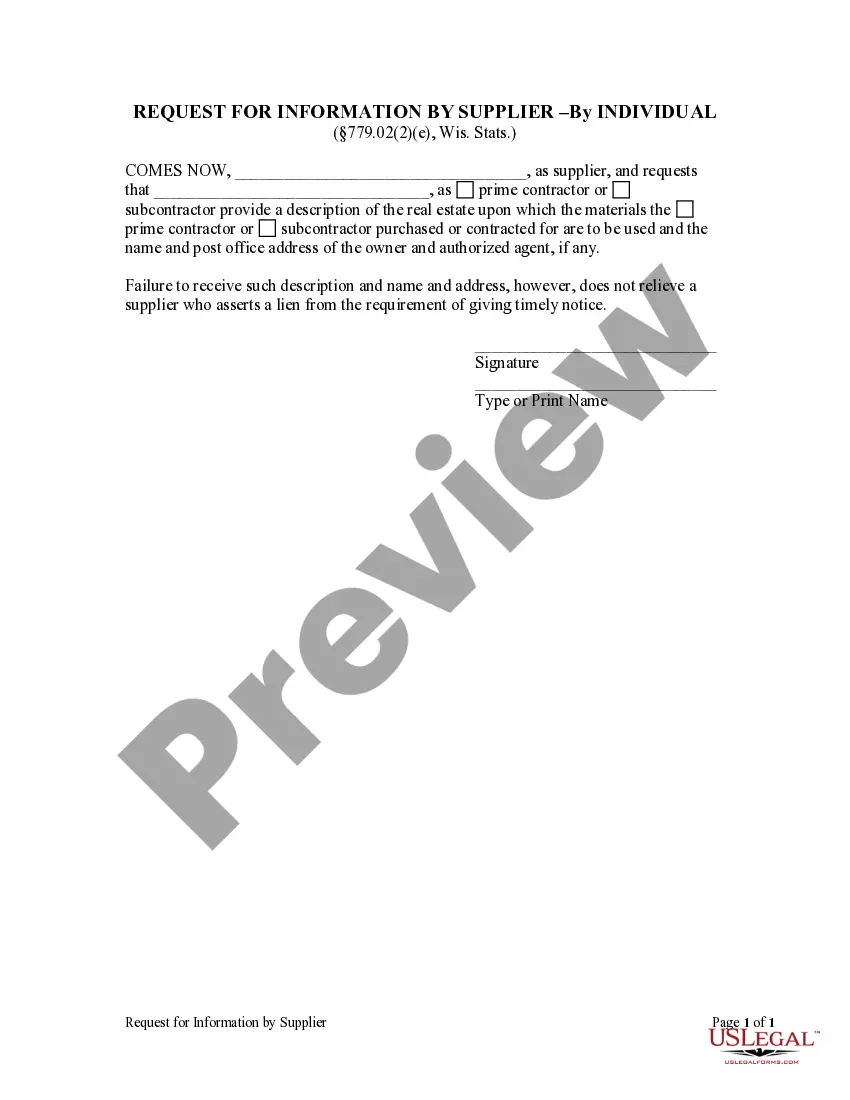
This form should be used when a corporate prime contractor or subcontractor has received a request from a supplier for details related to a particular project. Use this document in scenarios where you need to provide essential information about the property that will utilize contracted materials, ensuring compliance with state regulations on procurement and materials supply.
Who needs this form
This form is intended for:
- Corporate prime contractors involved in construction or material procurement.
- Subcontractors who work under a prime contractor and require clarity about the projects.
- Suppliers seeking detailed property information from prime contractors or subcontractors.
Instructions for completing this form
- Identify the parties involved, including the representative and the corporation's name.
- Describe the real estate pertinent to the materials specified in the purchase or contract.
- Provide the name and address of the property owner, along with their authorized agent, if there is one.
- Sign and date the document to validate the response.
- Ensure that all information is accurate and complete to avoid delays in processing.
Does this document require notarization?
This form does not typically require notarization unless specified by local law. However, verifying requirements based on specific situations or locations is advised to ensure compliance.
Get your form ready online
Our built-in tools help you complete, sign, share, and store your documents in one place.
Make edits, fill in missing information, and update formatting in US Legal Forms—just like you would in MS Word.
Download a copy, print it, send it by email, or mail it via USPS—whatever works best for your next step.
Sign and collect signatures with our SignNow integration. Send to multiple recipients, set reminders, and more. Go Premium to unlock E-Sign.
If this form requires notarization, complete it online through a secure video call—no need to meet a notary in person or wait for an appointment.
We protect your documents and personal data by following strict security and privacy standards.

Make edits, fill in missing information, and update formatting in US Legal Forms—just like you would in MS Word.

Download a copy, print it, send it by email, or mail it via USPS—whatever works best for your next step.

Sign and collect signatures with our SignNow integration. Send to multiple recipients, set reminders, and more. Go Premium to unlock E-Sign.

If this form requires notarization, complete it online through a secure video call—no need to meet a notary in person or wait for an appointment.

We protect your documents and personal data by following strict security and privacy standards.
Avoid these common issues
- Failing to include a complete description of the real estate.
- Not providing accurate ownership information or failing to identify the authorized agent.
- Neglecting to sign and date the form, which may render it invalid.
- Omitting essential details requested by the supplier.
Advantages of online completion
- Easy access to legal documents that can be downloaded and edited.
- Convenient and quick completion from any location without the need for physical paperwork.
- Forms drafted by licensed attorneys ensure legal compliance and reliability.
Quick recap
- The form is crucial for compliance when responding to supplier inquiries in construction contexts.
- Ensure all parties' information is accurately filled out to avoid misunderstandings or legal complications.
- Utilize this form to maintain proper documentation and transparency in material procurement.
Looking for another form?
Form popularity
FAQ
Like an independent contractor, a subcontractor is usually self-employed.A subcontractor is not considered an employee of the contracting company or the independent contractor, and is responsible for paying their own taxes.
Pr 1.2: Can a construction firm that is a subcontractor on one construction project simultaneously be a prime contractor on another project? Explain. Yes. There are several ways that this could happen.
When clients hire you to work on a specific project or on a freelance basis, you are usually considered a contractor. You provide the labor, services, and sometimes whatever equipment is needed to get the project done.Subcontractors are companies or individual people that you hire to help you complete a project.
(The general contractor is often referred to as a principal and the subcontractor as an independent contractor.) A general contractor is not ordinarily liable for the negligence of an independent contractor such as a subcontractor.
Prime contractors work directly with the government. They manage any subcontractors, and are responsible for ensuring that the work is completed as defined in the contract. To become a prime contractor, you must first register your business with the System for Award Management (SAM).
A prime or direct contractor is a contractor that has a contract directly with the property owner. A general contractor refers to a contractor in charge of hiring subcontractors and coordinating their work, keeping the job on track for timely and on-budget completion.
It depends on context, mostly. If you're a contractor, your suppliers are subcontractors.
For example, a building contractor may hire a subcontractor to complete the electrical wiring part of the contractor's building job. The contractor is responsible to the client for the building job including the part performed by the subcontractor.
A subcontractor is a type of contractor. Subcontractors also work on a contractual basis, and they also offer a particular set of skills which they perform for customers. The key point about subcontractors is that they form agreements with the contractor, not with the customer.