Vermont Notice of Mechanic's Lien
Understanding this form
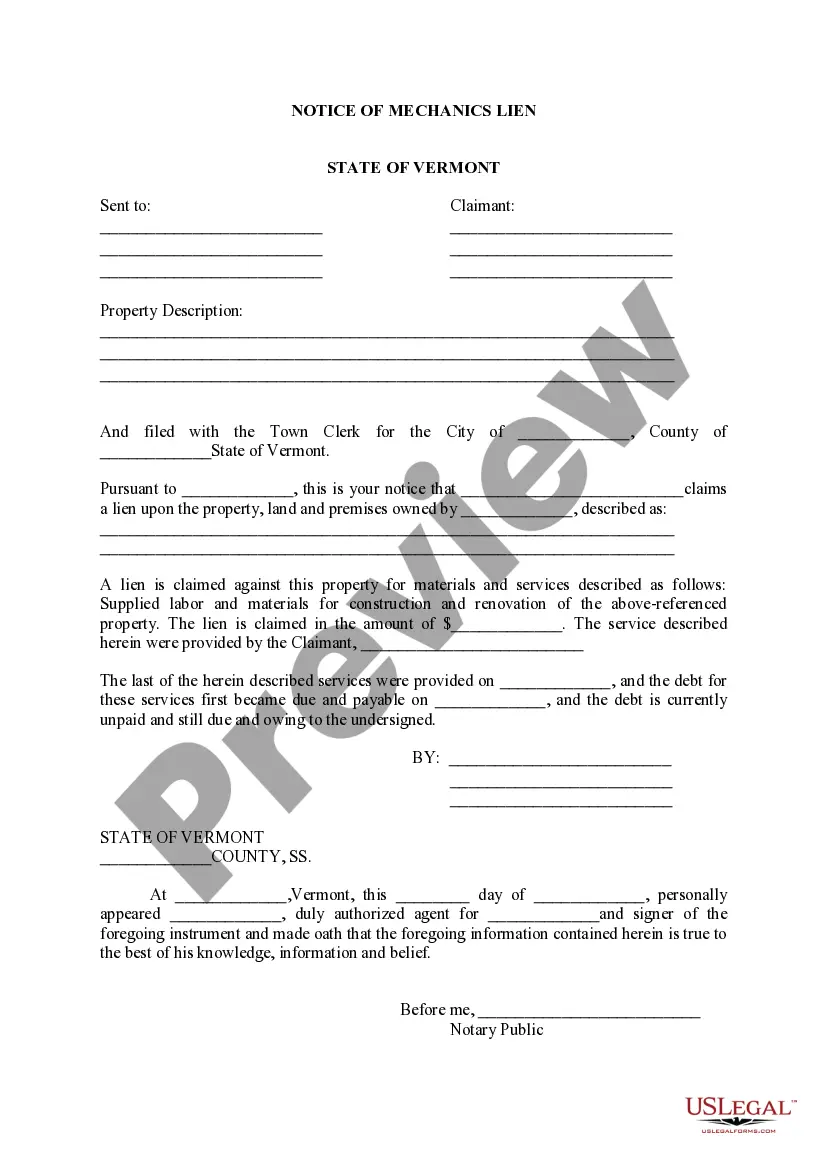
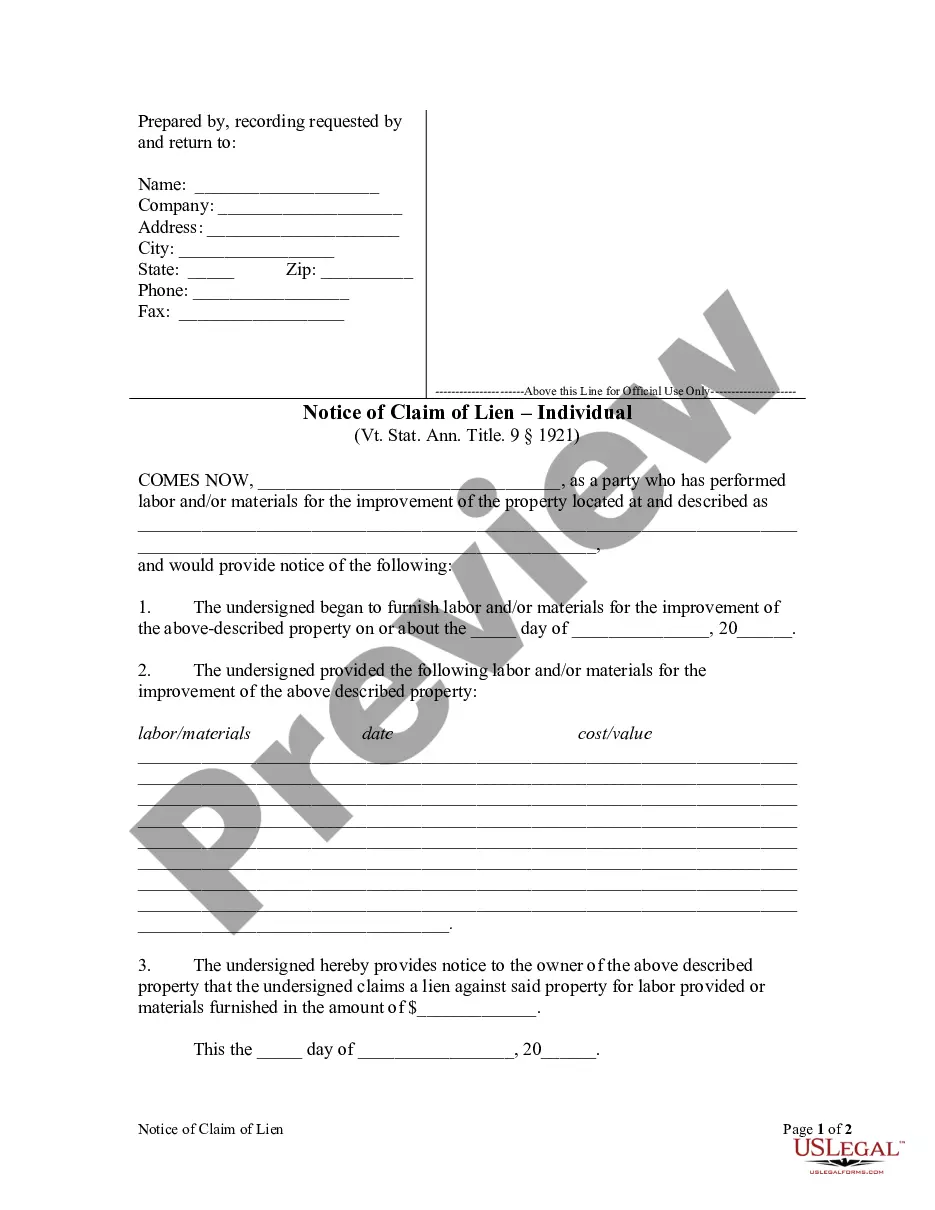
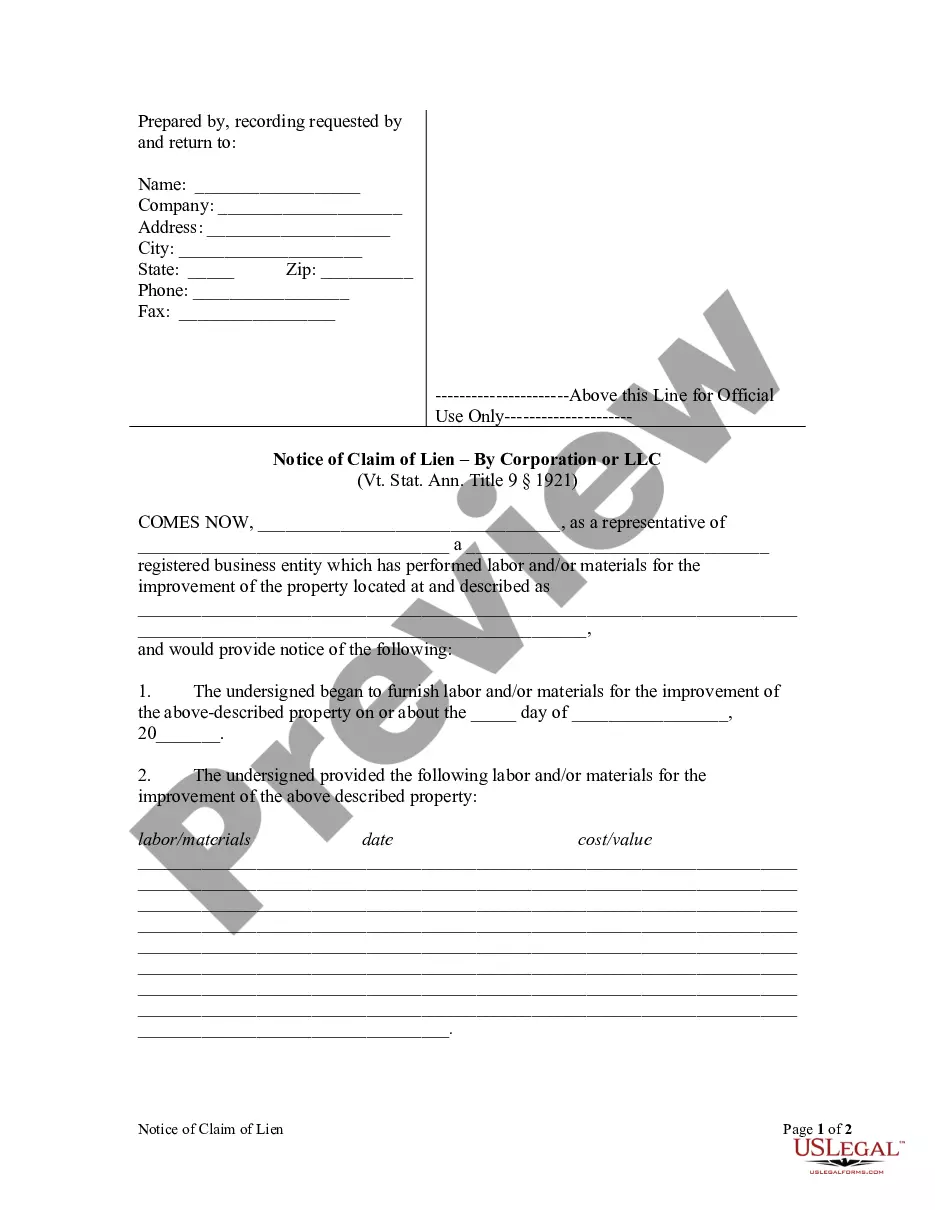
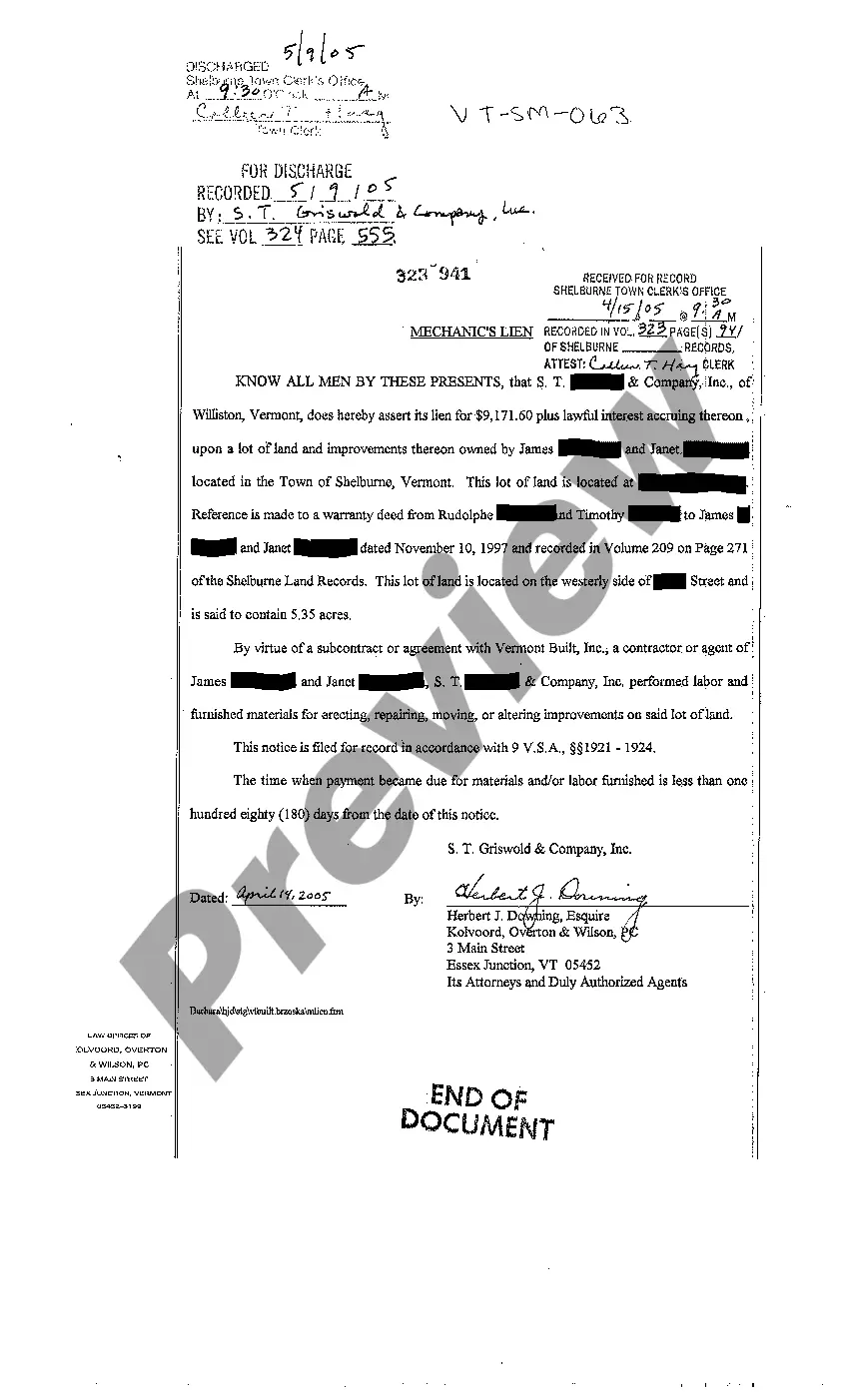
The Notice of Mechanic's Lien is a legal document used by unpaid workmen or suppliers to claim payment for services rendered or materials provided in the construction or renovation of a property. This form notifies property owners that a lien has been placed against their property, distinguishing it from other forms by its specific focus on construction-related debts. By filing this notice, claimants formalize their right to seek payment and protect their interests legally.
Form components explained
- Claimant information: Details of the individual or business making the claim.
- Property description: A legal description of the property involved.
- Claim amount: The total dollar amount for which the lien is filed.
- Service dates: Dates when the services were provided and when payment became due.
- Certification of mailing: Confirmation that the property owner was notified of the lien.
- Notary section: A requirement for witnessing and validating the document.
Common use cases
This form is necessary when contractors, subcontractors, or suppliers have not received payment for their work or materials after providing services on a property. It can be used in scenarios like completing construction projects without receiving compensation, or when suppliers have not been paid for materials delivered. Utilizing this notice proactively can help secure the right to payment and add a legal claim against the property if the debt remains unpaid.
Who can use this document
- General contractors who have completed work on a client's property but have not been compensated.
- Subcontractors providing specialized labor or materials as part of a larger project.
- Material suppliers seeking payment for construction materials provided to a property.
- Any party that has a legitimate claim for unpaid services related to the improvement of real estate.
Completing this form step by step
- Identify the claimant by entering their name and contact details.
- Specify the property by providing a clear and accurate legal description.
- Fill in the amount claim as compensation for services and/or materials provided.
- Provide dates for when the services were completed and when payment was first due.
- Sign the document in the space provided, ensuring it is witnessed by a notary.
- Make sure to mail a copy to the property owner at their last known address, and retain proof of mailing.
Does this document require notarization?
Yes, this form must be notarized to be legally valid. The notarization process provides a layer of authenticity and ensures the information reported is true. US Legal Forms offers integrated online notarization services, available 24/7 via secure video call, making it easy to have your document notarized without needing to travel.
Get your form ready online
Our built-in tools help you complete, sign, share, and store your documents in one place.
Make edits, fill in missing information, and update formatting in US Legal Forms—just like you would in MS Word.
Download a copy, print it, send it by email, or mail it via USPS—whatever works best for your next step.
Sign and collect signatures with our SignNow integration. Send to multiple recipients, set reminders, and more. Go Premium to unlock E-Sign.
If this form requires notarization, complete it online through a secure video call—no need to meet a notary in person or wait for an appointment.
We protect your documents and personal data by following strict security and privacy standards.

Make edits, fill in missing information, and update formatting in US Legal Forms—just like you would in MS Word.

Download a copy, print it, send it by email, or mail it via USPS—whatever works best for your next step.

Sign and collect signatures with our SignNow integration. Send to multiple recipients, set reminders, and more. Go Premium to unlock E-Sign.

If this form requires notarization, complete it online through a secure video call—no need to meet a notary in person or wait for an appointment.

We protect your documents and personal data by following strict security and privacy standards.
Typical mistakes to avoid
- Failing to accurately describe the property, which can invalidate the lien.
- Not including the correct amount owed or essential service dates.
- Omitting to send a copy of the notice to the property owner.
- Neglecting to have the form notarized, if required.
- Submitting the form after the applicable deadline for filing a lien.
Benefits of using this form online
- Convenience of downloading and filing forms from anywhere at any time.
- Editability allows for customization without needing to type or print repeatedly.
- Access to templates that are drafted by legal professionals ensures compliance with state laws.
- Streamlined process reduces the time spent on paperwork and legal understanding.
Main things to remember
- The Notice of Mechanic's Lien is vital for securing payment for services in construction.
- Correct completion and timely filing are crucial to enforceability.
- Notarization is required in Vermont for the form to be legally binding.
- The form must be sent to the property owner and filed with local authorities.
Looking for another form?
Form popularity
FAQ
Mechanics Liens must be recorded by a "subcontractor" within 90 days of "completion" or "cessation of work" and a general contractor who has a direct contract with the owner must record within 90 days of completion or of cessation of labor, unless completion or cessation of labor has occurred.
Mechanic's liens create a cloud on title, meaning that they appear in public property records. Liens are sometimes said to travel with the land, meaning that anyone who buys your house would take the property subject to the contractor's lien (or, more likely, demand that you pay it off first).
Generally, this requires the assistance of a lawyer. The homeowner may petition the courts under Civil Code Section 8480 in California to remove the mechanic's lien when it is not timely issued or recorded. A lawsuit is usually necessary to file it against the owner by the contractor or subcontractor.
In Texas, a mechanics lien expires after 1 or 2 years, depending on the type of project. A lien claimant will need to enforce their mechanics lien before the deadline. 1 year after termination, completion, or abandonment or the project.
A mechanics lien is a legal claim on the property for unpaid construction work or supplies. Once claimants file a mechanics lien in California, the owner's property turns into collateral, allowing claimants to secure the service they rendered or the supplies they provided.
Negotiate with the contractor who placed the lien (the "lienor" to remove it. Obtain a lien bond to discharge the lien, or. File a lawsuit to vacate the lien.
To enforce the lien, the contractor must file a lawsuit within 90 days from the date of recording the lien. If this deadline is passed, the contractor may not be able to enforce the lien and may be required to remove the lien.
When a contractor files a mechanics' (construction) lien on your home, the lien makes your home into what's called security for an outstanding debt, which the contractor claims is due and unpaid for services or materials.