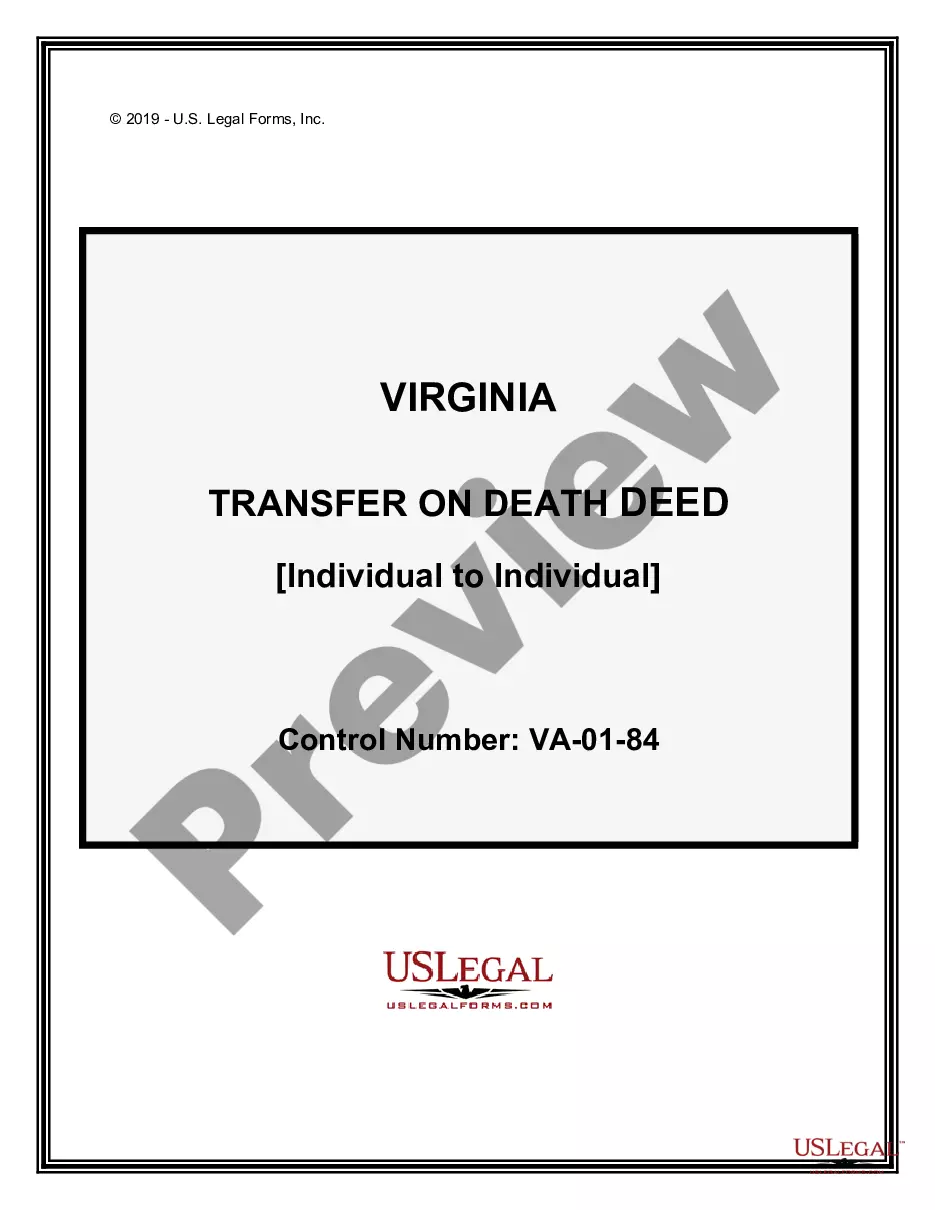
Virginia Revocable Transfer on Death Deed from Individual to Individual
What is this form?
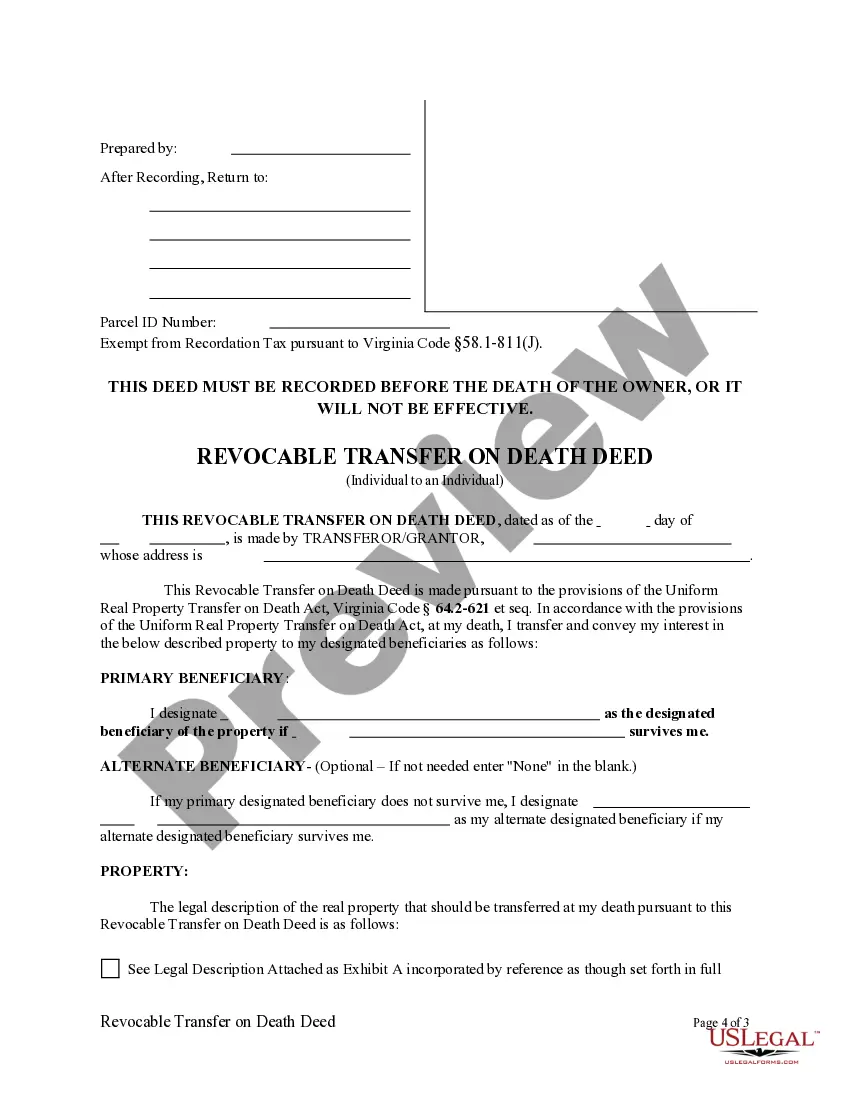
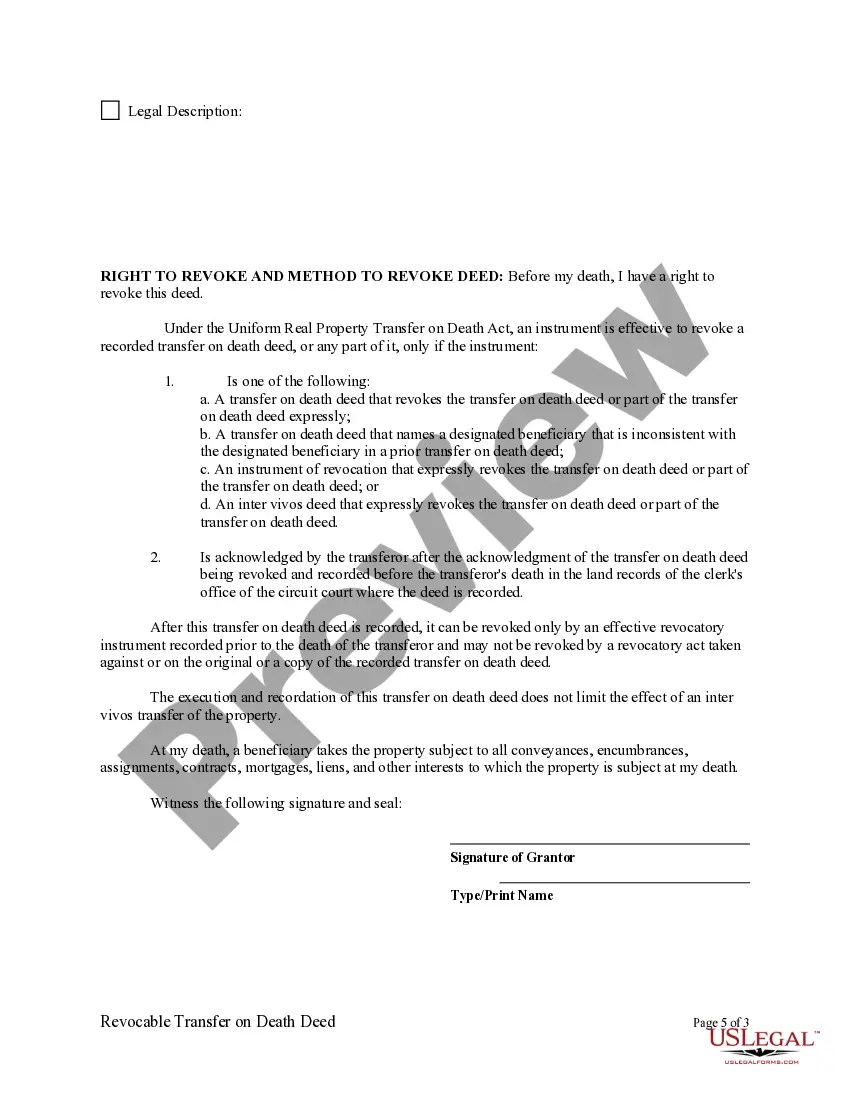
The Revocable Transfer on Death Deed is a legal document that allows an individual (the Grantor) to designate a beneficiary who will inherit property upon the Grantor's death. This transfer is revocable, meaning the Grantor retains the right to change their mind until death. Unlike a regular transfer of property, this deed only takes effect after the Grantor's passing, providing a straightforward way to transfer real estate without probate.
What’s included in this form
- Identification of the Grantor and the Primary Beneficiary.
- Optional section for specifying an alternative beneficiary.
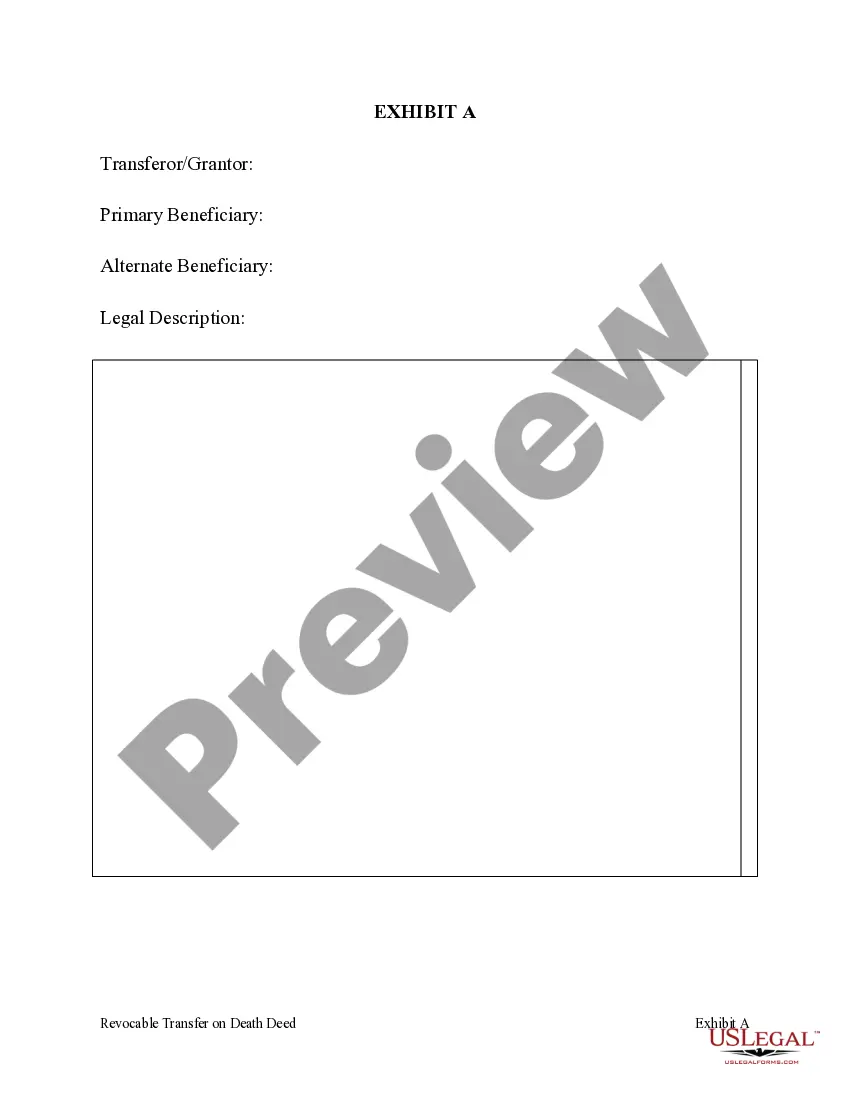
- Formal description of the property being transferred.
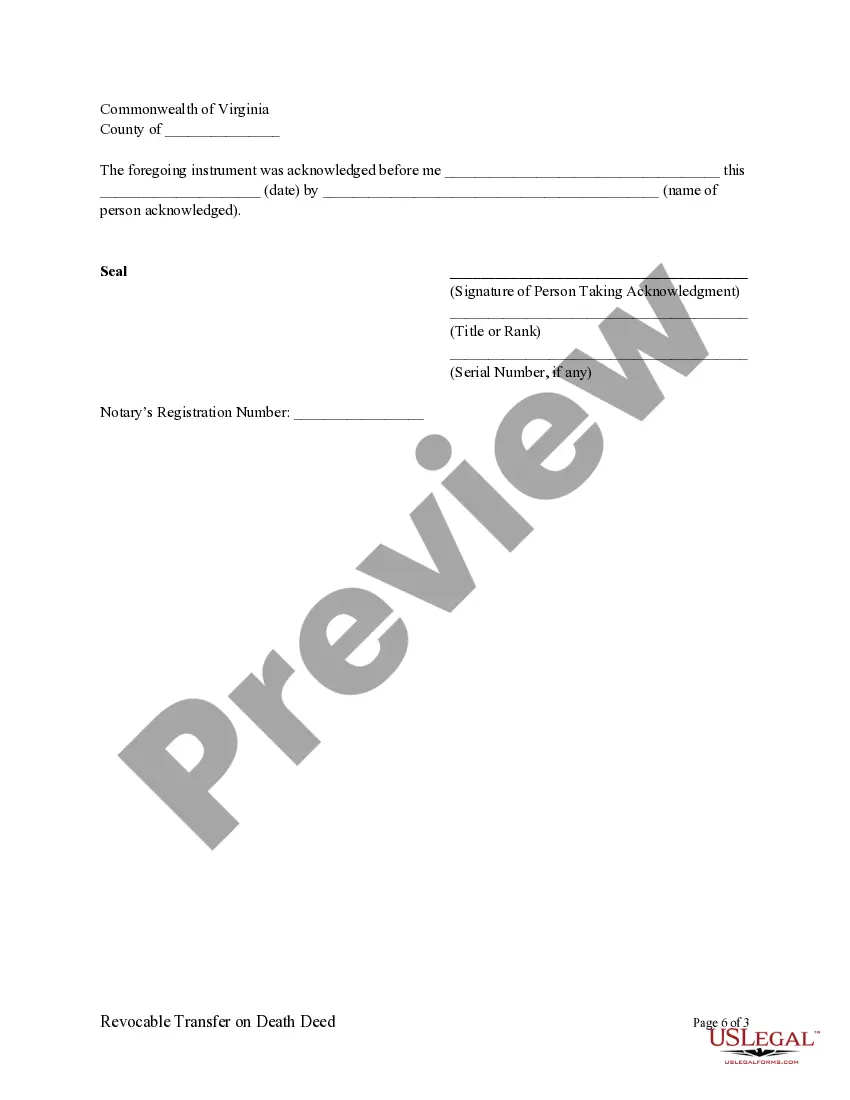
- Signature and acknowledgment by the Grantor.
- Fields for tax map reference and consideration amount.


When this form is needed
This form is useful when an individual wants to ensure that specific property is transferred directly to a chosen beneficiary, without going through probate. It is particularly beneficial for those wishing to simplify estate management and expedite the inheritance process. Common scenarios include transferring family homes, vacation properties, or investment real estate to loved ones.
Who should use this form
This form is intended for:
- Individuals who own real estate and wish to designate a beneficiary.
- People looking for an easy way to ensure their property passes outside of probate.
- Those who might want to change their beneficiary at any time before their death.
Completing this form step by step
- Identify the parties involved by entering the full names of the Grantor and the Primary Beneficiary.
- Complete the property description to clearly identify the real estate being transferred.
- If desired, provide an alternative beneficiary's name in case the Primary Beneficiary does not survive the Grantor.
- Enter the tax map reference and complete any fields for consideration in the designated areas.
- Sign the document in front of a notary public for legal validity.
Does this document require notarization?
This form must be notarized to be legally valid. U.S. Legal Forms offers integrated online notarization services that are available twenty-four-seven via secure video call, ensuring you can notarize your document without needing to travel.
Get your form ready online
Our built-in tools help you complete, sign, share, and store your documents in one place.
Make edits, fill in missing information, and update formatting in US Legal Forms—just like you would in MS Word.
Download a copy, print it, send it by email, or mail it via USPS—whatever works best for your next step.
Sign and collect signatures with our SignNow integration. Send to multiple recipients, set reminders, and more. Go Premium to unlock E-Sign.
If this form requires notarization, complete it online through a secure video call—no need to meet a notary in person or wait for an appointment.
We protect your documents and personal data by following strict security and privacy standards.

Make edits, fill in missing information, and update formatting in US Legal Forms—just like you would in MS Word.

Download a copy, print it, send it by email, or mail it via USPS—whatever works best for your next step.

Sign and collect signatures with our SignNow integration. Send to multiple recipients, set reminders, and more. Go Premium to unlock E-Sign.

If this form requires notarization, complete it online through a secure video call—no need to meet a notary in person or wait for an appointment.

We protect your documents and personal data by following strict security and privacy standards.
Avoid these common issues
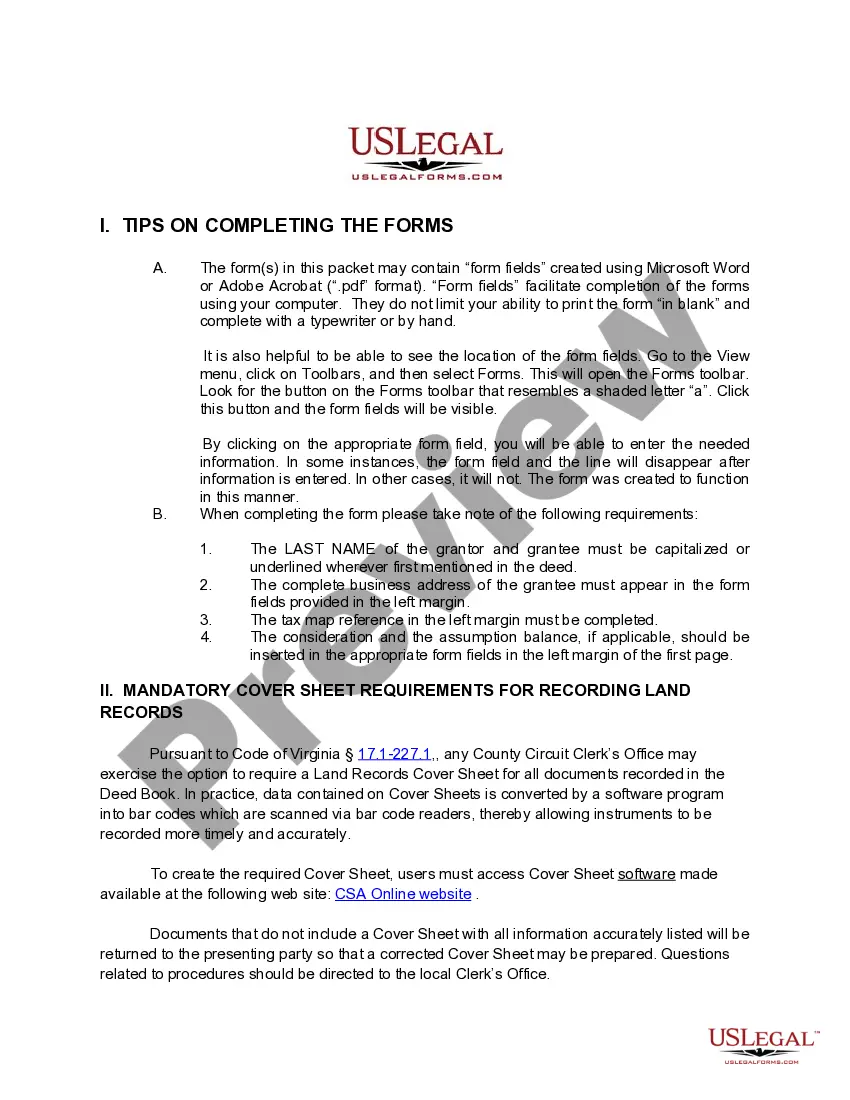
- Failing to capitalize or underline the LAST NAMES of the Grantor and Beneficiary as required.
- Omitting the complete business address of the grantee.
- Not providing the necessary tax map reference.
- Neglecting to have the deed notarized if required by local laws.
Why use this form online
- Convenience of filling out the form from your home with no need for physical trips to legal offices.
- Editability, allowing you to make changes until the document is finalized and signed.
- Access to professionally drafted templates that comply with current laws.
Legal use & context
- This deed must be properly executed and recorded to be enforceable.
- It is important to understand that this deed does not replace an inter vivos (living) transfer of property and should be used with proper estate planning.
What to keep in mind
- A Revocable Transfer on Death Deed allows for direct transfer of property to a beneficiary after death without probate.
- This form can be changed or revoked by the Grantor any time prior to their death.
- Proper notarization and recording are essential for the deed's validity.
Looking for another form?

Form popularity
FAQ
It’s a legal deed that lets the grantor name a beneficiary to inherit a specific Virginia property after death. The transfer is revocable during the grantor’s lifetime and takes effect only at death, avoiding probate for that property. It’s used to simplify estate planning and allow changes to beneficiaries before death.
Complete the form by identifying the grantor and the primary beneficiary, optionally naming an alternate beneficiary, describing the property, and providing the tax map reference and any consideration. The grantor must sign and have the deed acknowledged. The grantor may revoke or change beneficiaries before death, and the transfer takes effect after death to avoid probate.
While the form can be prepared without an attorney, many people consult a licensed attorney to ensure the deed accurately describes the property, correctly identifies beneficiaries, and complies with Virginia execution requirements. An attorney can help avoid mistakes that could affect probate avoidance or future transfers.
The main downside is that once the deed is recorded, changing beneficiaries or revoking the transfer requires action during the grantor’s lifetime. It may also create unintended conflicts with mortgages, other heirs, or tax planning. If not kept up to date, the property could pass to a beneficiary that doesn't reflect the grantor’s current intentions.
Common mistakes include incomplete identification of grantor or beneficiary, omitting the alternative beneficiary, an inaccurate property description, missing or improperly executed signature/acknowledgment, and failing to include the tax map reference or consideration details. Double-check all fields before execution to ensure the deed will be valid and effective after death.
The key difference is revocability during the grantor’s lifetime. This form lets the grantor change or revoke beneficiaries before death, whereas a non-revocable transfer on death deed would not be easily changed. The deed still takes effect only after death and is designed to avoid probate for the designated property.