Counterpart Execution
What this document covers
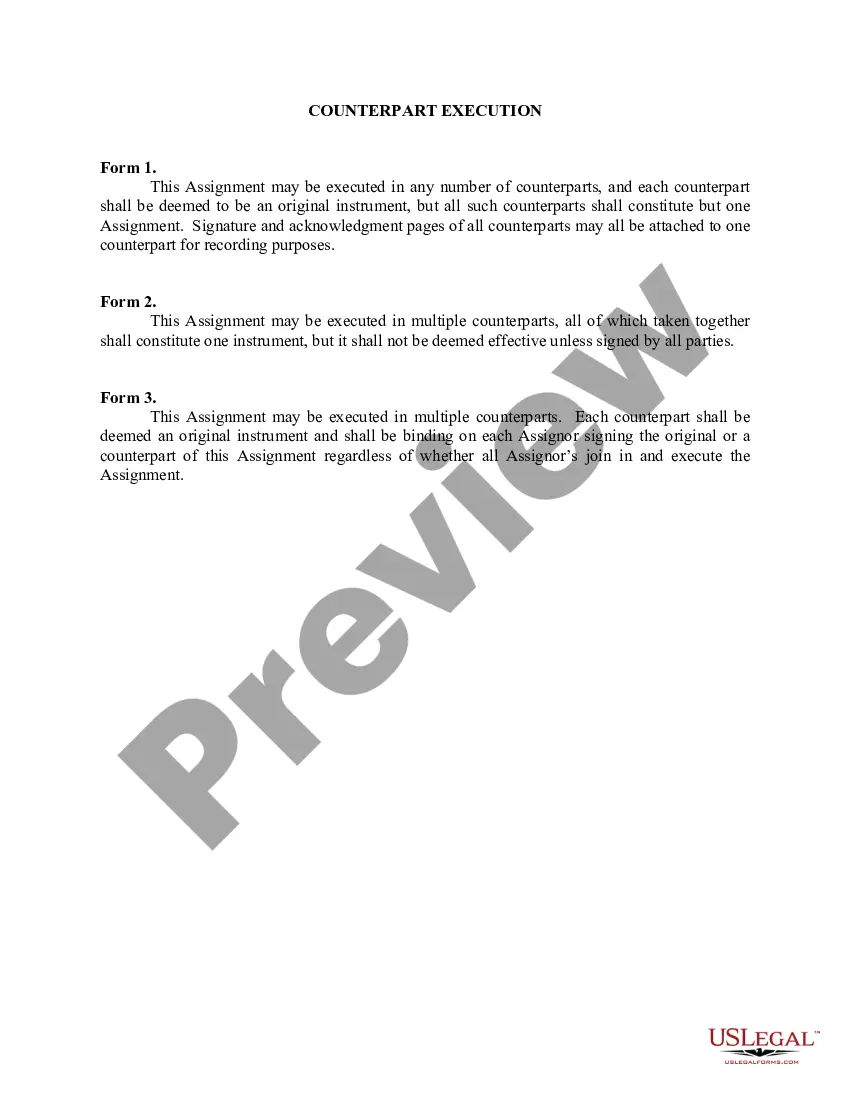
The Counterpart Execution form allows parties to execute a single legal document in multiple original copies, known as counterparts. Each counterpart is treated as an original, meaning that all can be combined to constitute one valid legal instrument. This form is particularly useful in situations where signatories are in different locations or unable to sign a single document at the same time, ensuring the agreement can still be legally effective without requiring everyone to be present at once.
Key parts of this document
- Statement of execution in counterparts, indicating all copies are considered originals.
- Clauses confirming that the total of the executed counterparts constitutes one legal agreement.
- Signature and acknowledgment provisions for each party involved.
- Instructions for attaching signature pages to one counterpart for recording purposes.


When this form is needed
This form is ideal in situations where multiple parties need to sign a contract but are unable to do so at the same location. It is common in business transactions, real estate agreements, or any contractual arrangements where parties reside in different areas and require a legally binding agreement without the need for simultaneous signing. The use of counterparts allows for flexibility in negotiations and execution.
Who needs this form
- Business partners wanting to execute a joint venture agreement remotely.
- Real estate professionals involved in property transactions with multiple stakeholders.
- Individuals entering into contracts that necessitate multiple signatures from different locations.
- Lawyers drafting agreements for clients who are unable to sign in person.
Steps to complete this form
- Identify all parties involved in the agreement.
- Draft the complete text of the Assignment, ensuring clarity and accuracy.
- Attach signature lines for each party on separate counterparts or on a single document.
- Ensure every party reviews and signs their respective counterpart.
- Compile all signed counterparts into one document for finalization and potential recording.
Is notarization required?
In most cases, this form does not require notarization. However, some jurisdictions or signing circumstances might. US Legal Forms offers online notarization powered by Notarize, accessible 24/7 for a quick, remote process.
Get your form ready online
Our built-in tools help you complete, sign, share, and store your documents in one place.
Make edits, fill in missing information, and update formatting in US Legal Forms—just like you would in MS Word.
Download a copy, print it, send it by email, or mail it via USPS—whatever works best for your next step.
Sign and collect signatures with our SignNow integration. Send to multiple recipients, set reminders, and more. Go Premium to unlock E-Sign.
If this form requires notarization, complete it online through a secure video call—no need to meet a notary in person or wait for an appointment.
We protect your documents and personal data by following strict security and privacy standards.

Make edits, fill in missing information, and update formatting in US Legal Forms—just like you would in MS Word.

Download a copy, print it, send it by email, or mail it via USPS—whatever works best for your next step.

Sign and collect signatures with our SignNow integration. Send to multiple recipients, set reminders, and more. Go Premium to unlock E-Sign.

If this form requires notarization, complete it online through a secure video call—no need to meet a notary in person or wait for an appointment.

We protect your documents and personal data by following strict security and privacy standards.
Common mistakes to avoid
- Failing to ensure all counterparts are signed by all required parties.
- Not clearly identifying each party in the document.
- Overlooking the requirement to keep together all executed counterparts for legal validity.
Benefits of completing this form online
- Convenient access to documents that can be downloaded and filled out at any time.
- Easy editing options allow for quick adjustments before finalizing the document.
- Reliability of forms drafted by licensed attorneys, ensuring compliance with legal standards.
Legal use & context
- Counterpart execution is recognized in many jurisdictions as a valid means of execution.
- Using this form helps clarify that all signed counterparts together create a single contract.
Quick recap
- The Counterpart Execution form enables multiple parties to sign an agreement across different locations.
- Each executed counterpart is considered an original document, which helps in maintaining the integrity of the agreement.
- It's applicable in various legal and business contexts, making it a versatile legal tool.
Definitions you should know
- Counterpart: A copy of a legal document that, when fully signed, forms part of a single agreement.
- Assignment: A legal term used to refer to the transfer of rights or property.
Looking for another form?

Form popularity
FAQ
The term "counterpart" is used in legal documents to describe a copy of a contract that is signed and is considered legally binding, in the same way as the original. In many cases, several copies of a contract document are prepared, so that all parties and signatories can have a copy of the contract.
Using a counterparts clause clarifies that: 2022 multiple copies of the same agreement or deed, known as counterparts, may be executed by the parties 2022 each signed copy will be treated as an original 2022 together the counterparts will comprise a single legal instrument.
In the law of contracts, a written paper that is one of several documents that constitute a contract, such as a written offer and a written acceptance. If the parties are in different localities, often a contract is executed in several counterparts that are the same, but each counterpart is signed by a different party.
Signing in counterpart means that duplicate contracts or deeds are printed so that there is a separate copy for signing by each party. The opposite situation is where one copy of the contract or deed is printed and signed by all parties to it.
When there are multiple parties to a deed, it is common to see a provision in the deed which says that it can be executed in counterpart.When properly executed the counterparts together comprise the entire deed. Each counterpart must be a complete document and not simply the signature pages.
What is a counterparts clause? A counterparts clause is normally included in a written agreement where the parties to the contract intend they will execute separate copies of the agreement (for example, in transactions where there is no signing meeting).
Counterparts. Simple contracts and deeds are often executed in counterparts. This means that each party to the contract will sign separate but identical copies of the same document. The signed copies will together form a single binding agreement.
Simple contracts and deeds are often executed in counterparts. This means that each party to the contract will sign separate but identical copies of the same document. The signed copies will together form a single binding agreement.