Extra Work Space Permit (For Fiber Optic System on Adjacent Land)
Understanding this form
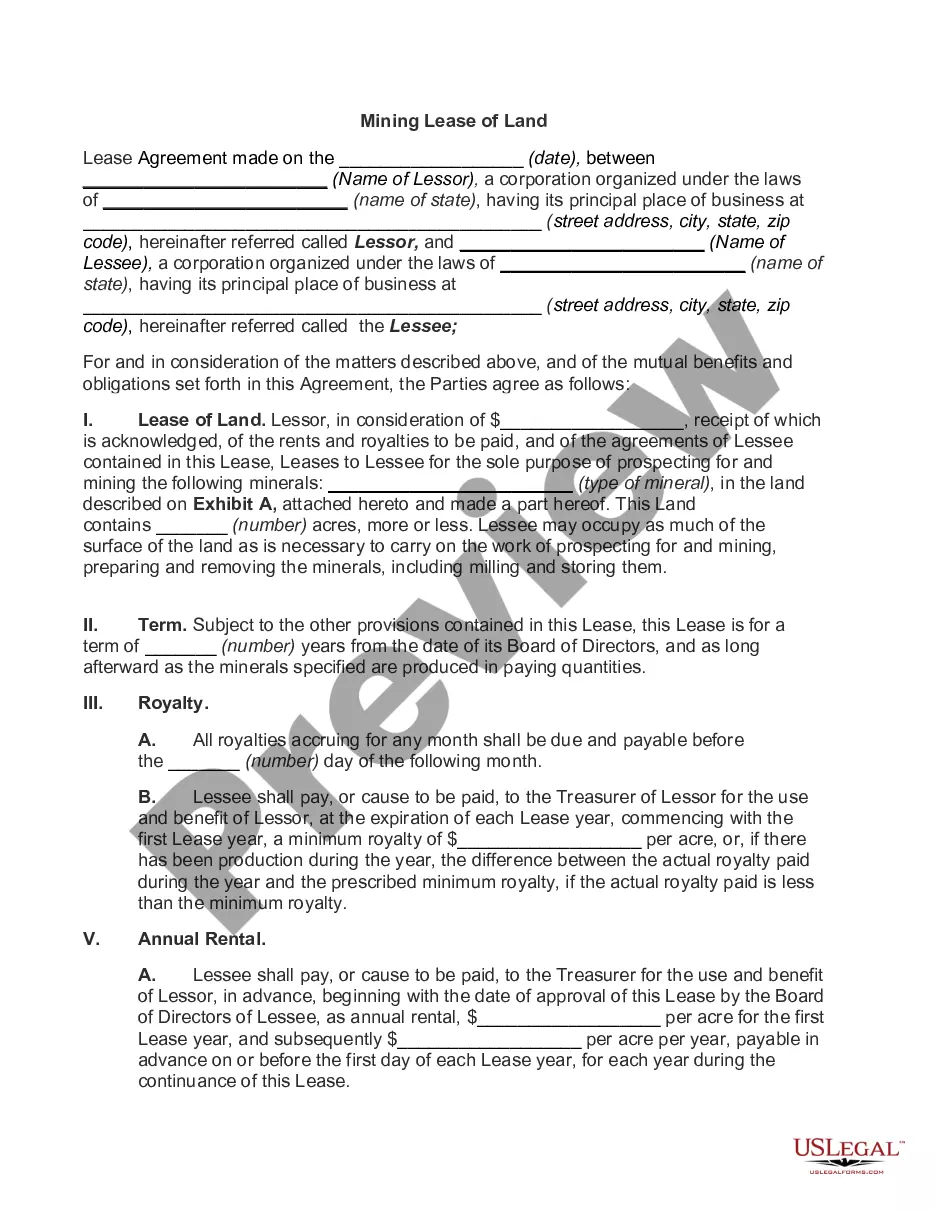
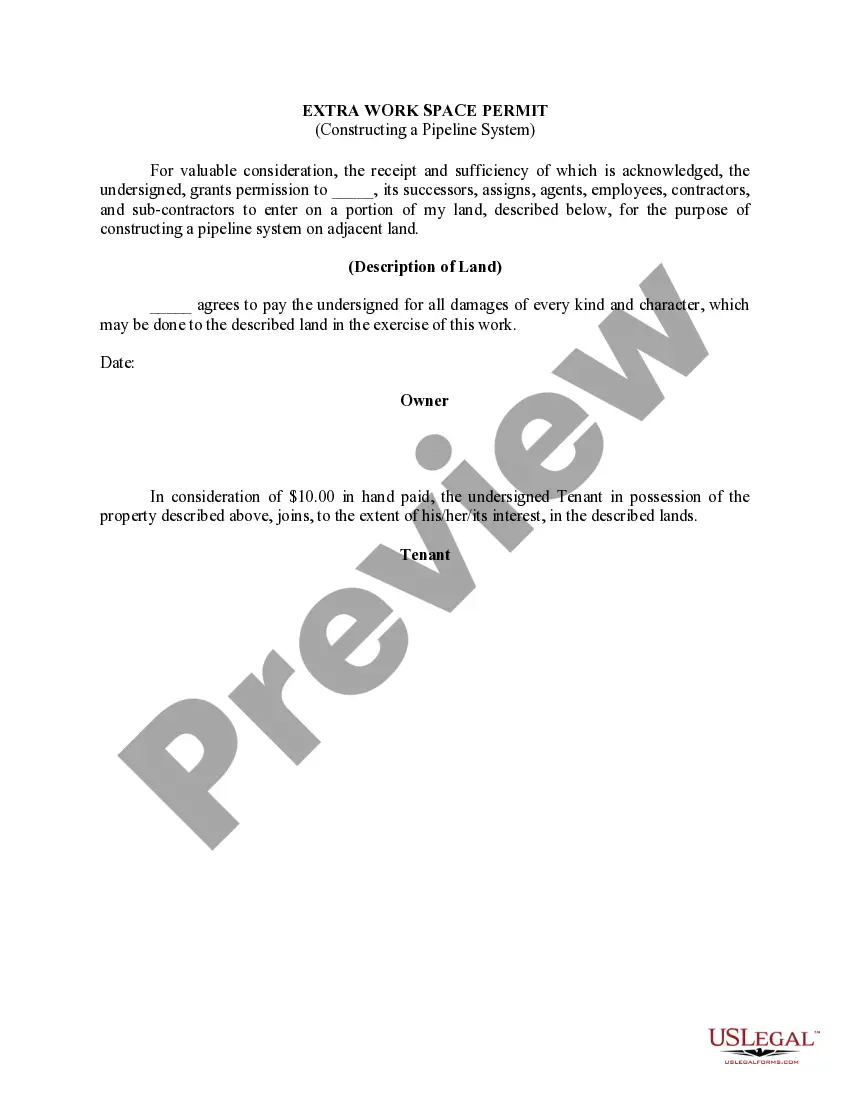
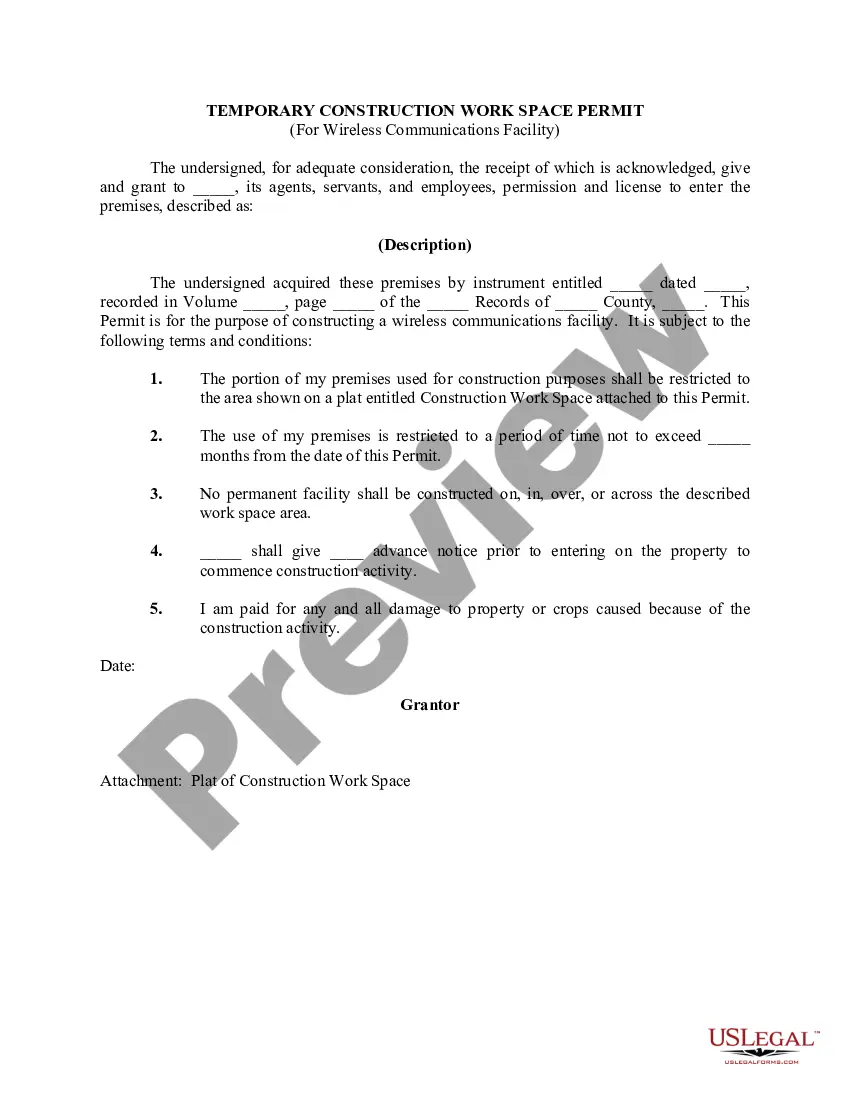
The Extra Work Space Permit is a legal document that grants permission to enter a portion of private land for the construction of a fiber optic communications system on adjacent property. This form differs from traditional land use agreements by specifically focusing on temporary access for fiber optic installation, ensuring both property rights and compensation for any damages incurred during the work.
Key components of this form
- Identification of the landowner and the party granted permission.
- Description of the specific land area for which access is permitted.
- Agreement on compensation for any damages to the land during construction.
- Signature lines for both the landowner and any tenants in possession.


Situations where this form applies
This form should be used when a telecommunications company or contractor needs temporary access to a property owner's land to install or upgrade a fiber optic system. It is important to have this permit in place to document the agreement and outline responsibilities, protecting both parties' interests during the work process.
Who needs this form
- Property owners granting access to third parties for fiber optic installation.
- Contractors or companies responsible for constructing fiber optic systems.
- Tenants who may need to consent to the use of the property for this purpose.
Completing this form step by step
- Identify the property owner and the contractor or company seeking access.
- Describe the portion of land that is being made available for the fiber optic work.
- Specify the compensation amount for any potential damages to the property.
- Enter the date of the agreement.
- Ensure both the owner and any tenants sign the form where indicated.
Notarization requirements for this form
This form does not typically require notarization to be legally valid. However, some jurisdictions or document types may still require it. US Legal Forms provides secure online notarization powered by Notarize, available 24/7 for added convenience.
Get your form ready online
Our built-in tools help you complete, sign, share, and store your documents in one place.
Make edits, fill in missing information, and update formatting in US Legal Forms—just like you would in MS Word.
Download a copy, print it, send it by email, or mail it via USPS—whatever works best for your next step.
Sign and collect signatures with our SignNow integration. Send to multiple recipients, set reminders, and more. Go Premium to unlock E-Sign.
If this form requires notarization, complete it online through a secure video call—no need to meet a notary in person or wait for an appointment.
We protect your documents and personal data by following strict security and privacy standards.

Make edits, fill in missing information, and update formatting in US Legal Forms—just like you would in MS Word.

Download a copy, print it, send it by email, or mail it via USPS—whatever works best for your next step.

Sign and collect signatures with our SignNow integration. Send to multiple recipients, set reminders, and more. Go Premium to unlock E-Sign.

If this form requires notarization, complete it online through a secure video call—no need to meet a notary in person or wait for an appointment.

We protect your documents and personal data by following strict security and privacy standards.
Avoid these common issues
- Failing to provide a clear description of the land area being accessed.
- Not specifying compensation terms, leading to disputes later.
- Omitting signatures from all required parties, such as tenants.
Advantages of online completion
- Convenient access to downloadable templates from any location.
- Editable fields allow for customization according to specific agreements.
- Reliability in ensuring that the legal language is accurate and vetted by licensed attorneys.
Looking for another form?






Form popularity
FAQ
The optical fibers are difficult to splice, and there are loss of the light in the fiber due to scattering. They have limited physical arc of cables. If you bend them too much, they will break. The optical fibers are more expensive to install, and they have to be installed by the specialists.
Fiber optic cables should be placed in their own dedicated ducts or trays. Do not mix copper cable and fiber cable in the same ducts or trays. After the fiber optic cable is installed into a duct or innerduct, end plugs should be installed to provide an effective water seal.
With well-designed pushable fiber and low friction microduct, you can usually push a fiber cable as far as 300 feet when there are five or less 90 degree angles in the run. The difference in bend radius of cables can be seen here.
Fiber Optic Cable Slack. A small amount of slack cable (20-30 feet) can be useful in the event that cable repair or relocation is needed.
Single-mode fibre can go as far as 40 km or more without hurting the signal, making it ideal for long-haul applications.
What is the minimum amount of slack that must be provided for splicing fiber-optic cable in underground installations? 15 meters on both the inbound and outbound span.
Corning Cable Systems recommends that fiber optic cable be buried a minimum depth/cover of 30 inches (77 cm).
This spread is modal dispersion, and it creates limits on data and distance. For OM3 multimode, 10 Gbs can be sent a maximum of about 300 meters or 1000 feet before the signal becomes indistinguishable. For OM3 multimode, 10 Gbs can be sent a maximum of about 300 m (1000 ft) before the signal becomes indistinguishable.
Fiber optic internet is delivered to your customers in two main ways: above ground on poles or underground through conduit. In some cases, a combination of the two methods must be used. Above ground service is the less expensive option of the two as usually the infrastructure is already in place.