Caption Provisions - Forms and Drafting
What is this form?
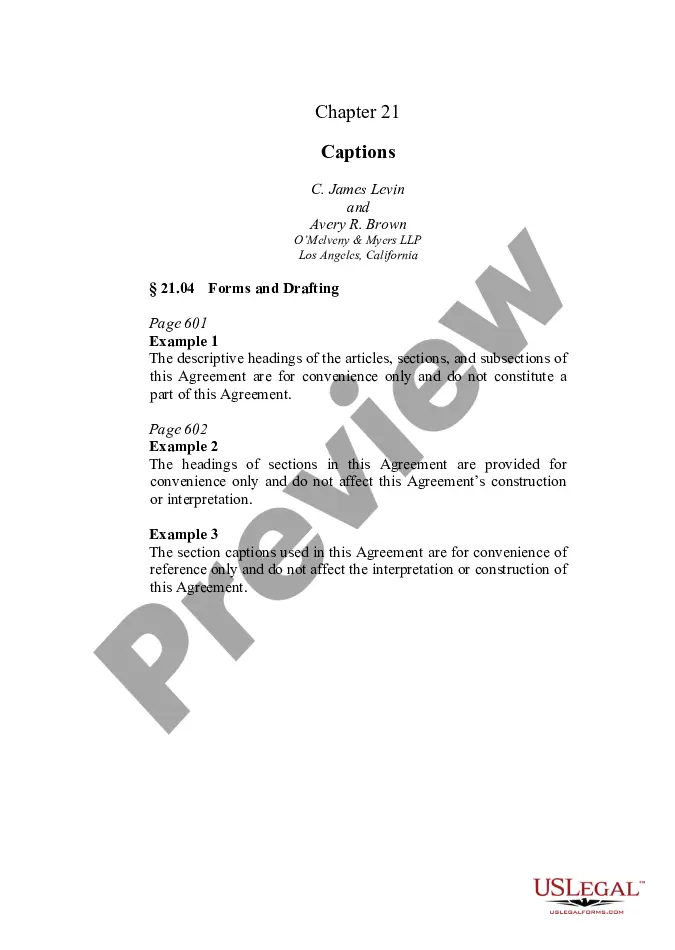
The Caption Provisions form provides essential clauses that clarify the role of captions in interpreting contract terms. This form is crucial for ensuring that the descriptive headings used in agreements are recognized as non-binding, serving merely for convenience. It differs from standard contract forms by specifically addressing how captions should not influence the construction or interpretation of the contract agreements, offering tailored language options to fit diverse legal scenarios.
Key components of this form
- Boilerplate contract clauses regarding captions
- Clarifications that captions do not affect contract interpretation
- Various language options for flexibility
When to use this document
This form is applicable when drafting or reviewing contracts that include captions or headings. If you want to ensure that these headings do not create unintended obligations or influence the interpretation of the contractâs terms, this form serves as a foundational tool. It is particularly useful in situations involving complex agreements where clarity is crucial to avoid disputes over how sections should be understood.
Who can use this document
- Legal professionals drafting contracts
- Business owners entering into contractual agreements
- Individuals needing clarification on the interpretation of contract headings
How to prepare this document
- Identify the relevant contract sections that will include captions.
- Choose the appropriate language option from the provided examples.
- Insert the chosen caption into the contract at the appropriate locations.
- Review the entire agreement to ensure no conflicting terms exist.
- Save and store the completed contract securely for future reference.
Notarization guidance
This form does not typically require notarization unless specified by local law. If you intend to enforce this contract in a particular jurisdiction, it is advisable to check local requirements regarding notarization.
Get your form ready online
Our built-in tools help you complete, sign, share, and store your documents in one place.
Make edits, fill in missing information, and update formatting in US Legal Forms—just like you would in MS Word.
Download a copy, print it, send it by email, or mail it via USPS—whatever works best for your next step.
Sign and collect signatures with our SignNow integration. Send to multiple recipients, set reminders, and more. Go Premium to unlock E-Sign.
If this form requires notarization, complete it online through a secure video call—no need to meet a notary in person or wait for an appointment.
We protect your documents and personal data by following strict security and privacy standards.

Make edits, fill in missing information, and update formatting in US Legal Forms—just like you would in MS Word.

Download a copy, print it, send it by email, or mail it via USPS—whatever works best for your next step.

Sign and collect signatures with our SignNow integration. Send to multiple recipients, set reminders, and more. Go Premium to unlock E-Sign.

If this form requires notarization, complete it online through a secure video call—no need to meet a notary in person or wait for an appointment.

We protect your documents and personal data by following strict security and privacy standards.
Common mistakes
- Using headings that imply legal obligations.
- Failing to clarify how captions impact contract interpretation.
- Ignoring specific state requirements related to contract language.
Why complete this form online
- Convenient access to customizable captions to fit various contracts.
- Easy download allows for instant usage without legal delays.
- Reliability as forms are drafted by licensed attorneys.
- Caption provisions help prevent misinterpretation of contract terms.
- They serve as a standard practice in contract drafting, enhancing enforceability.
- Understanding how captions function can protect parties in legal disputes regarding contract terms.
Main things to remember
- The Caption Provisions form clarifies the role of headings in legal documents.
- It provides multiple language options to suit various agreements.
- Utilizing this form can enhance clarity and reduce potential misinterpretation in contracts.
Looking for another form?



Form popularity
FAQ
Service and Filing. Title. Bottom Notation. Typed Names. Headings and Subheadings. Numbered Paper.
Four fundamental rules of pleading are; (1) Pleadings should state facts and not law; (2) The facts stated in pleadings should be material facts; (3) Pleadings should not state the evidence; and (4) The facts in pleadings should be stated in a concise form.
Comply With the Relevant Federal, State, and Local Rules. Research Before Writing. Allege Subject Matter Jurisdiction, Personal Jurisdiction, and Venue. Draft Concise and Plain Statement of the Facts. Draft Separate Counts for Each Legal Claim. Plead Facts With Particularity Where Necessary.
Write simply and carefully. Write purposefully. Do your research efficiently. Do not automatically rush to recreate the wheel. Do not be afraid to ask questions, both substantively and stylistically. Keep in mind the bigger picture and your role in the process. Masterful legislation requires teamwork.
Every pleading must have a caption with the court's name, the county, a title, a case number, and a Rule 7(a) designation. The caption of the complaint must name all the parties; the caption of other pleadings, after naming the first party on each side, may refer generally to other parties.
Life is the biggest party you'll ever be at. An apple a day will keep anyone away if you throw it hard enough. Give second chances but not for the same mistake. Never sacrifice three things: family, love, and or yourself. I'm an original and that's perfection in itself. You can't dull my sparkle 2728
A caption is text that appears below an image.A caption may be a few words or several sentences. Writing good captions takes effort; along with the lead and section headings, captions are the most commonly read words in an article, so they should be succinct and informative.
What Is a Good Caption for a Picture? Choose a Photo Caption That Fits the Platform. Use a Conversational Tone and Present Tense. Decide on the Purpose of Your Caption. Know Who Your Audience Is. Identify the Main People in Your Photo. Use a Quote or Lyrics Wisely. Add Value with Your Photo Caption.
Be a nice person. I'm a rock star! I'm a friendly human. Let life surprise you. I'm shining like the stars. My smile shimmers like the sun. We all shine on. Never dull your shimmer for somebody else.