Firm Billing Policies
What this document covers
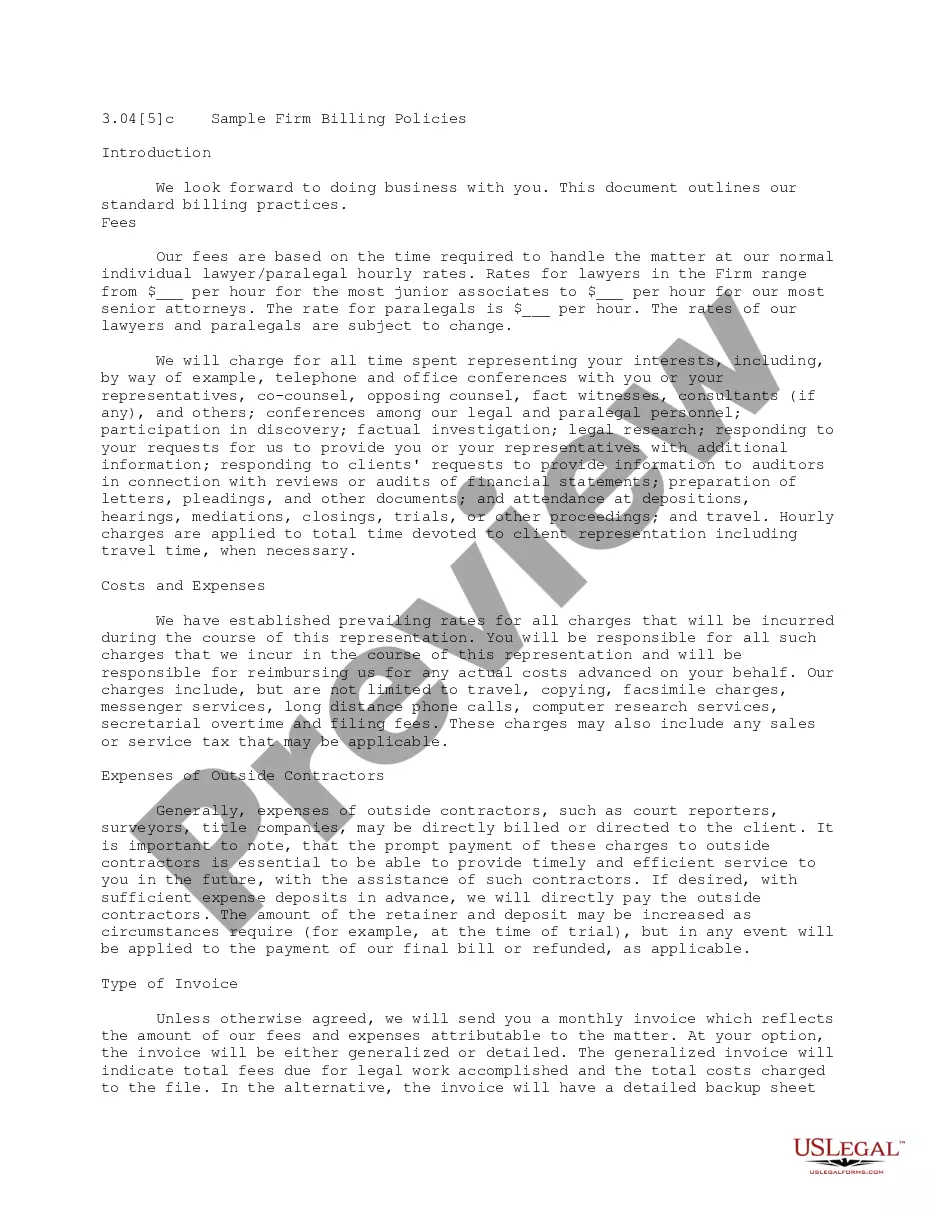
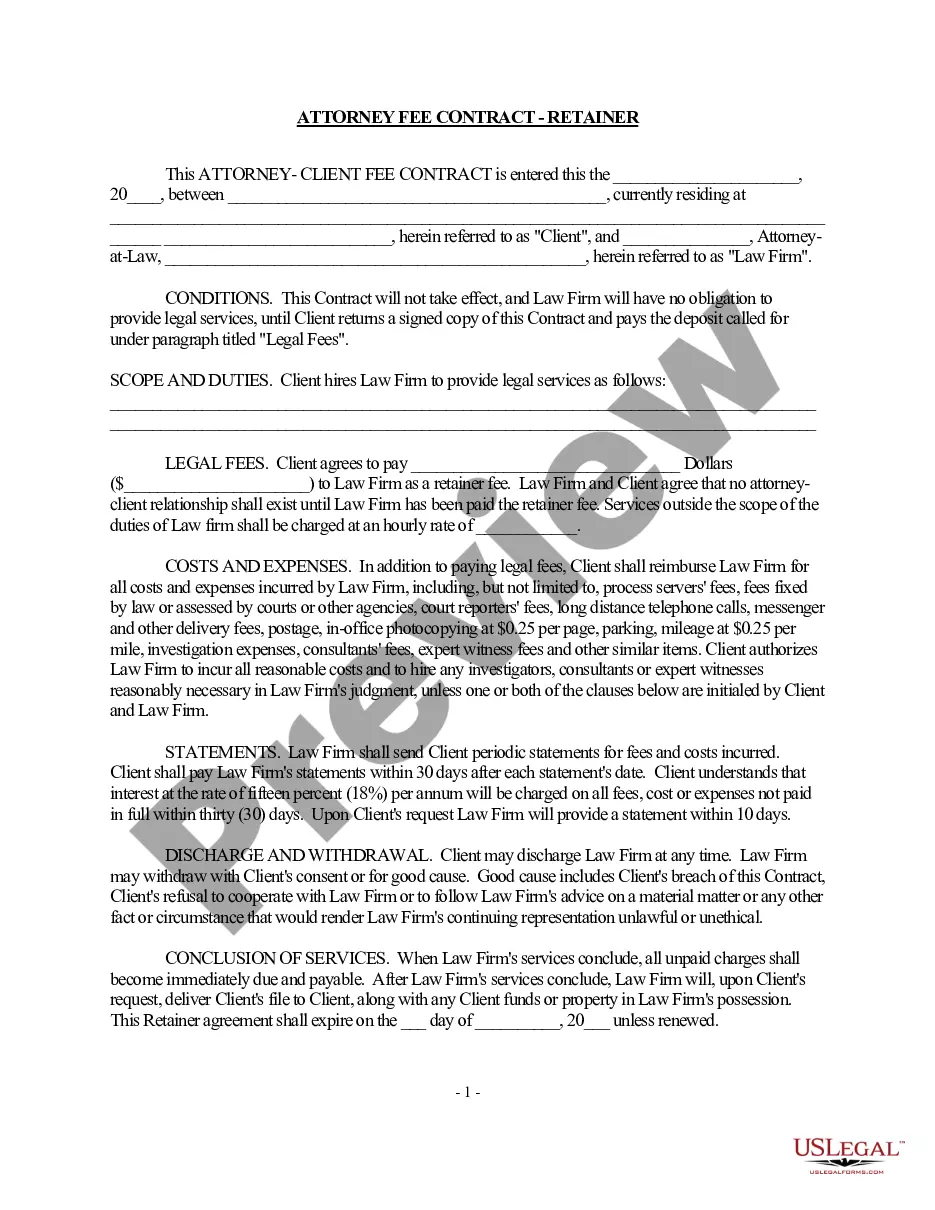
The Firm Billing Policies form is a comprehensive document that outlines a law firm's billing practices. It details the hourly rates of attorneys and paralegals, the services for which clients will be charged, and information about outside contractor expenses. This form is essential for clients to understand the financial aspects of legal representation, helping avoid misunderstandings regarding billing practices in contrast to general legal service agreements.
Key parts of this document
- Introduction to standard billing practices and expectations from clients.
- Detailed information on hourly rates for different legal professionals.
- Clarification of costs and expenses related to legal representation.
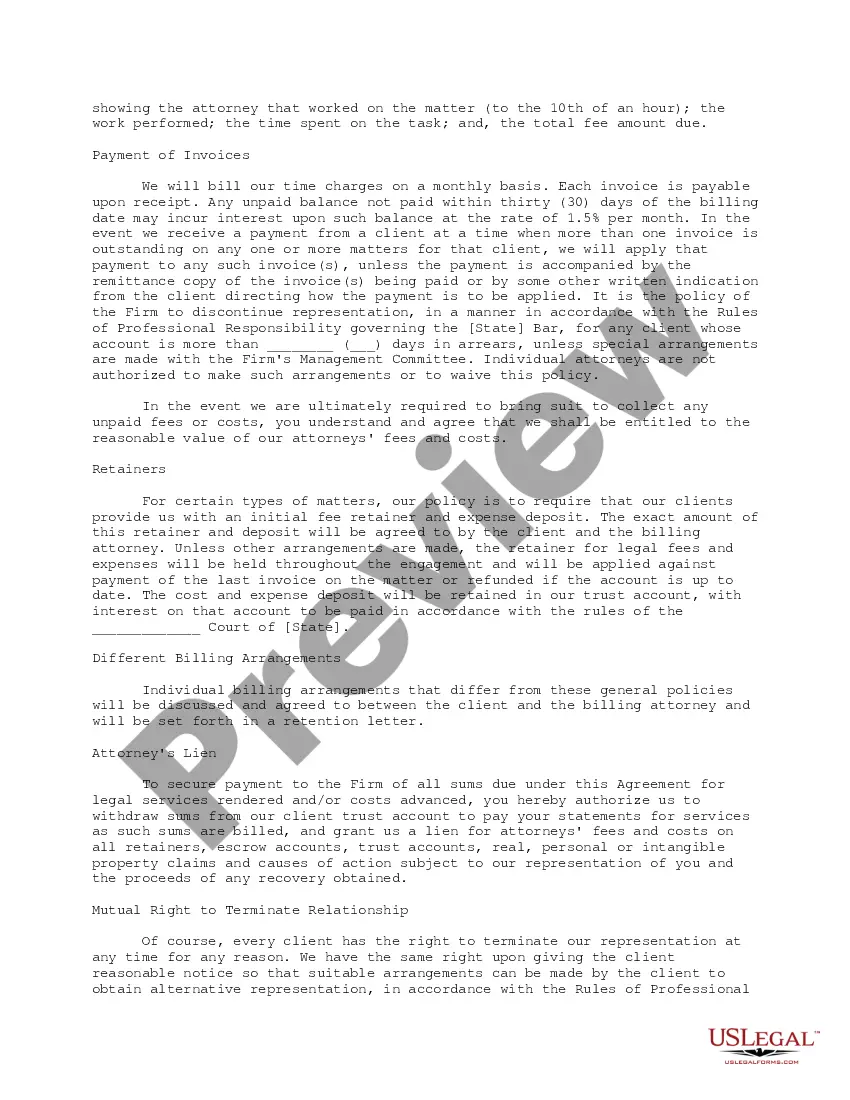
- Instructions regarding payment of invoices and potential late fees.
- Information on retainers and billing arrangements specific to the clientâs needs.
- Termination rights for both the client and the firm, ensuring clarity in the client-attorney relationship.



When to use this form
This form should be used whenever a law firm seeks to establish clear billing practices with its clients. It is particularly important during the initial stages of representation when discussing fees and expenses. Both new and existing clients will benefit from clarity on billing procedures to avoid any confusion while legal services are provided.
Who can use this document
This form is intended for:
- Law firms looking to formalize their billing policies.
- Clients entering into a legal agreement with a firm who want to understand billing practices.
- Legal professionals aiming to ensure transparency in financial matters pertaining to services rendered.
How to prepare this document
- Identify the firmâs title and standard billing practices clearly.
- Specify hourly rates for senior attorneys, associates, and paralegals.
- Detail the types of services that will incur charges and outline additional costs expected.
- Include the payment terms and conditions related to billing frequencies and late fees.
- Provide a section for client acknowledgment and signatures.
Is notarization required?
This form usually doesn’t need to be notarized. However, local laws or specific transactions may require it. Our online notarization service, powered by Notarize, lets you complete it remotely through a secure video session, available 24/7.
Get your form ready online
Our built-in tools help you complete, sign, share, and store your documents in one place.
Make edits, fill in missing information, and update formatting in US Legal Forms—just like you would in MS Word.
Download a copy, print it, send it by email, or mail it via USPS—whatever works best for your next step.
Sign and collect signatures with our SignNow integration. Send to multiple recipients, set reminders, and more. Go Premium to unlock E-Sign.
If this form requires notarization, complete it online through a secure video call—no need to meet a notary in person or wait for an appointment.
We protect your documents and personal data by following strict security and privacy standards.

Make edits, fill in missing information, and update formatting in US Legal Forms—just like you would in MS Word.

Download a copy, print it, send it by email, or mail it via USPS—whatever works best for your next step.

Sign and collect signatures with our SignNow integration. Send to multiple recipients, set reminders, and more. Go Premium to unlock E-Sign.

If this form requires notarization, complete it online through a secure video call—no need to meet a notary in person or wait for an appointment.

We protect your documents and personal data by following strict security and privacy standards.
Typical mistakes to avoid
- Failing to update hourly rates as they change over time.
- Not specifying all potential expenses, including travel and outside contractor fees.
- Omitting details about payment terms which can lead to confusion later on.
- Neglecting to include a clear termination policy within the billing practices.
Benefits of completing this form online
- Convenience of easily editable templates to tailor specific billing needs.
- Accessibility across devices, allowing prompt updates to billing practices.
- Reliable format and content drafted by licensed attorneys ensuring legal compliance.
- Easy sharing capabilities to keep clients informed about billing policies.
Legal use & context
- This form serves as a foundational guideline for billing in legal contexts, ensuring both parties understand their financial obligations.
- Clear documentation can help in potential disputes over fees, offering a reference for both the firm and the client.
- Utilizing this form can enhance the professional relationship by promoting transparency and trust regarding financial matters.
Quick recap
- The Firm Billing Policies form is essential for clear financial communication between a law firm and its clients.
- It details billing rates, chargeable services, and payment terms to avoid misunderstandings.
- Using this form helps in maintaining professionalism and transparency in the billing process.
Looking for another form?


Form popularity
FAQ
Time tracking apps are fast becoming the preferred choice for increasing productivity and tracking billable hours for law firms. Hubstaff's time tracking can help easily keep track of an individual's hours and billables as well as the projected budget of a large-scale project.
Create a (Verbal or Paper) Contract. Before you even begin working with a client, it's important to have a mutual agreement in place. Use a Template for Your Invoices. Simplify the Payment Process. Don't Hesitate to Send Out Invoices. Don't Be Too Shy to Follow Up. Being a Professional in Billing Clients.
The law firm billing process Billable time and disbursement fees/expenses are logged throughout the case. At the end of each month (or at the end of the case, if it's a shorter case), bills and expenses for each client and case are put into a draft bill. Attorneys add notes and adjust costs as needed and approve the
The stopwatch is a tried and true means to track time. Most modern legal software systems provide this time-tracking feature. For example, if a lawyer opens a case file, there's usually a digital stopwatch they can click to begin tracking the time spent on a task.
The Billable Hour Demon Therefore, often the substance of our work is minimized to billable hour maximization.This is because most law firms require their attorneys to bill their clients in six-minute (1/10 of an hour) standard billing increments.
Studies show that, on average, lawyers actually work three hours for every two billed. Therefore, to bill 2,200 hours per year, or 40 hours per week, a lawyer needs to work 12 hours a day, five days a week.
The law firm billing process Billable time and disbursement fees/expenses are logged throughout the case. At the end of each month (or at the end of the case, if it's a shorter case), bills and expenses for each client and case are put into a draft bill. Attorneys add notes and adjust costs as needed and approve the