Complaint regarding Veterinarian Malpractice for Surgical Procedure
What is this form?
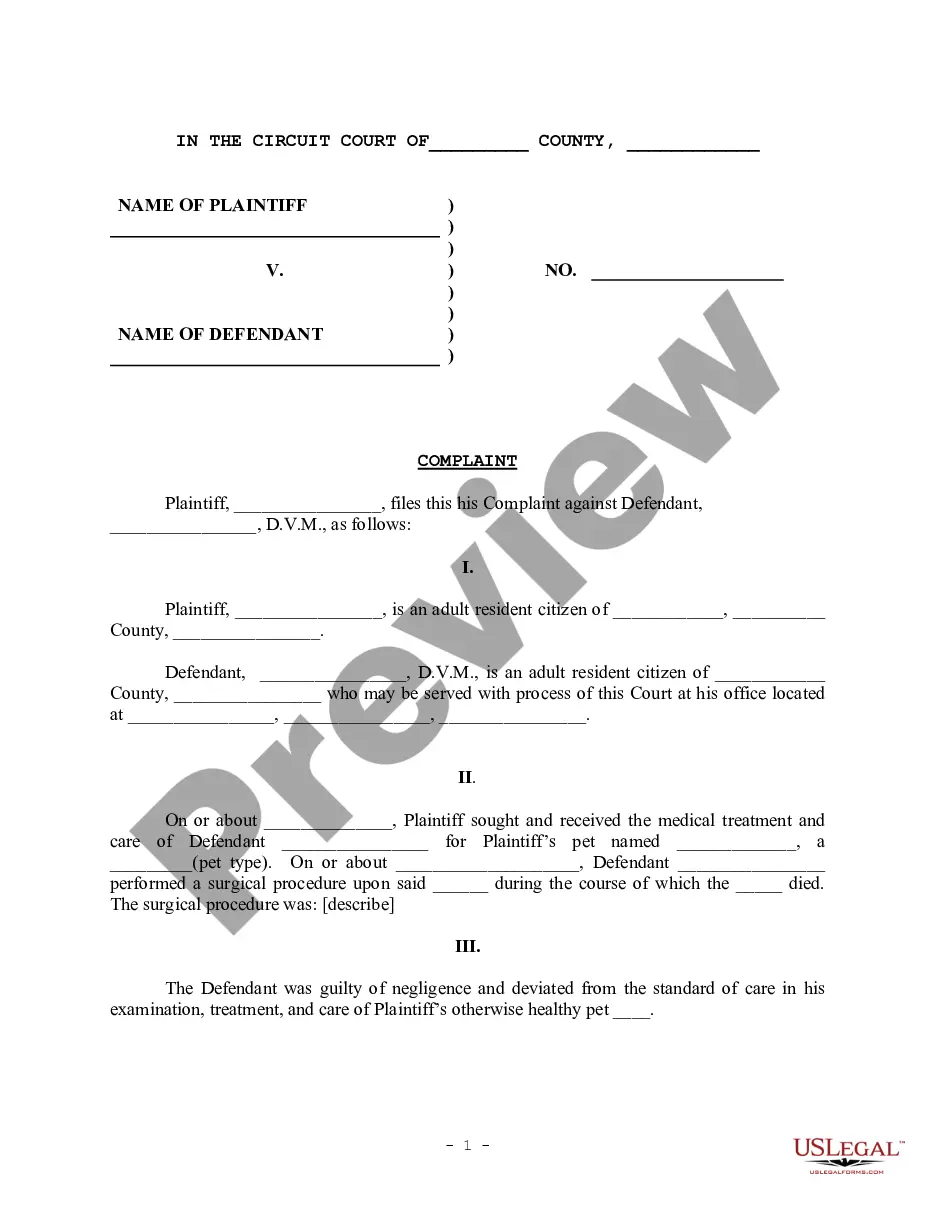
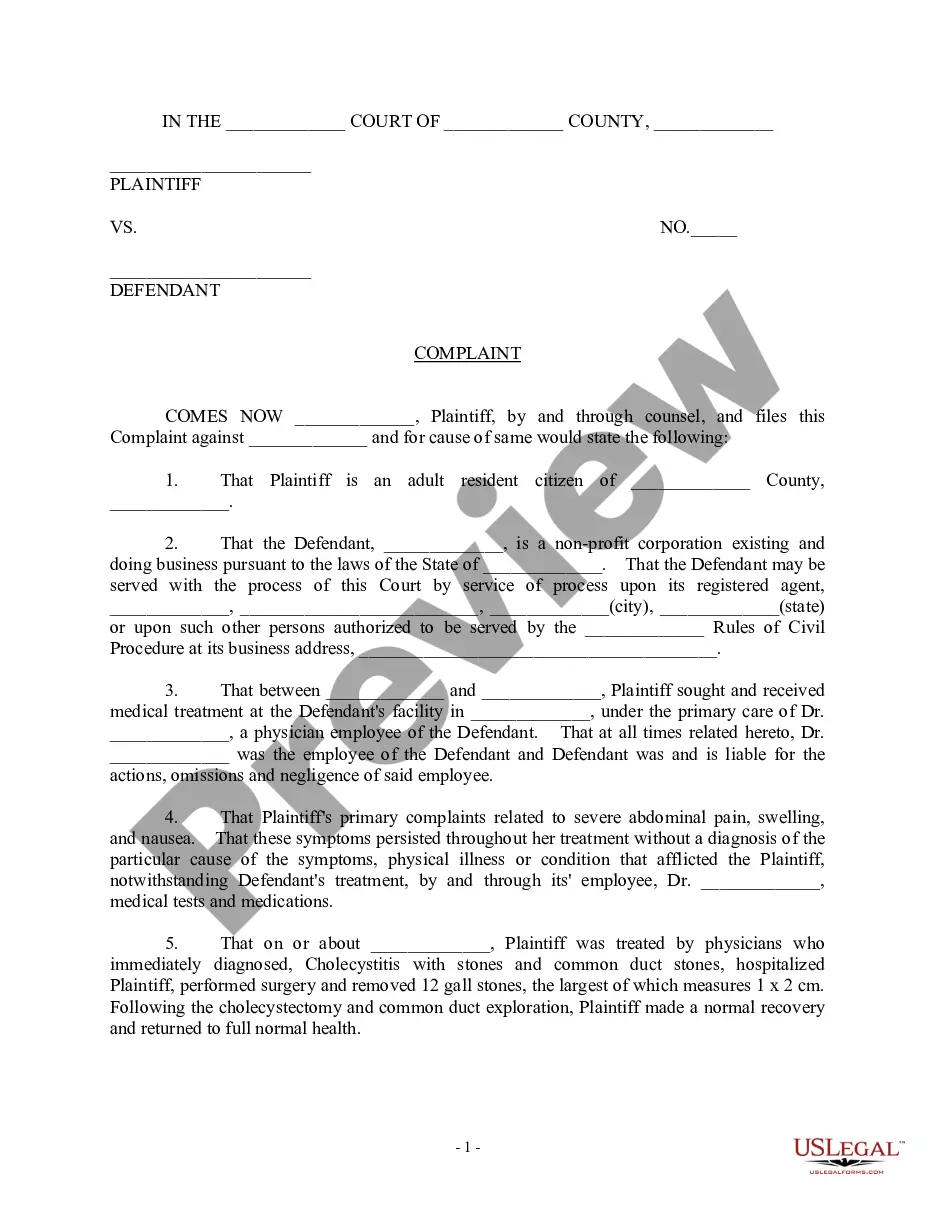
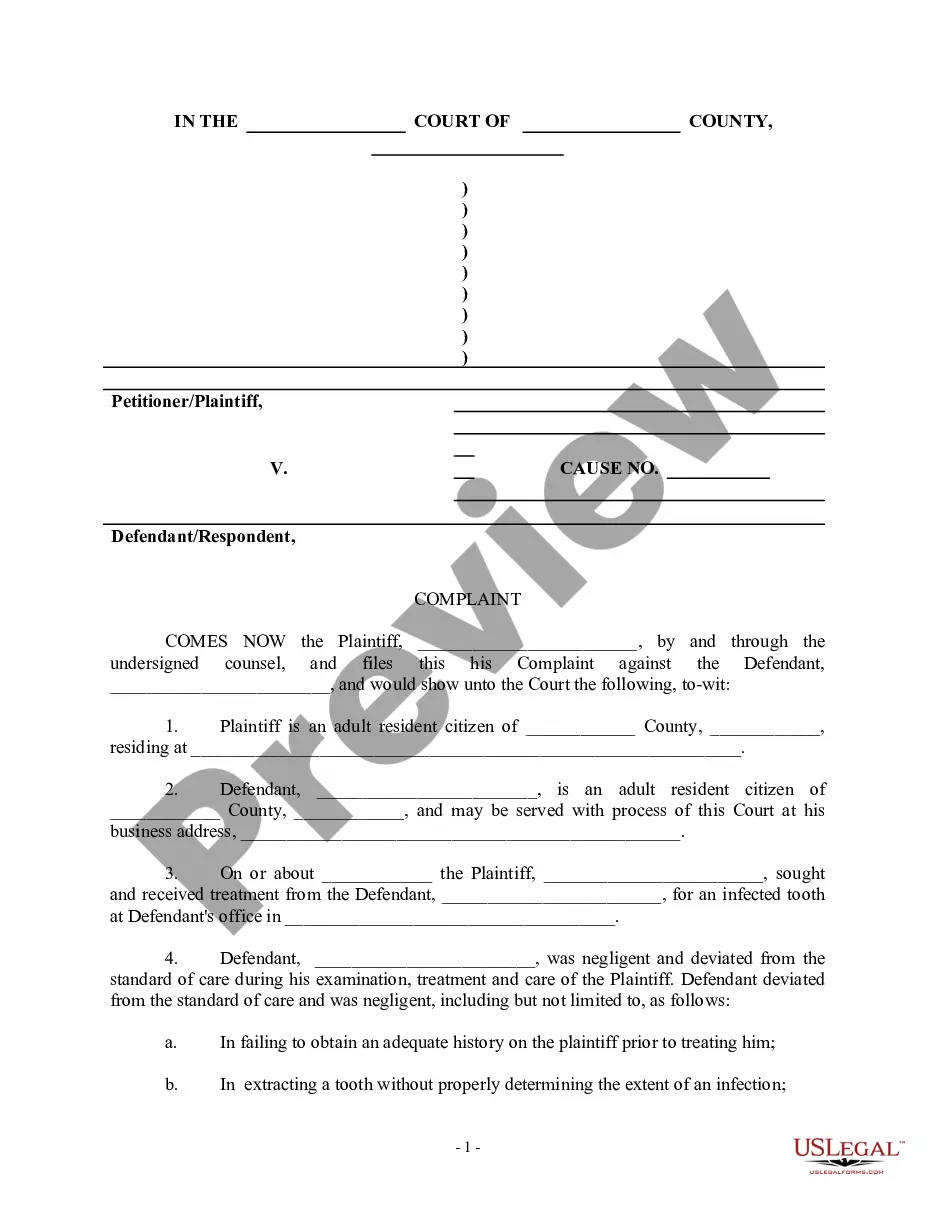
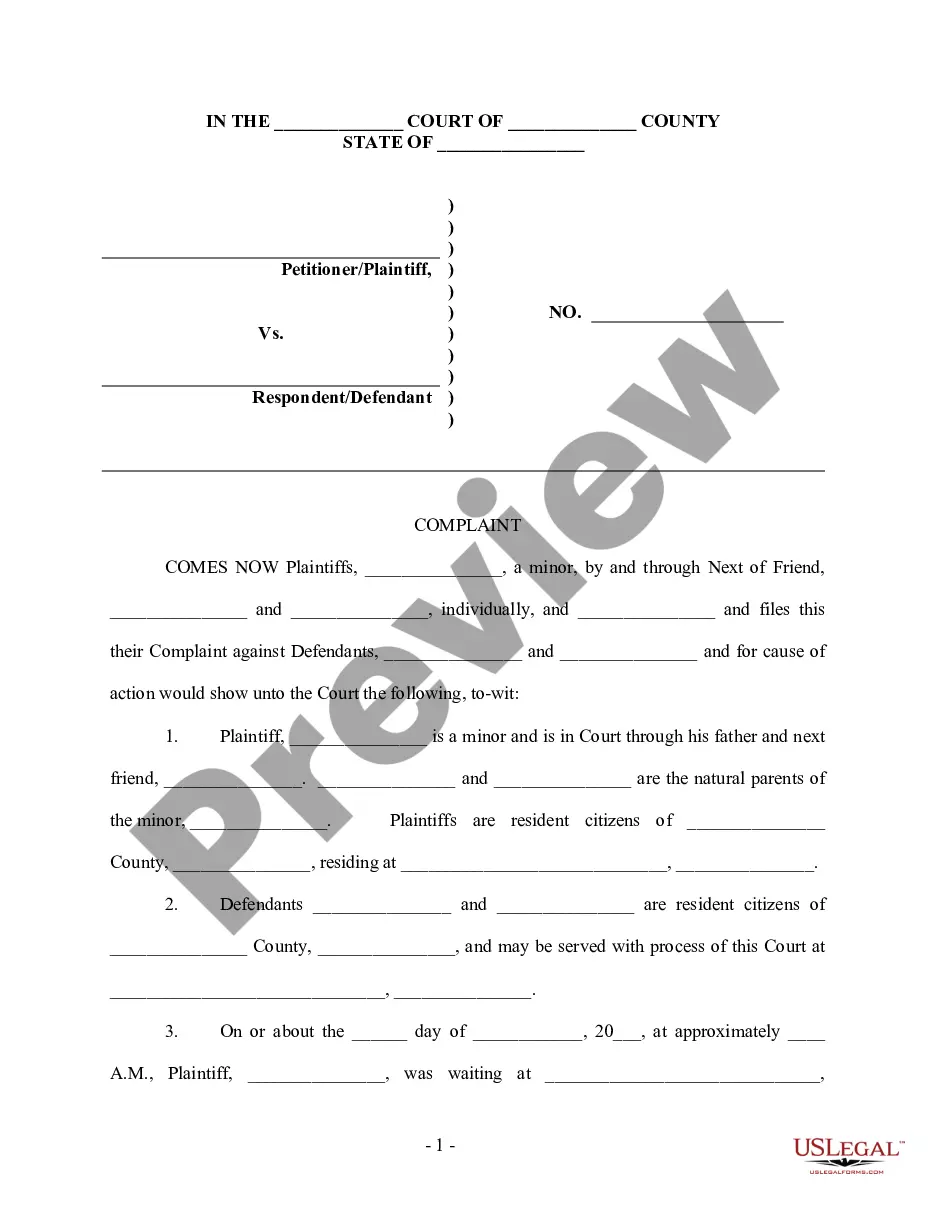
This Complaint Regarding Veterinarian Malpractice for Surgical Procedure is a legal document used to initiate a lawsuit against a veterinarian for alleged negligence during a surgical procedure on a pet. This form outlines the plaintiff's claims, which may include failure to follow the standard of care, lack of informed consent, and resulting damages. It serves as an essential tool for pet owners seeking compensation for the loss or injury of their pets due to veterinary malpractice.
Form components explained
- Identification of the plaintiff and defendant, including their names and addresses.
- Details of the medical treatment sought, including the date and type of surgical procedure performed.
- Allegations of negligence, specifying how the veterinarian deviated from standard care.
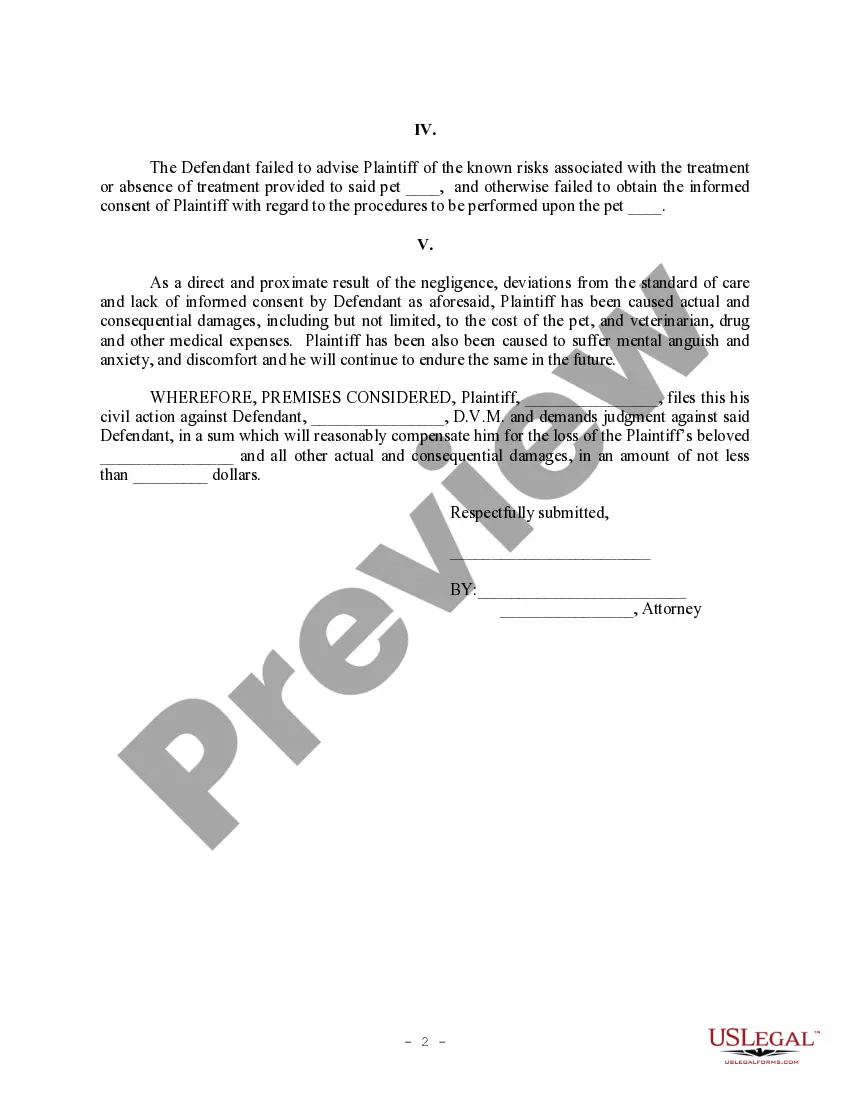
- Description of failure to obtain informed consent regarding risks associated with the procedure.
- Statement of damages suffered by the plaintiff, including financial losses and emotional distress.
- A request for judgment and compensation amount due to the malpractice.
When this form is needed
This form should be used when a pet owner believes that a veterinarian's negligence during a surgical procedure has resulted in harm or death to their pet. It is applicable in cases where the veterinarian did not meet the expected standard of care, failed to disclose risks, or caused emotional and financial damages to the pet owner. Common scenarios include complications post-surgery, lack of communication about treatment options, or inadequate care during the procedure.
Who can use this document
- Pet owners who suspect veterinarian malpractice related to surgical procedures.
- Individuals seeking to hold a veterinarian accountable for negligence.
- Owners of pets that have suffered serious injury or death as a result of veterinary treatment.
- Individuals looking to file a civil suit for damages incurred as a result of veterinary negligence.
How to prepare this document
- Enter the names and addresses of both the plaintiff and the defendant.
- Provide details of the veterinary surgery performed, including the date and the name of the pet.
- Clearly state the allegations of negligence and deviations from standard care.
- Document any lack of informed consent regarding the procedure and its risks.
- Specify the damages suffered, including emotional distress and any financial losses incurred.
- Sign and date the complaint, and ensure it is filed correctly with the appropriate court.
Does this form need to be notarized?
In most cases, this form does not require notarization. However, some jurisdictions or signing circumstances might. US Legal Forms offers online notarization powered by Notarize, accessible 24/7 for a quick, remote process.
Get your form ready online
Our built-in tools help you complete, sign, share, and store your documents in one place.
Make edits, fill in missing information, and update formatting in US Legal Forms—just like you would in MS Word.
Download a copy, print it, send it by email, or mail it via USPS—whatever works best for your next step.
Sign and collect signatures with our SignNow integration. Send to multiple recipients, set reminders, and more. Go Premium to unlock E-Sign.
If this form requires notarization, complete it online through a secure video call—no need to meet a notary in person or wait for an appointment.
We protect your documents and personal data by following strict security and privacy standards.

Make edits, fill in missing information, and update formatting in US Legal Forms—just like you would in MS Word.

Download a copy, print it, send it by email, or mail it via USPS—whatever works best for your next step.

Sign and collect signatures with our SignNow integration. Send to multiple recipients, set reminders, and more. Go Premium to unlock E-Sign.

If this form requires notarization, complete it online through a secure video call—no need to meet a notary in person or wait for an appointment.

We protect your documents and personal data by following strict security and privacy standards.
Mistakes to watch out for
- Failing to provide sufficient details about the surgery or treatment in question.
- Neglecting to clearly state the specific ways in which the defendant was negligent.
- Not keeping a copy of the submitted form for personal records.
- Missing the filing deadline for the complaint in court.
- Omitting required signatures or necessary documentation.
Advantages of online completion
- Convenience of accessing the form from anywhere at any time.
- Editable fields to ensure all required information is accurately captured.
- Instant availability for download and printing once completed.
- Access to templates drafted by licensed attorneys, ensuring legal compliance.
- Guidance throughout the completion process to avoid common errors.
Looking for another form?

Form popularity
FAQ
A doctor-patient relationship existed. The doctor was negligent. The doctor's negligence caused the injury. The injury led to specific damages. Failure to diagnose. Improper treatment. Failure to warn a patient of known risks.
A doctor-patient relationship existed. The doctor was negligent. The doctor's negligence caused the injury. The injury led to specific damages. Failure to diagnose. Improper treatment. Failure to warn a patient of known risks.
The injured patient must show that the physician acted negligently in rendering care, and that such negligence resulted in injury. To do so, four legal elements must be proven: (1) a professional duty owed to the patient; (2) breach of such duty; (3) injury caused by the breach; and (4) resulting damages.
Medical malpractice occurs when a hospital, doctor or other health care professional, through a negligent act or omission, causes an injury to a patient. The negligence might be the result of errors in diagnosis, treatment, aftercare or health management.The patient must prove that the negligence caused the injury.
To pursue a medical malpractice claim, the patient must show that the injury resulted in disability, loss of income, unusual pain, suffering and hardship, or significant past and future medical bills.
1) Duty: The first element requires that the practitioner owed a professional duty of care to the patient. This is assumed in any doctor-patient, or health care practitioner-patient relationship. 2) Breach: The second required element for a medical malpractice case is a breach of the duty owed to the patient.
The Key Difference Between Malpractice and Negligence In simple terms, medical negligence is a mistake that resulted in causing a patient unintended harm. Medical malpractice, on the other hand, is when a medical professional knowingly didn't follow through with the proper standard of care.
Existence of a legal duty. Breach of that duty. Causal connection between the breach and injury. Measurable harm from the injury.